By Amar Prakash Singh
Twenty five years ago, I asked a 3HO Sikh, why she never went to the Indian Gurdwara in town. I believed that one should never miss the opportunity to go to Gurdwara. Her reply was: 'When I go to that Gurdwara, I feel as if I am having 1,000 hair cuts.' Over the years I have come to understand what she was feeling and pretty much experience this feeling every time I go to Gurdwara. Maybe that's the reason that I don't have much of my hair left.
I remember one time when I must have lost quite a few hairs. There was a lady, a non-Sikh, who had come to visit Gurdwara. After Gurdwara, I was talking with her, trying to answer some of her questions. Evidently she had commited the horrendous sin of accepting prashad with only one hand. That's when this rude man, the kind that they make "Sardar jokes" about, approached us and proceeded in admonishing her for her transgretion. When he was through and had walked away, he decided that he had more to say and returned. I'm sure that in his arrogant ignorance, he felt that he was giving her good advice but was in fact was making sure that she would never come back. When he finally left with complete confidence that he done the right thing, she turned to me with a questioning look and I shrugged my shoulders and told her that 'his beard was just tied too tight and not to pay him any mind.'
I feel that I am getting 1,000 haircuts:
When I see Sikhs paying obsience to shastars. This can be seen in any Gurdwara where shastars are displayed. I find it odd that the word Sword appears in Guru Granth 37 times, all mentions being metiphorical, and appears 592 times in Dasam Granth, most being spoken in reverencial terms for swords in the literal sense. One thing that I find ironic here is that in Islam, believed by many as one of the most violent religions, the word sword appears only once.
When I see Sikhs paying obsience to golden domes and marble. I wrote about this before in Devolution.
"Over the years, Sikhs continued adding bricks of misunderstanding until the Gateway was closed. Then they stood before the non-existent Gateway and proclaimed what a great wall and religion had been built. As they stood there admiring their work, they decided to add golden domes and beautiful marble to the wall and they declared that God must really love them for allowing such a beautiful wall to be built.
When some pointed out that the Gateway had been bricked shut, they were told not to 'fiddle with Sikh traditions' and swords were unsheathed, excommunications were delivered, and those who insulted "Sikh religious sympathies" were jailed.
The status quo had been maintained because after all, that is what was important. But the Sikhs were still standing on the outside maybe never to walk through the Guru's Gate and a tear may have fallen from Guru Nanak's eye as he realized that everything had been for naught."
When I see Sikhs casting aspersions on those who disaree with them; accusing them of being part of a vast conspirosy (missionaries or even worse, intellectuals) to destroy Sikhi.
When I see Sikhs assaulting or even killing other Sikhs just because their "religious sensibilities" have been hurt.
When I see Sikhs wearing Chand Toras (a symbol of Shiva) on their turbans.
When I see Sikhs reading 20 simultanious Akhand Paats when there is no one listening. This is just one of many meaningless rituals that Sikhs engage in, from taking dips (thinking they are doing Ishnaan) to the highly structured rituals of Gurdwara.
Unobstructed is the path of one who believes in the Name (Sat)
He departs this earth with honor and renown.
He never walks in the wordily ways
Nor does he travel by ritualistic religious roads.
The believer in God's Name is sincere to his dharma.
Of such Greatness is the Naam (Sat;) only if one were to believe with all one's and soul, one would realize it. (14)
Guru Nanak page 3
It's odd that we read this every day and yet a "ritualistic religious road" is a very good three word definition of Sikhism.
"Imagine ... No religion too, Imagine all the people living life in peace..." John Lennon wrote these words and concluded with: "You may say I'm a dreamer,..." Well, I don't have to imagine or be a dreamer to realize this because Guru Nanak gave us "no religion."
"It'll be just like starting over,..."
About Gurmat Prakash
- Gurmat Prakash Publications
- has been publishing Sikh related media since 1994. "Transition into Infinity" is a continuation of the work that the "Journal of Contemporary Sikh Thought" began. This is not a true Blog but a magaZine. Guru Hargobind said that anyone who did Ishnaan at Gurdwara Babeksar, would receive the benefits of rational thinking(Babek).It is ironic, that in todays times there are continuing attacks on rational thought. It is important for there to be a place where Sikhs can freely express their views. If you have an article that you would like to see published here, please e-mail it to amarprakashs@yahoo.com for consideration. Editor Amar Prakash Singh
Tuesday, October 21, 2008
Friday, October 17, 2008
Serenity / ਉਜਲਤਾ
By Virinder Singh
Calmness of mind is one of the beautiful jewels of wisdom. It is the result of long and patient effort in mind-control gained through Akal Purkh’s Grace. Its presence is an indication of ripened experience, and of more than ordinary knowledge of the laws and operations of thought that are conducive to spiritual progress by discerning intellect (ਬਿਬੇਕ ਬੁੱਧੀ.) It progresses by following the teachings incorporated in Sabd Guru.
ਭਗਵੈ ਵੇਸਿ ਭ੍ਰਮਿ ਮੁਕਤਿ ਨ ਹੋਇ ॥ਬਹੁ ਸੰਜਮਿ ਸਾਂਤਿ ਨ ਪਾਵੈ ਕੋਇ ॥ਗੁਰਮਤਿ ਨਾਮੁ ਪਰਾਪਤਿ ਹੋਇ ॥
No one is liberated by wandering around in saffron-colored robes. Tranquility is not found by strict self-discipline, but by following the Guru's Teachings; one is blessed to receive, the Name of the Akal Purkh.
Guru Amardas, p. 1175
An individual becomes calm to the degree that he or she understands himself or herself as a thought evolved being. Such knowledge requires the understanding of the others. With this knowledge one sees more and more clearly the internal relations of things through the operation of cause and effect. One ceases to fuss and fume; worry and grieve and remains poised, steadfast, and serene. A serene individual is one who has learned how to govern him or herself, and knows how to adapt to others. They, in turn, revere his or her spiritual strength, and feel that they can learn from him or her and rely upon him or her. The more tranquil an individual becomes, the greater is his success, influence, and his power for good.
Such an individual will prosper along with his self-control and equanimity. People prefer to deal with an individual whose demeanor is consistently even. One who considers every one equal is religious. The latter is the original vision of Guru Nanak as expressed in Raag Sorath and in Raag Asa:
ਜੋ ਅੰਤਰਿ ਸੋ ਬਾਹਰਿ ਦੇਖਹੁ ਅਵਰੁ ਨ ਦੂਜਾ ਕੋਈ ਜੀਉ ॥ ਗੁਰਮੁਖਿ ਏਕ ਦ੍ਰਿਸਟਿ ਕਰਿ ਦੇਖਹੁ ਘਟਿ ਘਟਿ ਜੋਤਿ ਸਮੋਈ ਜੀਉ ॥
Akal Purkh is within -- see It outside as well; there is no one, other than It. As Gurmukh, look upon all with the single eye of equality; in each and every heart, the Divine Light is contained.
Guru Nanak,p. 599
ਸਭ ਏਕ ਦ੍ਰਿਸਟਿ ਸਮਤੁ ਕਰਿ ਦੇਖੈ ਸਭੁ ਆਤਮ ਰਾਮੁ ਪਛਾਨ ਜੀਉ ॥ ਹਰਿ ਹਰਿ ਜਸੁ ਗਾਇਆ ਪਰਮ ਪਦੁ ਪਾਇਆ ਤੇ ਊਤਮ ਜਨ ਪਰਧਾਨ ਜੀਉ ॥
They look upon all as equals, and recognize the Supreme Conscience, the Akal Purkh, pervading among all. Those who sing the Praises of the Akal Purkh, obtain the supreme status; they are the most exalted and acclaimed people.
Guru Ramdas, p. 446
The strong, calm individual is always loved and revered. He or she is like a shade-giving tree in a thirsty land, or a sheltering rock in a storm. "Who does not love a tranquil heart, a sweet-tempered, balanced life? It does not matter whether it rains or shines, or what changes come to those possessing these blessings, for they are always sweet, serene, and calm. That exquisite poise of character, which we call serenity, is the calm individual, having learned how.
The finishing lesson of a culture brings about the flowering of life and the fruition of spiritual knowledge. Wisdom thus acquired is more precious than gold. Mere money pales in comparison to a serene life -- a life that is dwelt in the ocean of Truth, beneath the waves, beyond the reach of tempests, in the Eternal Calm!
ਕੇਤੇ ਬੰਧਨ ਜੀਅ ਕੇ ਗੁਰਮੁਖਿ ਮੋਖ ਦੁਆਰ ॥ ਸਚਹੁ ਓਰੈ ਸਭੁ ਕੋ ਉਪਰਿ ਸਚੁ ਆਚਾਰੁ ॥
There are so many worldly entanglements for the mortal. Only as Gurmukh do we find the Gate of Liberation. Truth is above all and above Truth is Truthful conduct.
Guru Nanak, p. 62
ਸਚਾ ਤੀਰਥੁ ਜਿਤੁ ਸਤ ਸਰਿ ਨਾਵਣੁ ਗੁਰਮੁਖਿ ਆਪਿ ਬੁਝਾਏ ॥ ਅਠਸਠਿ ਤੀਰਥ ਗੁਰ ਸਬਦਿ ਦਿਖਾਏ ਤਿਤੁ ਨਾਤੈ ਮਲੁ ਜਾਏ ॥
True is that place of pilgrimage, where one bathes in the pool of Truth, and achieves self-realization as Gurmukh. The Gurmukh understands his own self. The Akal Purkh has shown that the Word of the Guru's Sabd is beyond the sixty-eight sacred shrines of pilgrimage; bathing in it, filth is washed away.
Guru Amar Das, p. 753
Too many people have soured their lives, and ruined all that is sweet and beautiful by their explosive tempers. They destroy their poise of character, lose self-control, mar their happiness and make bad blood! Very few people seem to be well balanced. Very few have that exquisite poise which is characteristic of the finished character! A different kind of flow of spiritual wisdom from the higher worlds begins to animate those who dwell below as they begin to grow in spirituality. This flow of spiritual vitality may occur when one follows the esoteric principles given in AGGS. Similar results may accrue to the followers of the other religions if their actions correspond to the tenets of their own faiths.
Yes, humanity surges with uncontrolled passion, is tumultuous with ungoverned grief, is blown about by anxiety and doubt. Only a wise individual, whose thoughts are controlled and purified, makes the storms of the mind obey him.
Tempest-tossed souls, wherever you may be, under whatsoever conditions you may live, know this: In the ocean of life the isles of Blessedness are smiling, and the sunny shore of your dreams await your coming. Keep your hand firmly upon the helm of thought. In the bark of your mind reclines the commanding Master; It does but sleep; wake It and follow Its command and will. Self-control is strength; Right Thought is mastery; Calmness is power. Say unto your heart, "Peace, be still!" Guru Tegh Bahadur describes the nature of such a human in Raag Sorath and Kabir in Raag Kedara:
ਜੋ ਨਰੁ ਦੁਖ ਮੈ ਦੁਖੁ ਨਹੀ ਮਾਨੈ ॥ ਸੁਖ ਸਨੇਹੁ ਅਰੁ ਭੈ ਨਹੀ ਜਾ ਕੈ ਕੰਚਨ ਮਾਟੀ ਮਾਨੈ ॥ ਨਹ ਨਿੰਦਿਆ ਨਹ ਉਸਤਤਿ ਜਾ ਕੈ ਲੋਭੁ ਮੋਹੁ ਅਭਿਮਾਨਾ ॥ਹਰਖ ਸੋਗ ਤੇ ਰਹੈ ਨਿਆਰਉ ਨਾਹਿ ਮਾਨ ਅਪਮਾਨਾ ॥ਆਸਾ ਮਨਸਾ ਸਗਲ ਤਿਆਗੈ ਜਗ ਤੇ ਰਹੈ ਨਿਰਾਸਾ ॥ ਕਾਮੁ ਕ੍ਰੋਧੁ ਜਿਹ ਪਰਸੈ ਨਾਹਨਿ ਤਿਹ ਘਟਿ ਬ੍ਰਹਮੁ ਨਿਵਾਸਾ ॥ਗੁਰ ਕਿਰਪਾ ਜਿਹ ਨਰ ਕਉ ਕੀਨੀ ਤਿਹ ਇਹ ਜੁਗਤਿ ਪਛਾਨੀ ॥ ਨਾਨਕ ਲੀਨ ਭਇਓ ਗੋਬਿੰਦ ਸਿਉ ਜਿਉ ਪਾਨੀ ਸੰਗਿ ਪਾਨੀ ॥
Who in the midst of pain does not feel pain? Who is not affected by pleasure, affection or fear, and who looks alike upon gold and dust? Who is not swayed by either slander or praise, nor affected by greed, attachment or pride; that remains unaffected by joy and sorrow, honor and dishonor? Who renounces all hopes and desires and remains desire -less in the world? Who is not touched by sexual desire or anger? Within the heart of such a person, God dwells. That person, blessed by Guru's Grace, understands Akal Purkh’s way. O Nanak, he merges with the Creator of the Universe, like water with water.
Guru Tegh Bahadur, p. 633
ਉਸਤਤਿ ਨਿੰਦਾ ਦੋਊ ਬਿਬਰਜਿਤ ਤਜਹੁ ਮਾਨੁ ਅਭਿਮਾਨਾ ॥ਲੋਹਾ ਕੰਚਨੁ ਸਮ ਕਰਿ ਜਾਨਹਿ ਤੇ ਮੂਰਤਿ ਭਗਵਾਨਾ ॥ਤੇਰਾ ਜਨੁ ਏਕੁ ਆਧੁ ਕੋਈ ॥ਕਾਮੁ ਕ੍ਰੋਧੁ ਲੋਭੁ ਮੋਹੁ ਬਿਬਰਜਿਤ ਹਰਿ ਪਦੁ ਚੀਨ੍ਹ੍ਹੈ ਸੋਈ ॥ਰਜ ਗੁਣ ਤਮ ਗੁਣ ਸਤ ਗੁਣ ਕਹੀਐ ਇਹ ਤੇਰੀ ਸਭ ਮਾਇਆ ॥ ਚਉਥੇ ਪਦ ਕਉ ਜੋ ਨਰੁ ਚੀਨ੍ਹ੍ਹੈ ਤਿਨ੍ਹ੍ਹ ਹੀ ਪਰਮ ਪਦੁ ਪਾਇਆ ॥ਤੀਰਥ ਬਰਤ ਨੇਮ ਸੁਚਿ ਸੰਜਮ ਸਦਾ ਰਹੈ ਨਿਹਕਾਮਾ ॥ਤ੍ਰਿਸਨਾ ਅਰੁ ਮਾਇਆ ਭ੍ਰਮੁ ਚੂਕਾ ਚਿਤਵਤ ਆਤਮ ਰਾਮਾ ॥ਜਿਹ ਮੰਦਰਿ ਦੀਪਕੁ ਪਰਗਾਸਿਆ ਅੰਧਕਾਰੁ ਤਹ ਨਾਸਾ ॥ਨਿਰਭਉ ਪੂਰਿ ਰਹੇ ਭ੍ਰਮੁ ਭਾਗਾ ਕਹਿ ਕਬੀਰ ਜਨ ਦਾਸਾ ॥
Those who ignore both praise and slander, who reject egotistical pride and conceit, and look alike upon iron and gold -- they are the very image of the God. Hardly anyone is a humble servant of Yours. O Akal Purkh. Ignoring sexual desire, anger, greed and attachment, a person becomes aware of the It's Feet. Raajas, the quality of energy and activity; Taamas, the quality of darkness and inertia; and Satvas, the quality of purity and light, are all called the three qualities of Maya, Your illusion. That man who realizes the fourth state - he alone obtains the supreme state. Amidst pilgrimages, fasting, rituals, purification and self-discipline, he remains always without thought of reward. Thirst and desire for Maya and doubt depart, remembering the God, the Supreme Soul. When the temple is illuminated by the lamp, its darkness is dispelled. The Fearless Akal Purkh is All-pervading. Doubt has run away, says Kabir, the It's humble slave. Some deal in bronze and copper, some in cloves and betel nuts. The Saints deal in the Naam, the Name of the Creator of the Universe. Such is my merchandise as well. I am a trader in Its Name. When the True Akal Purkh attached me then I was attached to Truth. I am a trader of the True Creator. I have loaded the commodity of Truth; It has reached the Akal Purkh, the Treasurer. God Itself is the pearl, the jewel, the ruby; the jeweler, and spreads out in the ten directions. The Merchant is Eternal and Unchanging. My mind is the bull, and meditation is the road; I have filled my packs with spiritual wisdom, and loaded them on the bull. Says Kabir, listen, O Saints: my merchandise has reached its destination!
Kabir, p. 1123
To be tranquil one has to erase the selfishness and conceit through the Akal Purkh’s Grace?
ਖੁਦੀ ਮਿਟੀ ਤਬ ਸੁਖ ਭਏ ਮਨ ਤਨ ਭਏ ਅਰੋਗ ॥ ਨਾਨਕ ਦ੍ਰਿਸਟੀ ਆਇਆ ਉਸਤਤਿ ਕਰਨੈ ਜੋਗੁ ॥
When selfishness and conceit are erased, peace comes, and the mind and body are healed. O Nanak, then Akal Purkh comes to be seen -- the One who is worthy of praise.
Guru Arjan, p. 260
When the five senses are stilled and thinking has ceased, when the intellect does not stir, in between two thoughts then one can enjoy the tranquility of mind and reach the highest state of spirituality. This is also the way to subjugate the lower instincts of lust, anger, attachment, pride, and greed. One thus lets God in with the development of Godly instincts of Truth, Contentment, Compassion, Faith and fortitude. Peace of mind or serenity is the natural outcome of the process. Guru Nanak describes the technique of liberation in Raag Asa:
ਇਹੁ ਤਨੁ ਧਰਤੀ ਬੀਜੁ ਕਰਮਾ ਕਰੋ ਸਲਿਲ ਆਪਾਉ ਸਾਰਿੰਗਪਾਣੀ ॥ਮਨੁ ਕਿਰਸਾਣੁ ਹਰਿ ਰਿਦੈ ਜੰਮਾਇ ਲੈ ਇਉ ਪਾਵਸਿ ਪਦੁ ਨਿਰਬਾਣੀ ॥
Make this body the field, and plant the seed of good actions. Water it with the Name of the Akal Purkh, who holds the entire world in Its Hands. Let your mind be the farmer; the Akal Purkh shall sprout in your heart, and you shall attain the state of Nirvaanaa.
Guru Nanak, p. 23
Calmness of mind is one of the beautiful jewels of wisdom. It is the result of long and patient effort in mind-control gained through Akal Purkh’s Grace. Its presence is an indication of ripened experience, and of more than ordinary knowledge of the laws and operations of thought that are conducive to spiritual progress by discerning intellect (ਬਿਬੇਕ ਬੁੱਧੀ.) It progresses by following the teachings incorporated in Sabd Guru.
ਭਗਵੈ ਵੇਸਿ ਭ੍ਰਮਿ ਮੁਕਤਿ ਨ ਹੋਇ ॥ਬਹੁ ਸੰਜਮਿ ਸਾਂਤਿ ਨ ਪਾਵੈ ਕੋਇ ॥ਗੁਰਮਤਿ ਨਾਮੁ ਪਰਾਪਤਿ ਹੋਇ ॥
No one is liberated by wandering around in saffron-colored robes. Tranquility is not found by strict self-discipline, but by following the Guru's Teachings; one is blessed to receive, the Name of the Akal Purkh.
Guru Amardas, p. 1175
An individual becomes calm to the degree that he or she understands himself or herself as a thought evolved being. Such knowledge requires the understanding of the others. With this knowledge one sees more and more clearly the internal relations of things through the operation of cause and effect. One ceases to fuss and fume; worry and grieve and remains poised, steadfast, and serene. A serene individual is one who has learned how to govern him or herself, and knows how to adapt to others. They, in turn, revere his or her spiritual strength, and feel that they can learn from him or her and rely upon him or her. The more tranquil an individual becomes, the greater is his success, influence, and his power for good.
Such an individual will prosper along with his self-control and equanimity. People prefer to deal with an individual whose demeanor is consistently even. One who considers every one equal is religious. The latter is the original vision of Guru Nanak as expressed in Raag Sorath and in Raag Asa:
ਜੋ ਅੰਤਰਿ ਸੋ ਬਾਹਰਿ ਦੇਖਹੁ ਅਵਰੁ ਨ ਦੂਜਾ ਕੋਈ ਜੀਉ ॥ ਗੁਰਮੁਖਿ ਏਕ ਦ੍ਰਿਸਟਿ ਕਰਿ ਦੇਖਹੁ ਘਟਿ ਘਟਿ ਜੋਤਿ ਸਮੋਈ ਜੀਉ ॥
Akal Purkh is within -- see It outside as well; there is no one, other than It. As Gurmukh, look upon all with the single eye of equality; in each and every heart, the Divine Light is contained.
Guru Nanak,p. 599
ਸਭ ਏਕ ਦ੍ਰਿਸਟਿ ਸਮਤੁ ਕਰਿ ਦੇਖੈ ਸਭੁ ਆਤਮ ਰਾਮੁ ਪਛਾਨ ਜੀਉ ॥ ਹਰਿ ਹਰਿ ਜਸੁ ਗਾਇਆ ਪਰਮ ਪਦੁ ਪਾਇਆ ਤੇ ਊਤਮ ਜਨ ਪਰਧਾਨ ਜੀਉ ॥
They look upon all as equals, and recognize the Supreme Conscience, the Akal Purkh, pervading among all. Those who sing the Praises of the Akal Purkh, obtain the supreme status; they are the most exalted and acclaimed people.
Guru Ramdas, p. 446
The strong, calm individual is always loved and revered. He or she is like a shade-giving tree in a thirsty land, or a sheltering rock in a storm. "Who does not love a tranquil heart, a sweet-tempered, balanced life? It does not matter whether it rains or shines, or what changes come to those possessing these blessings, for they are always sweet, serene, and calm. That exquisite poise of character, which we call serenity, is the calm individual, having learned how.
The finishing lesson of a culture brings about the flowering of life and the fruition of spiritual knowledge. Wisdom thus acquired is more precious than gold. Mere money pales in comparison to a serene life -- a life that is dwelt in the ocean of Truth, beneath the waves, beyond the reach of tempests, in the Eternal Calm!
ਕੇਤੇ ਬੰਧਨ ਜੀਅ ਕੇ ਗੁਰਮੁਖਿ ਮੋਖ ਦੁਆਰ ॥ ਸਚਹੁ ਓਰੈ ਸਭੁ ਕੋ ਉਪਰਿ ਸਚੁ ਆਚਾਰੁ ॥
There are so many worldly entanglements for the mortal. Only as Gurmukh do we find the Gate of Liberation. Truth is above all and above Truth is Truthful conduct.
Guru Nanak, p. 62
ਸਚਾ ਤੀਰਥੁ ਜਿਤੁ ਸਤ ਸਰਿ ਨਾਵਣੁ ਗੁਰਮੁਖਿ ਆਪਿ ਬੁਝਾਏ ॥ ਅਠਸਠਿ ਤੀਰਥ ਗੁਰ ਸਬਦਿ ਦਿਖਾਏ ਤਿਤੁ ਨਾਤੈ ਮਲੁ ਜਾਏ ॥
True is that place of pilgrimage, where one bathes in the pool of Truth, and achieves self-realization as Gurmukh. The Gurmukh understands his own self. The Akal Purkh has shown that the Word of the Guru's Sabd is beyond the sixty-eight sacred shrines of pilgrimage; bathing in it, filth is washed away.
Guru Amar Das, p. 753
Too many people have soured their lives, and ruined all that is sweet and beautiful by their explosive tempers. They destroy their poise of character, lose self-control, mar their happiness and make bad blood! Very few people seem to be well balanced. Very few have that exquisite poise which is characteristic of the finished character! A different kind of flow of spiritual wisdom from the higher worlds begins to animate those who dwell below as they begin to grow in spirituality. This flow of spiritual vitality may occur when one follows the esoteric principles given in AGGS. Similar results may accrue to the followers of the other religions if their actions correspond to the tenets of their own faiths.
Yes, humanity surges with uncontrolled passion, is tumultuous with ungoverned grief, is blown about by anxiety and doubt. Only a wise individual, whose thoughts are controlled and purified, makes the storms of the mind obey him.
Tempest-tossed souls, wherever you may be, under whatsoever conditions you may live, know this: In the ocean of life the isles of Blessedness are smiling, and the sunny shore of your dreams await your coming. Keep your hand firmly upon the helm of thought. In the bark of your mind reclines the commanding Master; It does but sleep; wake It and follow Its command and will. Self-control is strength; Right Thought is mastery; Calmness is power. Say unto your heart, "Peace, be still!" Guru Tegh Bahadur describes the nature of such a human in Raag Sorath and Kabir in Raag Kedara:
ਜੋ ਨਰੁ ਦੁਖ ਮੈ ਦੁਖੁ ਨਹੀ ਮਾਨੈ ॥ ਸੁਖ ਸਨੇਹੁ ਅਰੁ ਭੈ ਨਹੀ ਜਾ ਕੈ ਕੰਚਨ ਮਾਟੀ ਮਾਨੈ ॥ ਨਹ ਨਿੰਦਿਆ ਨਹ ਉਸਤਤਿ ਜਾ ਕੈ ਲੋਭੁ ਮੋਹੁ ਅਭਿਮਾਨਾ ॥ਹਰਖ ਸੋਗ ਤੇ ਰਹੈ ਨਿਆਰਉ ਨਾਹਿ ਮਾਨ ਅਪਮਾਨਾ ॥ਆਸਾ ਮਨਸਾ ਸਗਲ ਤਿਆਗੈ ਜਗ ਤੇ ਰਹੈ ਨਿਰਾਸਾ ॥ ਕਾਮੁ ਕ੍ਰੋਧੁ ਜਿਹ ਪਰਸੈ ਨਾਹਨਿ ਤਿਹ ਘਟਿ ਬ੍ਰਹਮੁ ਨਿਵਾਸਾ ॥ਗੁਰ ਕਿਰਪਾ ਜਿਹ ਨਰ ਕਉ ਕੀਨੀ ਤਿਹ ਇਹ ਜੁਗਤਿ ਪਛਾਨੀ ॥ ਨਾਨਕ ਲੀਨ ਭਇਓ ਗੋਬਿੰਦ ਸਿਉ ਜਿਉ ਪਾਨੀ ਸੰਗਿ ਪਾਨੀ ॥
Who in the midst of pain does not feel pain? Who is not affected by pleasure, affection or fear, and who looks alike upon gold and dust? Who is not swayed by either slander or praise, nor affected by greed, attachment or pride; that remains unaffected by joy and sorrow, honor and dishonor? Who renounces all hopes and desires and remains desire -less in the world? Who is not touched by sexual desire or anger? Within the heart of such a person, God dwells. That person, blessed by Guru's Grace, understands Akal Purkh’s way. O Nanak, he merges with the Creator of the Universe, like water with water.
Guru Tegh Bahadur, p. 633
ਉਸਤਤਿ ਨਿੰਦਾ ਦੋਊ ਬਿਬਰਜਿਤ ਤਜਹੁ ਮਾਨੁ ਅਭਿਮਾਨਾ ॥ਲੋਹਾ ਕੰਚਨੁ ਸਮ ਕਰਿ ਜਾਨਹਿ ਤੇ ਮੂਰਤਿ ਭਗਵਾਨਾ ॥ਤੇਰਾ ਜਨੁ ਏਕੁ ਆਧੁ ਕੋਈ ॥ਕਾਮੁ ਕ੍ਰੋਧੁ ਲੋਭੁ ਮੋਹੁ ਬਿਬਰਜਿਤ ਹਰਿ ਪਦੁ ਚੀਨ੍ਹ੍ਹੈ ਸੋਈ ॥ਰਜ ਗੁਣ ਤਮ ਗੁਣ ਸਤ ਗੁਣ ਕਹੀਐ ਇਹ ਤੇਰੀ ਸਭ ਮਾਇਆ ॥ ਚਉਥੇ ਪਦ ਕਉ ਜੋ ਨਰੁ ਚੀਨ੍ਹ੍ਹੈ ਤਿਨ੍ਹ੍ਹ ਹੀ ਪਰਮ ਪਦੁ ਪਾਇਆ ॥ਤੀਰਥ ਬਰਤ ਨੇਮ ਸੁਚਿ ਸੰਜਮ ਸਦਾ ਰਹੈ ਨਿਹਕਾਮਾ ॥ਤ੍ਰਿਸਨਾ ਅਰੁ ਮਾਇਆ ਭ੍ਰਮੁ ਚੂਕਾ ਚਿਤਵਤ ਆਤਮ ਰਾਮਾ ॥ਜਿਹ ਮੰਦਰਿ ਦੀਪਕੁ ਪਰਗਾਸਿਆ ਅੰਧਕਾਰੁ ਤਹ ਨਾਸਾ ॥ਨਿਰਭਉ ਪੂਰਿ ਰਹੇ ਭ੍ਰਮੁ ਭਾਗਾ ਕਹਿ ਕਬੀਰ ਜਨ ਦਾਸਾ ॥
Those who ignore both praise and slander, who reject egotistical pride and conceit, and look alike upon iron and gold -- they are the very image of the God. Hardly anyone is a humble servant of Yours. O Akal Purkh. Ignoring sexual desire, anger, greed and attachment, a person becomes aware of the It's Feet. Raajas, the quality of energy and activity; Taamas, the quality of darkness and inertia; and Satvas, the quality of purity and light, are all called the three qualities of Maya, Your illusion. That man who realizes the fourth state - he alone obtains the supreme state. Amidst pilgrimages, fasting, rituals, purification and self-discipline, he remains always without thought of reward. Thirst and desire for Maya and doubt depart, remembering the God, the Supreme Soul. When the temple is illuminated by the lamp, its darkness is dispelled. The Fearless Akal Purkh is All-pervading. Doubt has run away, says Kabir, the It's humble slave. Some deal in bronze and copper, some in cloves and betel nuts. The Saints deal in the Naam, the Name of the Creator of the Universe. Such is my merchandise as well. I am a trader in Its Name. When the True Akal Purkh attached me then I was attached to Truth. I am a trader of the True Creator. I have loaded the commodity of Truth; It has reached the Akal Purkh, the Treasurer. God Itself is the pearl, the jewel, the ruby; the jeweler, and spreads out in the ten directions. The Merchant is Eternal and Unchanging. My mind is the bull, and meditation is the road; I have filled my packs with spiritual wisdom, and loaded them on the bull. Says Kabir, listen, O Saints: my merchandise has reached its destination!
Kabir, p. 1123
To be tranquil one has to erase the selfishness and conceit through the Akal Purkh’s Grace?
ਖੁਦੀ ਮਿਟੀ ਤਬ ਸੁਖ ਭਏ ਮਨ ਤਨ ਭਏ ਅਰੋਗ ॥ ਨਾਨਕ ਦ੍ਰਿਸਟੀ ਆਇਆ ਉਸਤਤਿ ਕਰਨੈ ਜੋਗੁ ॥
When selfishness and conceit are erased, peace comes, and the mind and body are healed. O Nanak, then Akal Purkh comes to be seen -- the One who is worthy of praise.
Guru Arjan, p. 260
When the five senses are stilled and thinking has ceased, when the intellect does not stir, in between two thoughts then one can enjoy the tranquility of mind and reach the highest state of spirituality. This is also the way to subjugate the lower instincts of lust, anger, attachment, pride, and greed. One thus lets God in with the development of Godly instincts of Truth, Contentment, Compassion, Faith and fortitude. Peace of mind or serenity is the natural outcome of the process. Guru Nanak describes the technique of liberation in Raag Asa:
ਇਹੁ ਤਨੁ ਧਰਤੀ ਬੀਜੁ ਕਰਮਾ ਕਰੋ ਸਲਿਲ ਆਪਾਉ ਸਾਰਿੰਗਪਾਣੀ ॥ਮਨੁ ਕਿਰਸਾਣੁ ਹਰਿ ਰਿਦੈ ਜੰਮਾਇ ਲੈ ਇਉ ਪਾਵਸਿ ਪਦੁ ਨਿਰਬਾਣੀ ॥
Make this body the field, and plant the seed of good actions. Water it with the Name of the Akal Purkh, who holds the entire world in Its Hands. Let your mind be the farmer; the Akal Purkh shall sprout in your heart, and you shall attain the state of Nirvaanaa.
Guru Nanak, p. 23
Tuesday, October 14, 2008
Faith Without Right Action is Dead
By Virinder Singh
Every action is preceded by a thought and to do a right action one should have a right thought. It is important to train the all powerful mind to create a positive attitude to think that right thought till it becomes a second nature. Kabir says in Raag Gauri that through mind one speaks, acts, and comes to know the mystery about the Akal Purkh of the three worlds:
ਮਨ ਅੰਤਰਿ ਬੋਲੈ ਸਭੁ ਕੋਈ॥ਮਨ ਮਾਰੇ ਬਿਨੁ ਭਗਤਿ ਨ ਹੋਈ॥ਕਹੁ ਕਬੀਰ ਜੋ ਜਾਨੈ ਭੇਉ॥ਮਨੁ ਮਧੁਸੂਦਨੁ ਤ੍ਰਿਭਵਣ ਦੇਉ॥
Everyone speaks through the mind. Without killing the mind, devotional worship is not performed. Says Kabir, one who knows the secret of this mystery, beholds within his own mind the Akal Purkh of the three worlds.
Kabir, p. 329
Spiritual growth occurs by following the principles of a faith in their totality with honesty. Sabd Guru advises the humanity to give up the empty rituals and follow their own faiths truthfully and rightly. First is the Word, which leads to thought, and thought to action, and repeated actions form habits, which in turn shape the evolvement of Character. The latter is the essence of Guru Nanak’s teachings in Japji. In Siri Raag Guru Nanak says that as you sow and eventually so shall you reap?
ਜੇਹਾ ਰਾਧੇ ਤੇਹਾ ਲੁਣੈ ਬਿਨੁ ਗੁਣ ਜਨਮੁ ਵਿਣਾਸੁ॥ਮੁੰਧੇ ਗੁਣ ਦਾਸੀ ਸੁਖੁ ਹੋਇ॥ਅਵਗਣ ਤਿਆਗਿ ਸਮਾਈਐ ਗੁਰਮਤਿ ਪੂਰਾ ਸੋਇ॥
As you plant, so shall you harvest? Without virtue, this human life passes away in vain. O young bride, be a slave to virtue, and you shall find peace. Renouncing wrongful actions, following the Guru's Teachings, you shall be absorbed into the Perfect One.
Guru Nanak,p. 56
What is mind and what are thoughts? Without Consciousness, mind and thoughts do not exist. Therefore, we need to understand that ‘mind’ is a tool of Consciousness and depends for its existence on our experiences. Experiences are registered by Consciousness and without Consciousness we have no experiences. Mind forms thoughts and without them, mind cannot exist. Therefore we can say that mind and thoughts are the same since one without the other cannot function as Guru Nanak points out in Japji:
ਤਿਥੈ ਘੜੀਐ ਸੁਰਤਿ ਮਤਿ ਮਨਿ ਬੁਧਿ ॥
The intuitive consciousness, intellect and understanding of the mind are shaped there.
Guru Nanak, p. 8
If one inquires where a thought arises in the body in the first instance, it will be found that it is not in a physical part of the body, but from an Unknown part within Consciousness… a place that mystics call the Intelligence of the Heart. This is an intangible part of being. It accounts for the presence of ‘I.’ It is the Center of our mystical Heart that manifests in the world of duality as ‘I.’ It reflects the ego of materiality. Guru Nanak vouches for this in Raag Gauri:
ਦੂਜੀ ਮਾਇਆ ਜਗਤ ਚਿਤ ਵਾਸੁ ॥
The duality of Materialism dwells in the consciousness of the people of the world.
Guru Nanak, p. 223
The first and foremost of all the thoughts that arise in the mind are the primal I-thought. That is, we remain as Witnesses of ‘I Am I’. After this primal I-thought, an innumerable other thoughts arise. Only after the first personal pronoun, ‘I’, has arisen, do the second and third personal pronouns (‘you, he,’ etc.) occur to the mind. These secondary thoughts cannot subsist without the former. ‘I’ continues to be the ‘Witness’ and the ‘Witness’ is pure and Absolute Consciousness. Guru Nanak ponders on it in Raag Ramkali:
ਕਿਉ ਤਤੈ ਅਵਿਗਤੈ ਪਾਵੈ ਗੁਰਮੁਖਿ ਲਗੈ ਪਿਆਰੋ ॥ ਆਪੇ ਸੁਰਤਾ ਆਪੇ ਕਰਤਾ ਕਹੁ ਨਾਨਕ ਬੀਚਾਰੋ ॥
How can one find the essence of the unmanifest reality? This comes through the guidance of the Master and devotional love. The Akal Purkh Itself is consciousness, and the Creator; says Nanak understand it.
Guru Nanak, p. 940-9
Since all thoughts occur only after the rise of the ‘I Am’ thought and since the mind is nothing but a bundle of thoughts that forms the ego, it is only through the enquiry of ‘Who am I?’ that the mind settles down and begins to function properly. Automatically its attention turns towards Consciousness, the real Subject and Witness who is asking this crucial question. Guru Nanak explains in Raag Ramkali that it is here that the union with the “Akal Purkh” takes place through Its fear;
ਭਉ ਭੁਇ ਪਵਿਤੁ ਪਾਣੀ ਸਤੁ ਸੰਤੋਖੁ ਬਲੇਦ ॥ ਹਲੁ ਹਲੇਮੀ ਹਾਲੀ ਚਿਤੁ ਚੇਤਾ ਵਤ੍ਰ ਵਖਤ ਸੰਜੋਗੁ ॥
Make the Fear of God the farm, purity the water, truth and contentment the cows and bulls, humility the plow, consciousness the plowman, remembrance the preparation of the soil, and union with the Akal Purkh the sowing season.
Guru Nanak, p. 955
The basic acknowledgment of the ‘I Am’ Presence focuses the mind and its thought process towards its own source, which is ‘I’ the uncreated and unknown source that can never manifest except as ‘I Am I’. When a seeker enquires and asks questions about his own real identity, searching within himself for the Presence of the ‘I’ - what happens is that automatically all other thoughts collapse and are destroyed or consumed. This is because his mental patterns and thought forms have changed his way of seeing and experiencing himself and the world. Also since the ego cannot recognize itself, it instead reflects on its own Source, which is the ‘I.’ thus one gets lost in it, as indicated by Guru Ramdas in Raag Asa:
ਹਉਮੈ ਕਰਮ ਕਿਛੁ ਬਿਧਿ ਨਹੀ ਜਾਣੈ ॥
One, who acts in ego, knows nothing about the Way.
Guru Ram Das, p. 367
Can the shadow of an object lead and be responsible for the path that a man takes? Or the opposite is true -- it is the man that directs the shadow? Does the shadow follow the man? “Even when extraneous thoughts sprout up during such enquiry, one should not seek to complete the thoughts that arise. One should instead inquire deeply within oneself, and ask, “To whom has this thought occurred?” No matter how many thoughts occur, one should, with acute vigilance, enquire immediately as each individual thought arises. You may find that your answer is, “It is to ‘me’”. Then you follow up with the question, “Who am I?” At such questions the mind gets introverted. The flow of thoughts arising also subsides. In this manner as one perseveres more and more in the practice of Self-enquiry, the mind acquires increasing strength and power to abide in its Source. It then forgets the ego as explained by Guru Amardas in Raag Majh:
ਅਨ ਰਸੁ ਚੂਕੈ ਹਰਿ ਰਸੁ ਮੰਨਿ ਵਸਾਏ ॥
Other essences are forgotten, when the Akal Purkh's Essence comes to dwell in the mind.
Guru Amar Das, p. 115
The mind has no awareness of its own and does not even have intelligence. The mind can only think and doubt. It has beliefs, opinions, likes, dislikes but is not aware of anything. Awareness and true intelligence exist within the SELF. The inner consciousness is aware of what mind thinks. It is the intellectual or rational faculty in humans, which understands, conceives, and judges the entire spiritual nature in a state of harmony, balance, truth, and justice. This consciousness comprises the self itself. Over the centuries, people have asked, "Why does evil exist in this world? Why is there so much pain, so much wrong and so little right?" These questions are fundamental to the learning process through thought, action, habit, and finally evolution of character, leading to spiritual growth. One should continually, ask about the steps needed for conquering ignorance of spirituality, is to make the right thinking a second nature. What then, is evil? Evil is the condition that exists when good does nothing and is not opposite of good. Evil also begins in the mind with a thought followed by actions that create an evil habit. Guru Amardas has puts it in perspective in Siri Raag:
ਜੇ ਸਉ ਅੰਮ੍ਰਿਤੁ ਨੀਰੀਐ ਭੀ ਬਿਖੁ ਫਲੁ ਲਾਗੈ ਧਾਇ ॥
Even if the poisonous plant is watered with ambrosial nectar a hundred times, it will still bear poisonous fruit.
Guru Amardas, p. 65
Good is the light of creative action following from a creative thought? Evil too depends on thought and action -- negative thought, negative attitude and negative action. When thoughts are bad there is no good, there is only evil.
What is good?
The Primary Good is good, pure and simple, not by virtue of connection with some thing else, because there is nothing else above it. All things are below It, and receive good from It. It is further more an agent, whose action is intellect (The Higher Self), life, and every thing in which there is life and intelligence. It should not be supposed that evil/bad is opposite to the Primary Good, because there is no intermediary between them. The Primary Good (God) has no opposite. Good either does not exist, or if it does exist, it has no opposite what so ever. But it is impossible for the Good not to exist, because it is the cause of causes. Kabir in Gauri Bawan Akhri writes on word ਹ (Haha);
ਹਾਹਾ ਹੋਤ ਹੋਇ ਨਹੀ ਜਾਨਾ ॥ਜਬ ਹੀ ਹੋਇ ਤਬਹਿ ਮਨੁ ਮਾਨਾ ॥ਹੈ ਤਉ ਸਹੀ ਲਖੈ ਜਉ ਕੋਈ ॥ਤਬ ਓਹੀ ਉਹੁ ਏਹੁ ਨ ਹੋਈ ॥
HAHA: God exists, but also is not known to exist. When Akal Purkh is known to exist, then the mind is pleased and appeased. Of course the God exists, if one could only understand It. Then, alone It exists, and not this mortal being.
Kabir, p. 342
To fulfill the goal for which a human comes into this world, the only path is one of truth. So he must be guided by the right thoughts to take the right actions learned through the teachings of Sabd Guru as referred to, by Guru Arjan in Raag Gauri:
ਸਚੁ ਵਾਪਾਰੁ ਕਰਹੁ ਵਾਪਾਰੀ ॥ਦਰਗਹ ਨਿਬਹੈ ਖੇਪ ਤੁਮਾਰੀ ॥
Deal in the true trade, O trader, and your merchandise shall be safe in the Court of the Akal Purkh.
Guru Arjan, p. 293
Right action through right thought is the key to all existence. Without thought there is no action, but stasis and the emptiness of nonexistence. Where there is thought there is action, there is life and creation. The most important thing to realize is that it is one’s thoughts through his actions that determine the outcome. Thoughts and actions of each individual are important. All the things that can be thought of will never be more than a dream, unless acted upon. To end evil, one must think and act. To cure disease, one must have it diagnosed it and follow the prescription. To end starvation, one must think and act. It does not matter what it is - if one wants change, he must think and act. One’s words and prayers are nothing compared to the power of a single action accomplished through right thought, as Guru Arjan explains in Raag Jaitsari:
ਕਰਿ ਅਨਰਥ ਦਰਬੁ ਸੰਚਿਆ ਸੋ ਕਾਰਜਿ ਕੇਤੁ ॥ਜੈਸਾ ਬੀਜੈ ਸੋ ਲੁਣੈ ਕਰਮ ਇਹੁ ਖੇਤੁ ॥ਅਕਿਰਤਘਣਾ ਹਰਿ ਵਿਸਰਿਆ ਜੋਨੀ ਭਰਮੇਤੁ ॥
Practicing exploitation, he gathers wealth, but what use will it be in the end? As one plant, so does he harvest; the body is the field of actions. The ungrateful wretches forget the Akal Purkh, and wander in reincarnation.
Guru Arjan, p. 706
It all begins with you. There are two kinds of thoughts and actions you can do - right and wrong. Right thought and action create and wrong thought and action destroy. The final stage of spiritual evolvement is when all your thoughts and actions are right. Each day, you have a chance to change the course of your life. The first step is to examine what it is that makes you the person you are. You are the sum of your thoughts and actions. What were the actions you took today? Were they all right actions? The first step is to realize what actions you are taking. Each time you act, mentally analyze what type of action that was. If it is a wrong action, admit it. Then say to you 'I will not do that type of action again.'
Inside each of us is a small and independent form of thought process. It's called our conscience. It's the little voice that tells you when you have been bad, and when you have been good. This part of energy of consciousness could be called soul in layman’s term. All eternal laws of Mother Nature are energy oriented. There is a constant to and fro exchange of energy with a perfect accounting system in the Universe. The source of all creation is pure consciousness, which is our spiritual essence. When conscience begins to handle the job of determining right from wrong you feel more assured. Soon conscience can begin to govern all our functions. It will begin to automatically eliminate wrong thoughts, which lead to wrong actions, from even being generated. You, as a person, will begin to channel your energy towards right action. One can see the consequences of his actions with his inner vision. Each thought is also a form of energy traveling at individual frequency. As the spiritual growth occurs this leads one to the eternal powers of seeing without eyes, traveling without moving, and hearing without ears as described by Guru Angad in Vaar Majh:
ਅਖੀ ਬਾਝਹੁ ਵੇਖਣਾ ਵਿਣੁ ਕੰਨਾ ਸੁਨਣਾ ॥ਪੈਰਾ ਬਾਝਹੁ ਚਲਣਾ ਵਿਣੁ ਹਥਾ ਕਰਣਾ ॥ਜੀਭੈ ਬਾਝਹੁ ਬੋਲਣਾ ਇਉ ਜੀਵਤ ਮਰਣਾ ॥ ਨਾਨਕ ਹੁਕਮੁ ਪਛਾਣਿ ਕੈ ਤਉ ਖਸਮੈ ਮਿਲਣਾ ॥
To see without eyes; to hear without ears; to walk without feet; to work without hands; to speak without a tongue. In this way one can remain dead while yet alive .O Nanak, recognize the Akal Purkh's Command, and merge with your Husband and Master. --Guru Angad, p. 139
This recognizing of wrong thought is only half of the process. The other half is to create the right thoughts where there were none before. You start by doing one good deed a day. You create the thought, recognize it as right thought, and then tell yourself to carry it out. After a while, you will begin to generate these right thoughts without a conscious effort. You will be projecting the right thoughts out to those around you and your right actions will be altering another being's behavior. Your actions will speak louder than any words you have ever spoken. Spontaneous right action is the right action at the right moment. Perception of Divinity through right thoughts leads in the right action making the Unmanifest to Manifest. Anything, we thus behold, come from the unknown and show us the right way. This is put in to perspective by Guru Nanak in Raag Sarang:
ਘਾਲਿ ਖਾਇ ਕਿਛੁ ਹਥਹੁ ਦੇਇ ॥ ਨਾਨਕ ਰਾਹੁ ਪਛਾਣਹਿ ਸੇਇ ॥
He who toils and earns and then gives away some, has discovered the real way.
Guru Nanak, p. 1245
One should practice the law of Giving, before one can receive. The more you give, the more you will receive because you will keep the abundance of Universal energy circulating in your life. The gifts of caring, attention, affection, appreciation, and love are some of the most precious gifts you can give, and they do not cost you anything. This all originates in mind as Guru Angad says in Raag Asa:
ਜੋ ਜੀਇ ਹੋਇ ਸੁ ਉਗਵੈ ਮੁਹ ਕਾ ਕਹਿਆ ਵਾਉ ॥ ਬੀਜੇ ਬਿਖੁ ਮੰਗੈ ਅੰਮ੍ਰਿਤੁ ਵੇਖਹੁ ਏਹੁ ਨਿਆਉ ॥
Whatever is in the mind comes forth; spoken words by themselves are just wind. He sows seeds of poison, and demands Ambrosial Nectar. Behold, what justice is this?
Guru Angad, p. 474
It is not an easy task, to take only the right actions. There will be times when others will do wrong to you. You may do wrong in return to them, but the only one whom you have really wronged is yourself. These actions become part of you, they are you. Do right actions even to those who would do wrong to you as advised by Sabd Guru. Do well to others without thinking about anything you may get in return. Then you will find the source of all right thought. Then you will find the source of all life. You will have progressed spiritually by living in the Sabd as Guru Nanak stated it in Raag Parbhati:
ਇਸੁ ਜਗ ਮਹਿ ਸਬਦੁ ਕਰਣੀ ਹੈ ਸਾਰੁ ॥ਬਿਨੁ ਸਬਦੈ ਹੋਰੁ ਮੋਹੁ ਗੁਬਾਰੁ ॥ ਸਬਦੇ ਨਾਮੁ ਰਖੈ ਉਰਿ ਧਾਰਿ ॥ਸਬਦੇ ਗਤਿ ਮਤਿ ਮੋਖ ਦੁਆਰੁ ॥
In this world, the practice of the Sabd is the most excellent occupation. Without the Sabd, everything else is the darkness of emotional attachment. Through the Sabd, the Naam is enshrined within the heart. Through the Sabd, one obtains clear understanding and the door of salvation.
Guru Nanak, p. 1342
This is the journey through the ocean of life. Realize your thoughts and take control over them. Guide your thoughts toward right thought. When you know in your heart the difference between right and wrong, you will know what needs to be changed. And with this wisdom, all becomes obtainable through mind and thought processes. Guru Nanak expressed this thought in Sri Raag:
ਮਤੁ ਜਾਣ ਸਹਿ ਗਲੀ ਪਾਇਆ ॥ਮਾਲ ਕੈ ਮਾਣੈ ਰੂਪ ਕੀ ਸੋਭਾ ਇਤੁ ਬਿਧੀ ਜਨਮੁ ਗਵਾਇਆ ॥
Do not think that your Husband Akal Purkh can be obtained by mere words. You are wasting this life in the pride of wealth and the splendor of beauty.
Guru Nanak, p. 24
The ego wearing a social mask wants others to live in fear, so that it can control them through many ways. These can be religious robes or abstract principles. However, if one has an exquisite combination of acceptance of the moment, responsibility and defenselessness, one can experience life flowing with effortless ease. Such acceptance must be total and complete. But it is easier said than done. Acting on one’s faith is difficult. A faith even in the right direction, if not followed by action is dead. One cannot progress in spirituality without selfless service to humanity. Such service requires compassion in thought and right action as Guru Nanak says in Sri Raag:
ਵਿਚਿ ਦੁਨੀਆ ਸੇਵ ਕਮਾਈਐ ॥ ਤਾ ਦਰਗਹ ਬੈਸਣੁ ਪਾਈਐ ॥
In the midst of this world, do service (Seva), and you shall be given a place of honor in the Court of the Akal Purkh.
Guru Nanak, p. 26
Every action is preceded by a thought and to do a right action one should have a right thought. It is important to train the all powerful mind to create a positive attitude to think that right thought till it becomes a second nature. Kabir says in Raag Gauri that through mind one speaks, acts, and comes to know the mystery about the Akal Purkh of the three worlds:
ਮਨ ਅੰਤਰਿ ਬੋਲੈ ਸਭੁ ਕੋਈ॥ਮਨ ਮਾਰੇ ਬਿਨੁ ਭਗਤਿ ਨ ਹੋਈ॥ਕਹੁ ਕਬੀਰ ਜੋ ਜਾਨੈ ਭੇਉ॥ਮਨੁ ਮਧੁਸੂਦਨੁ ਤ੍ਰਿਭਵਣ ਦੇਉ॥
Everyone speaks through the mind. Without killing the mind, devotional worship is not performed. Says Kabir, one who knows the secret of this mystery, beholds within his own mind the Akal Purkh of the three worlds.
Kabir, p. 329
Spiritual growth occurs by following the principles of a faith in their totality with honesty. Sabd Guru advises the humanity to give up the empty rituals and follow their own faiths truthfully and rightly. First is the Word, which leads to thought, and thought to action, and repeated actions form habits, which in turn shape the evolvement of Character. The latter is the essence of Guru Nanak’s teachings in Japji. In Siri Raag Guru Nanak says that as you sow and eventually so shall you reap?
ਜੇਹਾ ਰਾਧੇ ਤੇਹਾ ਲੁਣੈ ਬਿਨੁ ਗੁਣ ਜਨਮੁ ਵਿਣਾਸੁ॥ਮੁੰਧੇ ਗੁਣ ਦਾਸੀ ਸੁਖੁ ਹੋਇ॥ਅਵਗਣ ਤਿਆਗਿ ਸਮਾਈਐ ਗੁਰਮਤਿ ਪੂਰਾ ਸੋਇ॥
As you plant, so shall you harvest? Without virtue, this human life passes away in vain. O young bride, be a slave to virtue, and you shall find peace. Renouncing wrongful actions, following the Guru's Teachings, you shall be absorbed into the Perfect One.
Guru Nanak,p. 56
What is mind and what are thoughts? Without Consciousness, mind and thoughts do not exist. Therefore, we need to understand that ‘mind’ is a tool of Consciousness and depends for its existence on our experiences. Experiences are registered by Consciousness and without Consciousness we have no experiences. Mind forms thoughts and without them, mind cannot exist. Therefore we can say that mind and thoughts are the same since one without the other cannot function as Guru Nanak points out in Japji:
ਤਿਥੈ ਘੜੀਐ ਸੁਰਤਿ ਮਤਿ ਮਨਿ ਬੁਧਿ ॥
The intuitive consciousness, intellect and understanding of the mind are shaped there.
Guru Nanak, p. 8
If one inquires where a thought arises in the body in the first instance, it will be found that it is not in a physical part of the body, but from an Unknown part within Consciousness… a place that mystics call the Intelligence of the Heart. This is an intangible part of being. It accounts for the presence of ‘I.’ It is the Center of our mystical Heart that manifests in the world of duality as ‘I.’ It reflects the ego of materiality. Guru Nanak vouches for this in Raag Gauri:
ਦੂਜੀ ਮਾਇਆ ਜਗਤ ਚਿਤ ਵਾਸੁ ॥
The duality of Materialism dwells in the consciousness of the people of the world.
Guru Nanak, p. 223
The first and foremost of all the thoughts that arise in the mind are the primal I-thought. That is, we remain as Witnesses of ‘I Am I’. After this primal I-thought, an innumerable other thoughts arise. Only after the first personal pronoun, ‘I’, has arisen, do the second and third personal pronouns (‘you, he,’ etc.) occur to the mind. These secondary thoughts cannot subsist without the former. ‘I’ continues to be the ‘Witness’ and the ‘Witness’ is pure and Absolute Consciousness. Guru Nanak ponders on it in Raag Ramkali:
ਕਿਉ ਤਤੈ ਅਵਿਗਤੈ ਪਾਵੈ ਗੁਰਮੁਖਿ ਲਗੈ ਪਿਆਰੋ ॥ ਆਪੇ ਸੁਰਤਾ ਆਪੇ ਕਰਤਾ ਕਹੁ ਨਾਨਕ ਬੀਚਾਰੋ ॥
How can one find the essence of the unmanifest reality? This comes through the guidance of the Master and devotional love. The Akal Purkh Itself is consciousness, and the Creator; says Nanak understand it.
Guru Nanak, p. 940-9
Since all thoughts occur only after the rise of the ‘I Am’ thought and since the mind is nothing but a bundle of thoughts that forms the ego, it is only through the enquiry of ‘Who am I?’ that the mind settles down and begins to function properly. Automatically its attention turns towards Consciousness, the real Subject and Witness who is asking this crucial question. Guru Nanak explains in Raag Ramkali that it is here that the union with the “Akal Purkh” takes place through Its fear;
ਭਉ ਭੁਇ ਪਵਿਤੁ ਪਾਣੀ ਸਤੁ ਸੰਤੋਖੁ ਬਲੇਦ ॥ ਹਲੁ ਹਲੇਮੀ ਹਾਲੀ ਚਿਤੁ ਚੇਤਾ ਵਤ੍ਰ ਵਖਤ ਸੰਜੋਗੁ ॥
Make the Fear of God the farm, purity the water, truth and contentment the cows and bulls, humility the plow, consciousness the plowman, remembrance the preparation of the soil, and union with the Akal Purkh the sowing season.
Guru Nanak, p. 955
The basic acknowledgment of the ‘I Am’ Presence focuses the mind and its thought process towards its own source, which is ‘I’ the uncreated and unknown source that can never manifest except as ‘I Am I’. When a seeker enquires and asks questions about his own real identity, searching within himself for the Presence of the ‘I’ - what happens is that automatically all other thoughts collapse and are destroyed or consumed. This is because his mental patterns and thought forms have changed his way of seeing and experiencing himself and the world. Also since the ego cannot recognize itself, it instead reflects on its own Source, which is the ‘I.’ thus one gets lost in it, as indicated by Guru Ramdas in Raag Asa:
ਹਉਮੈ ਕਰਮ ਕਿਛੁ ਬਿਧਿ ਨਹੀ ਜਾਣੈ ॥
One, who acts in ego, knows nothing about the Way.
Guru Ram Das, p. 367
Can the shadow of an object lead and be responsible for the path that a man takes? Or the opposite is true -- it is the man that directs the shadow? Does the shadow follow the man? “Even when extraneous thoughts sprout up during such enquiry, one should not seek to complete the thoughts that arise. One should instead inquire deeply within oneself, and ask, “To whom has this thought occurred?” No matter how many thoughts occur, one should, with acute vigilance, enquire immediately as each individual thought arises. You may find that your answer is, “It is to ‘me’”. Then you follow up with the question, “Who am I?” At such questions the mind gets introverted. The flow of thoughts arising also subsides. In this manner as one perseveres more and more in the practice of Self-enquiry, the mind acquires increasing strength and power to abide in its Source. It then forgets the ego as explained by Guru Amardas in Raag Majh:
ਅਨ ਰਸੁ ਚੂਕੈ ਹਰਿ ਰਸੁ ਮੰਨਿ ਵਸਾਏ ॥
Other essences are forgotten, when the Akal Purkh's Essence comes to dwell in the mind.
Guru Amar Das, p. 115
The mind has no awareness of its own and does not even have intelligence. The mind can only think and doubt. It has beliefs, opinions, likes, dislikes but is not aware of anything. Awareness and true intelligence exist within the SELF. The inner consciousness is aware of what mind thinks. It is the intellectual or rational faculty in humans, which understands, conceives, and judges the entire spiritual nature in a state of harmony, balance, truth, and justice. This consciousness comprises the self itself. Over the centuries, people have asked, "Why does evil exist in this world? Why is there so much pain, so much wrong and so little right?" These questions are fundamental to the learning process through thought, action, habit, and finally evolution of character, leading to spiritual growth. One should continually, ask about the steps needed for conquering ignorance of spirituality, is to make the right thinking a second nature. What then, is evil? Evil is the condition that exists when good does nothing and is not opposite of good. Evil also begins in the mind with a thought followed by actions that create an evil habit. Guru Amardas has puts it in perspective in Siri Raag:
ਜੇ ਸਉ ਅੰਮ੍ਰਿਤੁ ਨੀਰੀਐ ਭੀ ਬਿਖੁ ਫਲੁ ਲਾਗੈ ਧਾਇ ॥
Even if the poisonous plant is watered with ambrosial nectar a hundred times, it will still bear poisonous fruit.
Guru Amardas, p. 65
Good is the light of creative action following from a creative thought? Evil too depends on thought and action -- negative thought, negative attitude and negative action. When thoughts are bad there is no good, there is only evil.
What is good?
The Primary Good is good, pure and simple, not by virtue of connection with some thing else, because there is nothing else above it. All things are below It, and receive good from It. It is further more an agent, whose action is intellect (The Higher Self), life, and every thing in which there is life and intelligence. It should not be supposed that evil/bad is opposite to the Primary Good, because there is no intermediary between them. The Primary Good (God) has no opposite. Good either does not exist, or if it does exist, it has no opposite what so ever. But it is impossible for the Good not to exist, because it is the cause of causes. Kabir in Gauri Bawan Akhri writes on word ਹ (Haha);
ਹਾਹਾ ਹੋਤ ਹੋਇ ਨਹੀ ਜਾਨਾ ॥ਜਬ ਹੀ ਹੋਇ ਤਬਹਿ ਮਨੁ ਮਾਨਾ ॥ਹੈ ਤਉ ਸਹੀ ਲਖੈ ਜਉ ਕੋਈ ॥ਤਬ ਓਹੀ ਉਹੁ ਏਹੁ ਨ ਹੋਈ ॥
HAHA: God exists, but also is not known to exist. When Akal Purkh is known to exist, then the mind is pleased and appeased. Of course the God exists, if one could only understand It. Then, alone It exists, and not this mortal being.
Kabir, p. 342
To fulfill the goal for which a human comes into this world, the only path is one of truth. So he must be guided by the right thoughts to take the right actions learned through the teachings of Sabd Guru as referred to, by Guru Arjan in Raag Gauri:
ਸਚੁ ਵਾਪਾਰੁ ਕਰਹੁ ਵਾਪਾਰੀ ॥ਦਰਗਹ ਨਿਬਹੈ ਖੇਪ ਤੁਮਾਰੀ ॥
Deal in the true trade, O trader, and your merchandise shall be safe in the Court of the Akal Purkh.
Guru Arjan, p. 293
Right action through right thought is the key to all existence. Without thought there is no action, but stasis and the emptiness of nonexistence. Where there is thought there is action, there is life and creation. The most important thing to realize is that it is one’s thoughts through his actions that determine the outcome. Thoughts and actions of each individual are important. All the things that can be thought of will never be more than a dream, unless acted upon. To end evil, one must think and act. To cure disease, one must have it diagnosed it and follow the prescription. To end starvation, one must think and act. It does not matter what it is - if one wants change, he must think and act. One’s words and prayers are nothing compared to the power of a single action accomplished through right thought, as Guru Arjan explains in Raag Jaitsari:
ਕਰਿ ਅਨਰਥ ਦਰਬੁ ਸੰਚਿਆ ਸੋ ਕਾਰਜਿ ਕੇਤੁ ॥ਜੈਸਾ ਬੀਜੈ ਸੋ ਲੁਣੈ ਕਰਮ ਇਹੁ ਖੇਤੁ ॥ਅਕਿਰਤਘਣਾ ਹਰਿ ਵਿਸਰਿਆ ਜੋਨੀ ਭਰਮੇਤੁ ॥
Practicing exploitation, he gathers wealth, but what use will it be in the end? As one plant, so does he harvest; the body is the field of actions. The ungrateful wretches forget the Akal Purkh, and wander in reincarnation.
Guru Arjan, p. 706
It all begins with you. There are two kinds of thoughts and actions you can do - right and wrong. Right thought and action create and wrong thought and action destroy. The final stage of spiritual evolvement is when all your thoughts and actions are right. Each day, you have a chance to change the course of your life. The first step is to examine what it is that makes you the person you are. You are the sum of your thoughts and actions. What were the actions you took today? Were they all right actions? The first step is to realize what actions you are taking. Each time you act, mentally analyze what type of action that was. If it is a wrong action, admit it. Then say to you 'I will not do that type of action again.'
Inside each of us is a small and independent form of thought process. It's called our conscience. It's the little voice that tells you when you have been bad, and when you have been good. This part of energy of consciousness could be called soul in layman’s term. All eternal laws of Mother Nature are energy oriented. There is a constant to and fro exchange of energy with a perfect accounting system in the Universe. The source of all creation is pure consciousness, which is our spiritual essence. When conscience begins to handle the job of determining right from wrong you feel more assured. Soon conscience can begin to govern all our functions. It will begin to automatically eliminate wrong thoughts, which lead to wrong actions, from even being generated. You, as a person, will begin to channel your energy towards right action. One can see the consequences of his actions with his inner vision. Each thought is also a form of energy traveling at individual frequency. As the spiritual growth occurs this leads one to the eternal powers of seeing without eyes, traveling without moving, and hearing without ears as described by Guru Angad in Vaar Majh:
ਅਖੀ ਬਾਝਹੁ ਵੇਖਣਾ ਵਿਣੁ ਕੰਨਾ ਸੁਨਣਾ ॥ਪੈਰਾ ਬਾਝਹੁ ਚਲਣਾ ਵਿਣੁ ਹਥਾ ਕਰਣਾ ॥ਜੀਭੈ ਬਾਝਹੁ ਬੋਲਣਾ ਇਉ ਜੀਵਤ ਮਰਣਾ ॥ ਨਾਨਕ ਹੁਕਮੁ ਪਛਾਣਿ ਕੈ ਤਉ ਖਸਮੈ ਮਿਲਣਾ ॥
To see without eyes; to hear without ears; to walk without feet; to work without hands; to speak without a tongue. In this way one can remain dead while yet alive .O Nanak, recognize the Akal Purkh's Command, and merge with your Husband and Master. --Guru Angad, p. 139
This recognizing of wrong thought is only half of the process. The other half is to create the right thoughts where there were none before. You start by doing one good deed a day. You create the thought, recognize it as right thought, and then tell yourself to carry it out. After a while, you will begin to generate these right thoughts without a conscious effort. You will be projecting the right thoughts out to those around you and your right actions will be altering another being's behavior. Your actions will speak louder than any words you have ever spoken. Spontaneous right action is the right action at the right moment. Perception of Divinity through right thoughts leads in the right action making the Unmanifest to Manifest. Anything, we thus behold, come from the unknown and show us the right way. This is put in to perspective by Guru Nanak in Raag Sarang:
ਘਾਲਿ ਖਾਇ ਕਿਛੁ ਹਥਹੁ ਦੇਇ ॥ ਨਾਨਕ ਰਾਹੁ ਪਛਾਣਹਿ ਸੇਇ ॥
He who toils and earns and then gives away some, has discovered the real way.
Guru Nanak, p. 1245
One should practice the law of Giving, before one can receive. The more you give, the more you will receive because you will keep the abundance of Universal energy circulating in your life. The gifts of caring, attention, affection, appreciation, and love are some of the most precious gifts you can give, and they do not cost you anything. This all originates in mind as Guru Angad says in Raag Asa:
ਜੋ ਜੀਇ ਹੋਇ ਸੁ ਉਗਵੈ ਮੁਹ ਕਾ ਕਹਿਆ ਵਾਉ ॥ ਬੀਜੇ ਬਿਖੁ ਮੰਗੈ ਅੰਮ੍ਰਿਤੁ ਵੇਖਹੁ ਏਹੁ ਨਿਆਉ ॥
Whatever is in the mind comes forth; spoken words by themselves are just wind. He sows seeds of poison, and demands Ambrosial Nectar. Behold, what justice is this?
Guru Angad, p. 474
It is not an easy task, to take only the right actions. There will be times when others will do wrong to you. You may do wrong in return to them, but the only one whom you have really wronged is yourself. These actions become part of you, they are you. Do right actions even to those who would do wrong to you as advised by Sabd Guru. Do well to others without thinking about anything you may get in return. Then you will find the source of all right thought. Then you will find the source of all life. You will have progressed spiritually by living in the Sabd as Guru Nanak stated it in Raag Parbhati:
ਇਸੁ ਜਗ ਮਹਿ ਸਬਦੁ ਕਰਣੀ ਹੈ ਸਾਰੁ ॥ਬਿਨੁ ਸਬਦੈ ਹੋਰੁ ਮੋਹੁ ਗੁਬਾਰੁ ॥ ਸਬਦੇ ਨਾਮੁ ਰਖੈ ਉਰਿ ਧਾਰਿ ॥ਸਬਦੇ ਗਤਿ ਮਤਿ ਮੋਖ ਦੁਆਰੁ ॥
In this world, the practice of the Sabd is the most excellent occupation. Without the Sabd, everything else is the darkness of emotional attachment. Through the Sabd, the Naam is enshrined within the heart. Through the Sabd, one obtains clear understanding and the door of salvation.
Guru Nanak, p. 1342
This is the journey through the ocean of life. Realize your thoughts and take control over them. Guide your thoughts toward right thought. When you know in your heart the difference between right and wrong, you will know what needs to be changed. And with this wisdom, all becomes obtainable through mind and thought processes. Guru Nanak expressed this thought in Sri Raag:
ਮਤੁ ਜਾਣ ਸਹਿ ਗਲੀ ਪਾਇਆ ॥ਮਾਲ ਕੈ ਮਾਣੈ ਰੂਪ ਕੀ ਸੋਭਾ ਇਤੁ ਬਿਧੀ ਜਨਮੁ ਗਵਾਇਆ ॥
Do not think that your Husband Akal Purkh can be obtained by mere words. You are wasting this life in the pride of wealth and the splendor of beauty.
Guru Nanak, p. 24
The ego wearing a social mask wants others to live in fear, so that it can control them through many ways. These can be religious robes or abstract principles. However, if one has an exquisite combination of acceptance of the moment, responsibility and defenselessness, one can experience life flowing with effortless ease. Such acceptance must be total and complete. But it is easier said than done. Acting on one’s faith is difficult. A faith even in the right direction, if not followed by action is dead. One cannot progress in spirituality without selfless service to humanity. Such service requires compassion in thought and right action as Guru Nanak says in Sri Raag:
ਵਿਚਿ ਦੁਨੀਆ ਸੇਵ ਕਮਾਈਐ ॥ ਤਾ ਦਰਗਹ ਬੈਸਣੁ ਪਾਈਐ ॥
In the midst of this world, do service (Seva), and you shall be given a place of honor in the Court of the Akal Purkh.
Guru Nanak, p. 26
Friday, April 11, 2008
"Losing My Religion"
By Amar Prakash Singh
Today, I have made the decision to lose my religion. This is not to say that I am leaving the Spiritual Path that was given to me by Guru Nanak but that I am losing this religion called Sikhism.
That's me in the corner
That's me in the spotlight
Losing my religion
Trying to keep up with you
And I don't know if I can do it
REM
Ten years ago when the song that contains the above lyrics was popular, it was inconceivable for me to even think about the idea of "losing my religion." Recently, I have come to the conclusion that that is exactly what Guru Nanak wanted us to do and we should be "trying to keep up with" Nanak because that is what he did in writing Mul Mantar.
In his article Evolution of the Concept of God, Rawel Singh talks about how the concept of God has evolved through human history. I think that it is very interesting that he uses the term "concept" because that is exactly what God is: a concept but more accurately a metaphor. He talks about how the God of the Old Testament is different than the God of the New Testament, which is different than the Islamic God, which is different than the Hindu God and even different than Nanak's God. But how can all of these be true? And even more importantly, it begs the question: Is man a creation of God or is God a creation of man?
How can God be Akaal Moorat, the Timeless Being if he keeps changing through time? But is it God that Nanak is talking about or is it Sat? I believe that it is Sat.
Ek Ong Kaar Sat Naam
There us one Truth
Sat is Karta Purakh, the Creative Force.
Sat is Akaal Moorat, the Timeless Being.
In the descriptions of God in various Religions, God is said to have birth, form, even death, fear, and anger. In Mul Mantar, Nanak dispels all these descriptions of God with: He is without birth, without form, without death, without fear and without anger. But is he saying that these are the attributes of God? No, these are all the attributes of Sat.
This whole idea can be extremely frightening and full of doubt. However, once you have passed through that fear and doubt, it is incredibly liberating.
Along this same theme, Wajinder Singh wrote:
My Guru is NOT a BOOK
My Guru Is NOT even a DEITY
The SHABAD is my Guru .... this Shabad is the Divine Knowledge (Gian)
This knowledge is the Guru, Gu-darkness (ignorance) Ru-light JOT (knowledge)
so my Guru is definitely not an Idol, i don't have to follow around my Guru
But when i read / hear the shabad ALL i can HEAR is my Guru SPEAKING
So how could i force others to see my Guru this way,
They don't accept nor believe in this GIAN knowledge
but I DEFINITELY do ..........and this is all that matters !
.... Eh Saagar Soi Teray Jo Har Gun Gavey
Throughout time, Religion has been the barrier that creates the "veil of illusion." As I described in Devolution, "Sikhs continued adding bricks of misunderstanding until the Gateway was closed. Then they stood before the non-existent Gateway and proclaimed what a great wall and religion had been built. As they stood there admiring their work, they decided to add golden domes and beautiful marble to the wall and they declared that God must really love them for allowing such a beautiful wall to be built.
"When some pointed out that the Gateway had been bricked shut, they were told not to 'fiddle with Sikh traditions' and swords were unsheathed, excommunications were delivered, and those who insulted "Sikh religious sympathies" were jailed."
So how can you become truthful? And how can the veil of illusion be torn away?
Guru Nanak page 1
The first step is understanding that the concept of God is the illusion and that Truth and only Truth was what the Gurus were talking about.
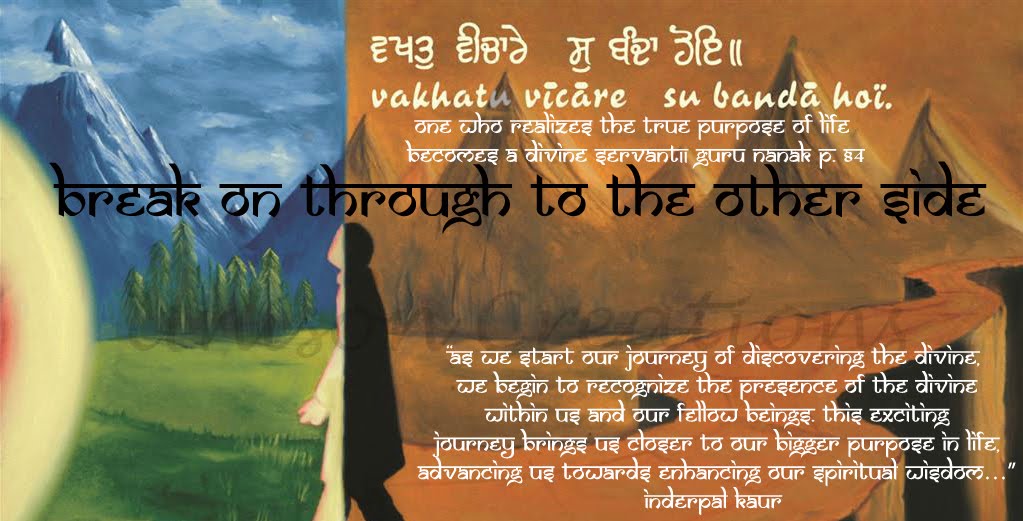
In "Break on Through to the Other Side," "We stand before this wall with great fear and trepidation. Why? Because that wall is made up of all of our beliefs that we hold so dear."
One who understands this becomes truthful.
Guru Nanak page 3
We also become free of unanswerable Theological questions, such as: What is the Name of God? Is Nanak God? Is the Guru Granth the word of God?
Our concern turns to: What is Truth? and How do we live a Truthful life?
The Naam, the Name of the Lord, is abstinence, truthfulness, and self-restraint. Without the Name, no one becomes pure.
Guru Nanak page 33
Truth is higher than everything; but higher still is truthful living. ||5||
Guru Nanak page 62
Some understand Truthfulness; they are given the inexhaustible treasure.
Guru Amar Das page 85
All of this appears in the first 85 pages of Guru Granth, Why has it taken me so long to see it? Better yet, why has it taken so long for people to understand? Because what the Guru's are talking about is a moral framework that has nothing to do with religion. It's a framework that can be simply expressed as: Do the Right thing because it is the Right Thing to do, not because some religion threatens you with eternal damnation. Do we really need a religion or God to tell us that killing and stealing are not the Right Things to do? I think not.
In fact, some times doing the Right Thing is contrary to what your religion tells you. I remember one evening in India, as I was approaching Gurdwara Nadha Sahib, One of the legless beggars asked me for money. According to modern day Sikhi, we are told that Sikhs should never beg therefore you should not give money to any beggars. I had a 100 Rupee bill in my hand that I was going to donate to the Golak and walked by the beggar. A few steps later as I was looking at this magnificent Gurdwara, it dawned on me that this Gurdwara was as cold as the marble it was built of and there was no Truth there. I turned to the beggar and saw the Guru in him. I approached him and gave him my money, that he grasped it between his handless arms, instead of the Golak. Why? Because it was at that moment I realized that that was the Right Thing to do.
Salok, First Mehla:
Let mercy be your mosque, faith your prayer-mat, and honest living your Koran. Make modesty your circumcision, and good conduct your fast. In this way, you shall be a true Muslim. Let good conduct be your Kaabaa, Truth your spiritual guide, and the karma of good deeds your prayer and chant. Let your rosary be that which is pleasing to His Will. O Nanak, God shall preserve your honor.
Guru Nanak p. 140
The above quote from Nanak is telling a Muslim how to be a good Muslim. But it also begs the question: If this is followed, would anyone, let alone another Muslim, recognize this person as a Muslim? I think not.
As I was reading this quote, it dawned on me what Nanak might say to a modern day Sikh. It would be something like this.
Let mercy be your Gurdwara, faith your Simran, and honest living your Guru Granth. Make modesty your Kakkars, and good conduct your rituals. In this way, you shall be a true Sikh. Let good conduct be your Golden Temple, Truth your Guru, and the karma of good deeds your Banis.
Again, This begs the question: If this is followed, would anyone, let alone another Sikh, recognize this person as a Sikh? Again, I think not. But the Truth is that this person would really be the True Sikh.
And this is the reason that I have decided to lose my religion. Not to stop being a Sikh but to become a True Sikh.
Today, I have made the decision to lose my religion. This is not to say that I am leaving the Spiritual Path that was given to me by Guru Nanak but that I am losing this religion called Sikhism.
That's me in the corner
That's me in the spotlight
Losing my religion
Trying to keep up with you
And I don't know if I can do it
REM
Ten years ago when the song that contains the above lyrics was popular, it was inconceivable for me to even think about the idea of "losing my religion." Recently, I have come to the conclusion that that is exactly what Guru Nanak wanted us to do and we should be "trying to keep up with" Nanak because that is what he did in writing Mul Mantar.
In his article Evolution of the Concept of God, Rawel Singh talks about how the concept of God has evolved through human history. I think that it is very interesting that he uses the term "concept" because that is exactly what God is: a concept but more accurately a metaphor. He talks about how the God of the Old Testament is different than the God of the New Testament, which is different than the Islamic God, which is different than the Hindu God and even different than Nanak's God. But how can all of these be true? And even more importantly, it begs the question: Is man a creation of God or is God a creation of man?
How can God be Akaal Moorat, the Timeless Being if he keeps changing through time? But is it God that Nanak is talking about or is it Sat? I believe that it is Sat.
Ek Ong Kaar Sat Naam
There us one Truth
Sat is Karta Purakh, the Creative Force.
Sat is Akaal Moorat, the Timeless Being.
In the descriptions of God in various Religions, God is said to have birth, form, even death, fear, and anger. In Mul Mantar, Nanak dispels all these descriptions of God with: He is without birth, without form, without death, without fear and without anger. But is he saying that these are the attributes of God? No, these are all the attributes of Sat.
This whole idea can be extremely frightening and full of doubt. However, once you have passed through that fear and doubt, it is incredibly liberating.
Along this same theme, Wajinder Singh wrote:
My Guru is NOT a BOOK
My Guru Is NOT even a DEITY
The SHABAD is my Guru .... this Shabad is the Divine Knowledge (Gian)
This knowledge is the Guru, Gu-darkness (ignorance) Ru-light JOT (knowledge)
so my Guru is definitely not an Idol, i don't have to follow around my Guru
But when i read / hear the shabad ALL i can HEAR is my Guru SPEAKING
So how could i force others to see my Guru this way,
They don't accept nor believe in this GIAN knowledge
but I DEFINITELY do ..........and this is all that matters !
.... Eh Saagar Soi Teray Jo Har Gun Gavey
Throughout time, Religion has been the barrier that creates the "veil of illusion." As I described in Devolution, "Sikhs continued adding bricks of misunderstanding until the Gateway was closed. Then they stood before the non-existent Gateway and proclaimed what a great wall and religion had been built. As they stood there admiring their work, they decided to add golden domes and beautiful marble to the wall and they declared that God must really love them for allowing such a beautiful wall to be built.
"When some pointed out that the Gateway had been bricked shut, they were told not to 'fiddle with Sikh traditions' and swords were unsheathed, excommunications were delivered, and those who insulted "Sikh religious sympathies" were jailed."
So how can you become truthful? And how can the veil of illusion be torn away?
Guru Nanak page 1
The first step is understanding that the concept of God is the illusion and that Truth and only Truth was what the Gurus were talking about.
In "Break on Through to the Other Side," "We stand before this wall with great fear and trepidation. Why? Because that wall is made up of all of our beliefs that we hold so dear."
One who understands this becomes truthful.
Guru Nanak page 3
We also become free of unanswerable Theological questions, such as: What is the Name of God? Is Nanak God? Is the Guru Granth the word of God?
Our concern turns to: What is Truth? and How do we live a Truthful life?
The Naam, the Name of the Lord, is abstinence, truthfulness, and self-restraint. Without the Name, no one becomes pure.
Guru Nanak page 33
Truth is higher than everything; but higher still is truthful living. ||5||
Guru Nanak page 62
Some understand Truthfulness; they are given the inexhaustible treasure.
Guru Amar Das page 85
All of this appears in the first 85 pages of Guru Granth, Why has it taken me so long to see it? Better yet, why has it taken so long for people to understand? Because what the Guru's are talking about is a moral framework that has nothing to do with religion. It's a framework that can be simply expressed as: Do the Right thing because it is the Right Thing to do, not because some religion threatens you with eternal damnation. Do we really need a religion or God to tell us that killing and stealing are not the Right Things to do? I think not.
In fact, some times doing the Right Thing is contrary to what your religion tells you. I remember one evening in India, as I was approaching Gurdwara Nadha Sahib, One of the legless beggars asked me for money. According to modern day Sikhi, we are told that Sikhs should never beg therefore you should not give money to any beggars. I had a 100 Rupee bill in my hand that I was going to donate to the Golak and walked by the beggar. A few steps later as I was looking at this magnificent Gurdwara, it dawned on me that this Gurdwara was as cold as the marble it was built of and there was no Truth there. I turned to the beggar and saw the Guru in him. I approached him and gave him my money, that he grasped it between his handless arms, instead of the Golak. Why? Because it was at that moment I realized that that was the Right Thing to do.
Salok, First Mehla:
Let mercy be your mosque, faith your prayer-mat, and honest living your Koran. Make modesty your circumcision, and good conduct your fast. In this way, you shall be a true Muslim. Let good conduct be your Kaabaa, Truth your spiritual guide, and the karma of good deeds your prayer and chant. Let your rosary be that which is pleasing to His Will. O Nanak, God shall preserve your honor.
Guru Nanak p. 140
The above quote from Nanak is telling a Muslim how to be a good Muslim. But it also begs the question: If this is followed, would anyone, let alone another Muslim, recognize this person as a Muslim? I think not.
As I was reading this quote, it dawned on me what Nanak might say to a modern day Sikh. It would be something like this.
Let mercy be your Gurdwara, faith your Simran, and honest living your Guru Granth. Make modesty your Kakkars, and good conduct your rituals. In this way, you shall be a true Sikh. Let good conduct be your Golden Temple, Truth your Guru, and the karma of good deeds your Banis.
Again, This begs the question: If this is followed, would anyone, let alone another Sikh, recognize this person as a Sikh? Again, I think not. But the Truth is that this person would really be the True Sikh.
And this is the reason that I have decided to lose my religion. Not to stop being a Sikh but to become a True Sikh.
Tuesday, March 11, 2008
Meditation in Sikhism
By Devinderjit Singh
If you were to ask a devout Sikh to summarize the ideal way of life, you'd probably hear the slogan Naam japna, wand ke shakna te dharam dhe kirat karnee. That is to say (in reverse order): `Earning an honest living, sharing one's blessings with those less fortunate and meditating on the name of God.' While this phrase is not in the Sikh Scriptures, the Guru Granth Sahib, it does capture the sentiment of the teachings well.
Lead a life of activity,and earn its comforts with honest hard work. Through devoted remembrance meet the Lord, and, O Nanak, all worries are dispelled. [1]
Guru Granth Sahib, Raaga Gujari, Mahala 5, p. 522
The central spiritual issue, which has perplexed me for a long time, is: What is this Naam and how should we meditate upon it?
In the mid-1970s, when I was a teenager, my father gave me a copy of the Autobiography of Bhai Sahib Randhir Singh. This was an English translation, by Dr. Trilochan Singh, of the Punjabi book Jail Chittian or `Letters from Jail'. Although the description of the hardships endured by Randhir Singh and his fellow patriots during their incarceration for independence activities in India in the early twentieth century were very moving, and mirrored the fate of Nelson Mandela and his companions in South Africa some decades later, I was entranced by the narrative about his spiritual quest as a young man. Randhir Singh took the instruction to meditate on the Naam to heart, but wasn't sure which word he should use for the mantric recitation because God is referred to by a myriad different names in the Guru Granth Sahib: Creator, Giver, Lord, Almightly and so on. He was drawn to the popular term Waheguru, but confirmation only came with a mystical episode; subsequently he enjoyed deep spiritual experiences, which helped him cope through the trying years that lay ahead.
Being young and impressionable at the time, I went through a brief rosary period. Sadly it did little for me, but I put this down to my lack of commitment; unlike Randhir Singh, I didn't get up at 2 a.m. to meditate. The topic came back to the fore in the late 1980s, when I went to the Los Alamos National Laboratory in New Mexico, U.S.A., as a post-doc for a few years. I was only 20 miles from a community of European-American Sikhs who practiced meditation seriously, at the Espanola headquarters of Yogi Harbhajan Singh. Although I rapidly came to the conclusion that the latter was a complete charlatan, was there anything of value in the yogic techniques for an aspiring meditant? I can't speak from experience, since I was too put off by the Yogi-centred setup to try it, but somehow I don't think I missed out on much of significance.
More recently, it has finally started to dawn on me that the notions of Naam and Simaran, or contemplation, as generally expounded within Sikh circles are at odds with Gurbani they can't have anything to do with the physical recitation of a particular word or phrase! While the beginning of the following hymn by the tailor-Saint Nam Dev might suggest a conventional mantric interpretation, the subsequent lines rule it out:
With the mind as my yard-stick and the tongue my scissors, Measure by measure I'm cutting off death's noose. [1] What do I care about caste and what do I care about sub-caste, When I recite the Lord's Name day and night. [Refrain] Even through the chores of dying and sewing, Without God's Name I don't live a moment.[2] I contemplate and sing the Lord's praises, Remembering God every hour of the day.[3] Just like a silver thread in a golden needle, Nama's mind is attached with the Almighty. [4]
Guru Granth Sahib, Raaga Aasaa, Bhagat Nam Dev, p. 485
It doesn't matter how committed you are, it's not possible to repeat Waheguru, or anything else, every second of the day through human endeavour. Even if you could train your mind to do so while awake, could you guarantee that the process would continue uninterrupted during sleep? No, not without the process becoming akin to one's breathing or heartbeat; that is, involuntary. The Naam and Simaran that Gurbani talks about, which goes on continually day and night, is something transcendental.
Even those who concede that Gurbani is alluding to a spiritual process, rather than a physical one, tend to argue that the repetition of the Waheguru mantra is a necessary first step for achieving the hallowed state; as such, meditative practice is seen as being essential to get things started. I'm afraid this doesn't seem right to me anymore.
O my mind, take the shelter of God's Name. Its contemplation dispels bad thoughts and leads to the state of contentment. [Refrain] Consider such souls truly blessed, who sing the praises of the Almighty. Washing away their accumulated sins, they find a place in heaven. [1] In his final moments, Ajamal obtained an understanding of the Lord. That sublime state, sought by grand-yogis, in an instant did he achieve. [2]
Lacking in merit and devoid of learning, no religious acts could Gaj perform. Nanak behold the way of God, the gift of tranquillity he gave him. [3]
(Guru Granth Sahib, Raaga Raamkali, Mahala 9, p. 901)
Two references from Indian mythology, the fables of the `sinner' Ajamal and the `arrogant elephant' Gaj, are used in the second half of this verse to make a point: only the Grace of the Lord, and not years of religious acts or yogic practice, leads to the state of enlightenment, contentment and tranquillity. The citations of Ajamal and Gaj do not indicate that Sikhism accepts that either really existed, but simply means that a useful lesson can be learnt from the folklore. Indeed, as in Gurbani, the elephant could merely be a metaphor for arrogance, just as a tiny ant is sometimes used to represent humility.
God is like sugar that is scattered in sand,
An elephant can't pick out the sweet grains.
Kabir says, the Guru has given this sound advice:
Become like an ant and savour the nectar. [238]
(Guru Granth Sahib, Slokas, Bhagat Kabir, p. 1377)
The notion that the recitation of Waheguru as a mantra is central to the Sikh spiritual path seems like a gross misconception to me. The word only occurs about a dozen times in the 1430 pages of the Guru Granth Sahib, and attaching special significance to one name for God over another is contrary to its teachings. Even if we accept that the use of Waheguru in preference to other names for God is just a convention, will its repeated chanting lead us eventually to enlightenment? I very much doubt it.
Purity is not obtained by bathing, even if you wash a million times over. Tranquillity does not come with silence, no matter how long the meditation. Satiety is not achieved through indulgence, even with the wealth of the world. Despite countless techniques and practices, not one leads to emancipation. How can we perceive the Truth? How can the wall of falsehood be breached? It happens in accordance with God's Will, O Nanak, as it is ordained. [1]
(Guru Granth Sahib, Japji, p. 1)
The second verse of the first composition, Japji, then goes on to discuss God's
Will: everything happens in accordance with it, but it defies description; those
who are lucky enough to recognize it become free from the clutches of their ego. Having dismissed some of the most common religious practices as misguided, such as asceticism, pilgrimage and sacred bathing, and ruled out all the others that might be dreamt up, it's highly unlikely that Guru Nanak would have advocated some variant of his own.
What is the Truth with which Guru Nanak is concerned, and what constitutes the wall of falsehood? He answers this in a short Sloka at the head of the 38 verses of Japji:
The Truth was there in the beginning,
The Truth has been there throughout the ages.
The Truth exists even today and,
O Nanak, the Truth will also exit in the future. [1]
(Guru Granth Sahib, Japji, p. 1)
The Truth that is being referred to is something which is eternal. Everything else, being transitory, is considered an illusion akin to a dream; that which appears to be real but vanishes on waking. Since all that surrounds us has been in existence for only a finite amount time, be it ourselves, our planet, the galaxies and even thee stuff from which the universe is made (currently estimated to be around 15 billion years old), the Truth must be unlike anything we know. It is this very uniqueness that makes it impossible to describe, since there is nothing in our experience with which it can be meaningfully compared. The declaration of this basic feature, and the associated limitations of description and understanding, form the cornerstone of the Sikh creed: the Mool Mantra.
There is One God, whose name is Truth. The omnipresent creator, who is without fear and without enmity;
A timeless being, who is not born but is self-existent. Enlightenment comes through his Grace.
(Guru Granth Sahib, p. 1)
This fundamental statement is reiterated at the start of each chapter and major composition, and its abridged version (Ek Onkaar - Sat - Gurparsaad) occurs in numerous places. The rest of the Guru Granth Sahib is an exposition that expands on this theme in different ways.
A year ago, I was taken aback when a good Sikh friend of mine told me that he'd come to the conclusion that there was no God! While I would have paid little attention to such a claim from someone like Richard Dawkins, my friend was a devout and spiritual man who thought deeply about the message of Gurbani. So, how could he say that? He went on to elaborate that God was simply a metaphor, which stood for all that was transcendental. Although I still have reservations, I'm sympathetic towards the idea. Rather than God making man in his own image, as asserted in the first book of the Bible (Genesis), we tend to visualize God in human terms: presumably he must live somewhere, so we picture a place called heaven; he must have friends and enemies, so we become the chosen people while others feel his wrath; being the ultimate authority, he must expect homage and obedience; and so on. According to Guru Nanak, such worldly attributes of time, space, birth, death, fear, enmity, etc., are not applicable to God. The metaphorical view discourages these preconceptions by emphasizing the transcendental nature of the quest.
The task at hand can be summarized as follows: we seek an eternal Truth, but it is beyond our comprehension because it lies outside the experience of the only reality we know (transient as that might be). While some, understandably, regard this situation as absurd and dismiss the whole notion, others are not so easily put off by its daunting challenge. The problem for those drawn to the spiritual path is figuring out how to proceed.
Ritual prayers, fasts, denominational marks, sacred baths and ostentatious charitable donations. None of these acts impress the Lord, no matter how sweet the words with which they're performed. [1] The contemplation of God's Name brings tranquillity to the mind. People seek the Lord through many different ways, but it's a difficult task and he can't be found. [Refrain] Chanting, penance, wandering the globe, extreme austerities and ascension to the highest chakra. Such methods find no favour with the Lord, whether they be yogic techniques or Jain practice. [2] The ambrosial Name, that priceless praise of God, is obtained by those on whom he showers his Grace. The Lord bestows this joy in holy company, O Nanak, and such blessed souls live in peace. [3]
(Guru Granth Sahib, Raaga Dhanaasri, Mahala 5, p. 674)
Although the purpose of the quest is clear-the acquisition of a perpetual state of mental peace, joy and tranquillity the method by which the necessary enlightenment can be attained is not obvious. Indeed, given the nature of the task, it's important to realize that this goal cannot be reached by human endeavour. Only if the veil of falsehood is lifted for us will the the Truth be revealed; once glimpsed, the illusion of everyday reality loses its power. Thus concludes Guru Nanak, with Gurparsaad.
If enlightenment can only be achieved through God's Grace, what can we do to encourage this blessing? The answer, I believe, is nothing! As long as you think that certain acts, practices or behaviour will make you more worthy of Grace, you've lost the plot. We are after something so priceless, there is no way in which it can be earned; there is nothing we can give in return. All we can do is harbour a heart-felt desire for the invaluable gift.
Of what use is your meditation, penance, fasting and worship, If in your heart you don't have the Love of the Almighty? [1] My friends, you should attach your mind with the Creator. God is not attained through clever techniques and rituals. [Refrain] You should give up your pride and pretensions to impress others; And relinquish your obsession with lust, anger and your ego. [2] Instead you fan your ego by making a great show of your piety; And waste your time in the service of idols and tombstones. [3] Only through devoted remembrance is God attained, says Kabir; Only through the innocence of a child does one meet the Almighty. [4]
(Guru Granth Sahib, Raaga Gaudi, Bhagat Kabir, p. 324)
But how can we develop a thirst for something that is transcendental? After all, it's not easy to fall in love without the sense of sight, sound, smell, taste or touch. There is just one possibility: seek inspiration from those rare souls who have been lucky enough to have been blessed with the divine experience.
O mother, I have obtained the treasure of God's Name. My mind has ceased its hankerings and finally come to rest. [Refrain] The draw of illusion has left the body and divine knowledge has emerged. Greed and attachment can ensnare no longer, I'm absorbed with the Lord. [1] The uncertainty of lifetimes lifted when I obtained the gem of God's Name. All the desires vanished from my mind and perpetual bliss settled within. [2] The one on whom the Lord showers his Grace sings the praises of the Almighty. Nanak says, rare are the blessed souls who acquire this type of wealth. [3]
(Guru Granth Sahib, Raaga Baasant, Mahala 9, p. 1186)
Given the scarcity of enlightened individuals, finding such holy company is not an easy job. Sadly, the search is also fraught with danger. While there is no threat from the saint we seek, the problem is one of avoiding the many charlatans who are only too eager to exploit the unwary. Even though the warning signs are usually obvious, blind faith tends to take over and victims of spiritual fraud abound. A simple checklist should include the following questions. Is the person perpetually content, or does he or she succumb to lust, anger, greed, undue attachment and ego? Is a blissful state maintained under trying circumstances? Is the company of the honest, humble and poor preferred, or is much more interest shown towards the rich, famous and powerful?
Sikhs can eliminate the risk of falling prey to charlatans by seeking spiritual inspiration directly from the Guru Granth Sahib, because it was composed and compiled by the (enlightened) founders. The Sikh Gurus also included the writings of some contemporary saints from various religious and social backgrounds, such as Kabir, Farid, Nam Dev, Ravi Das and Trilochan, to emphasize that the Truth with which they were concerned was universal as well as eternal. Despite being in this unique and privileged position with regard to their scriptures, most still want a saint they can see and touch in person and, thereby, lay themselves open to the potential pitfalls which that entails. Since our goal is transcendental, the lack of human form is irrelevant. If the physical presence of a sage guaranteed salvation, everyone with whom Guru Nanak came into contact would have become a saint. It didn't work for his eldest son, Siri Chand, for example, who egotistically assumed that it was his rightful inheritance to succeed his father; when his expectations were dashed, because Guru Nanak chose the humble Bhai Lehna over him, he went off in a huff and set up his own ascetic sect (completely at odds with Guru Nanak's teachings). Likewise, Prithi Chand, the eldest son of the fourth Guru, Ram Das, was a source of much grief; and what about Ram Rai, Dhir Mul, and the people who tortured and killed the fifth and ninth Gurus, Arjan and Teg Bahadhur? What we're after is not a matter of having flesh and blood communion with a saint, but one of deriving inspiration from their utterances about that rarest of sublime experiences.
If I discover a curiosity, or gain some particular insight, or just buy a gadget that enthralls me, I get excited and want to tell my friends about it. When people fall in love, or have their hearts broken, or go through other deep emotions, they are often driven to setting their feelings to poetry and song. The contents of the Guru Granth Sahib make most sense when viewed in this light: its saintly authors are trying to give expression to the most profound of experiences, but it's dificult to capture in words.
Oh what bliss. To whom can I describe this state? I have become ecstatic with delight on catching sight of the Lord; my mind is filled with joy and sings his praises. [Refrain] I am awestruck on seeing the Wondrous One, the Blesser is everywhere. I drink the priceless nectar of God's Name but, like a mute, I can only convey the taste with a contented smile. [1] Just as when some stop their breathing, the air flow can't be perceived. So a person within whom God becomes resplendent, their inner state cannot be described with words. [2] The various techniques discussed by people, can all be learnt by study. But my beloved Lord, the dispeller of worry, appeared inside my heart from within; it's hard to say how it could be. [3] The undefinable, formless and eternal Lord; boundless beyond measure. Nanak says, only those enjoined with the ever-youthful Lord can ever know about this state of pleasure. [4]
(Guru Granth Sahib, Raaga Saarang, Mahala 5, p. 1205)
I'd say that the Sikh Gurus left us with a simple diet of wholesome food to provide fitness and good health; instead we've turned to junk fast food that is low in spiritual value and high in superstition and ritual. The resultant obesity and ill-health is clear to see and growing.
I began this article with the question of Naam, and have to confess that I still have no idea of what it is. I have learnt that this knowledge can only be acquired with God's Grace, but that the lucky few to be so blessed don't have the words to describe it. In any case, it's a far cry from the conventional mantric viewpoint usually preached! I guess the misconception stems from people interpreting the vocabulary of the Guru Granth Sahib too literally, and not taking due account of the fact that Guru Nanak had to use concepts and phrases with which his audience was familiar in order to explain his message; meditational terms were used for the benefit of yogis, agricultural ones for farmers, nautical references for fishermen and so on. The way to reduce the risk of misunderstandings, and the construction of superstitions, is to consider hymns in their entirety and to make sure that the interpretation fits in with Gurbani as a whole. Meditation in Sikhism is not something that is done to become blessed, but it's what happens automatically if we are ever lucky enough to be the recipients of the Lord's Grace.
I become attached by what I see. How can I meet you eternal Lord? Bless me and put me on the right path. Let holy company be my support. [1] How can we traverse the turbulent illusion of the world? The enlightener of Truth is the boat to ferry us safely across. [Refrain]
The illusion shakes us like a breeze. Only God's saints remain unmoved. They stay aloof from joy and sorrow. The Lord himself looks after them. [2] The illusion engulfs all like a snake. Burning with ego like a moth to a flame. God defies every sanctification. Only with Grace is enlightenment found. [3] I wandered sad seeking a gem. A priceless jewel not obtained by any means. Within me was this gem. Its glory revealed when the Lord lifted the veil. [4] Whoever partakes savours its taste. Like a mute who's mind fills with awe. I can see the Bliss everywhere. Servant Nanak is now lost in God's praise. [5]
(Guru Granth Sahib, Raaga Bilaawal, Mahala 5, p. 801)
If you were to ask a devout Sikh to summarize the ideal way of life, you'd probably hear the slogan Naam japna, wand ke shakna te dharam dhe kirat karnee. That is to say (in reverse order): `Earning an honest living, sharing one's blessings with those less fortunate and meditating on the name of God.' While this phrase is not in the Sikh Scriptures, the Guru Granth Sahib, it does capture the sentiment of the teachings well.
Lead a life of activity,and earn its comforts with honest hard work. Through devoted remembrance meet the Lord, and, O Nanak, all worries are dispelled. [1]
Guru Granth Sahib, Raaga Gujari, Mahala 5, p. 522
The central spiritual issue, which has perplexed me for a long time, is: What is this Naam and how should we meditate upon it?
In the mid-1970s, when I was a teenager, my father gave me a copy of the Autobiography of Bhai Sahib Randhir Singh. This was an English translation, by Dr. Trilochan Singh, of the Punjabi book Jail Chittian or `Letters from Jail'. Although the description of the hardships endured by Randhir Singh and his fellow patriots during their incarceration for independence activities in India in the early twentieth century were very moving, and mirrored the fate of Nelson Mandela and his companions in South Africa some decades later, I was entranced by the narrative about his spiritual quest as a young man. Randhir Singh took the instruction to meditate on the Naam to heart, but wasn't sure which word he should use for the mantric recitation because God is referred to by a myriad different names in the Guru Granth Sahib: Creator, Giver, Lord, Almightly and so on. He was drawn to the popular term Waheguru, but confirmation only came with a mystical episode; subsequently he enjoyed deep spiritual experiences, which helped him cope through the trying years that lay ahead.
Being young and impressionable at the time, I went through a brief rosary period. Sadly it did little for me, but I put this down to my lack of commitment; unlike Randhir Singh, I didn't get up at 2 a.m. to meditate. The topic came back to the fore in the late 1980s, when I went to the Los Alamos National Laboratory in New Mexico, U.S.A., as a post-doc for a few years. I was only 20 miles from a community of European-American Sikhs who practiced meditation seriously, at the Espanola headquarters of Yogi Harbhajan Singh. Although I rapidly came to the conclusion that the latter was a complete charlatan, was there anything of value in the yogic techniques for an aspiring meditant? I can't speak from experience, since I was too put off by the Yogi-centred setup to try it, but somehow I don't think I missed out on much of significance.
More recently, it has finally started to dawn on me that the notions of Naam and Simaran, or contemplation, as generally expounded within Sikh circles are at odds with Gurbani they can't have anything to do with the physical recitation of a particular word or phrase! While the beginning of the following hymn by the tailor-Saint Nam Dev might suggest a conventional mantric interpretation, the subsequent lines rule it out:
With the mind as my yard-stick and the tongue my scissors, Measure by measure I'm cutting off death's noose. [1] What do I care about caste and what do I care about sub-caste, When I recite the Lord's Name day and night. [Refrain] Even through the chores of dying and sewing, Without God's Name I don't live a moment.[2] I contemplate and sing the Lord's praises, Remembering God every hour of the day.[3] Just like a silver thread in a golden needle, Nama's mind is attached with the Almighty. [4]
Guru Granth Sahib, Raaga Aasaa, Bhagat Nam Dev, p. 485
It doesn't matter how committed you are, it's not possible to repeat Waheguru, or anything else, every second of the day through human endeavour. Even if you could train your mind to do so while awake, could you guarantee that the process would continue uninterrupted during sleep? No, not without the process becoming akin to one's breathing or heartbeat; that is, involuntary. The Naam and Simaran that Gurbani talks about, which goes on continually day and night, is something transcendental.
Even those who concede that Gurbani is alluding to a spiritual process, rather than a physical one, tend to argue that the repetition of the Waheguru mantra is a necessary first step for achieving the hallowed state; as such, meditative practice is seen as being essential to get things started. I'm afraid this doesn't seem right to me anymore.
O my mind, take the shelter of God's Name. Its contemplation dispels bad thoughts and leads to the state of contentment. [Refrain] Consider such souls truly blessed, who sing the praises of the Almighty. Washing away their accumulated sins, they find a place in heaven. [1] In his final moments, Ajamal obtained an understanding of the Lord. That sublime state, sought by grand-yogis, in an instant did he achieve. [2]
Lacking in merit and devoid of learning, no religious acts could Gaj perform. Nanak behold the way of God, the gift of tranquillity he gave him. [3]
(Guru Granth Sahib, Raaga Raamkali, Mahala 9, p. 901)
Two references from Indian mythology, the fables of the `sinner' Ajamal and the `arrogant elephant' Gaj, are used in the second half of this verse to make a point: only the Grace of the Lord, and not years of religious acts or yogic practice, leads to the state of enlightenment, contentment and tranquillity. The citations of Ajamal and Gaj do not indicate that Sikhism accepts that either really existed, but simply means that a useful lesson can be learnt from the folklore. Indeed, as in Gurbani, the elephant could merely be a metaphor for arrogance, just as a tiny ant is sometimes used to represent humility.
God is like sugar that is scattered in sand,
An elephant can't pick out the sweet grains.
Kabir says, the Guru has given this sound advice:
Become like an ant and savour the nectar. [238]
(Guru Granth Sahib, Slokas, Bhagat Kabir, p. 1377)
The notion that the recitation of Waheguru as a mantra is central to the Sikh spiritual path seems like a gross misconception to me. The word only occurs about a dozen times in the 1430 pages of the Guru Granth Sahib, and attaching special significance to one name for God over another is contrary to its teachings. Even if we accept that the use of Waheguru in preference to other names for God is just a convention, will its repeated chanting lead us eventually to enlightenment? I very much doubt it.
Purity is not obtained by bathing, even if you wash a million times over. Tranquillity does not come with silence, no matter how long the meditation. Satiety is not achieved through indulgence, even with the wealth of the world. Despite countless techniques and practices, not one leads to emancipation. How can we perceive the Truth? How can the wall of falsehood be breached? It happens in accordance with God's Will, O Nanak, as it is ordained. [1]
(Guru Granth Sahib, Japji, p. 1)
The second verse of the first composition, Japji, then goes on to discuss God's
Will: everything happens in accordance with it, but it defies description; those
who are lucky enough to recognize it become free from the clutches of their ego. Having dismissed some of the most common religious practices as misguided, such as asceticism, pilgrimage and sacred bathing, and ruled out all the others that might be dreamt up, it's highly unlikely that Guru Nanak would have advocated some variant of his own.
What is the Truth with which Guru Nanak is concerned, and what constitutes the wall of falsehood? He answers this in a short Sloka at the head of the 38 verses of Japji:
The Truth was there in the beginning,
The Truth has been there throughout the ages.
The Truth exists even today and,
O Nanak, the Truth will also exit in the future. [1]
(Guru Granth Sahib, Japji, p. 1)
The Truth that is being referred to is something which is eternal. Everything else, being transitory, is considered an illusion akin to a dream; that which appears to be real but vanishes on waking. Since all that surrounds us has been in existence for only a finite amount time, be it ourselves, our planet, the galaxies and even thee stuff from which the universe is made (currently estimated to be around 15 billion years old), the Truth must be unlike anything we know. It is this very uniqueness that makes it impossible to describe, since there is nothing in our experience with which it can be meaningfully compared. The declaration of this basic feature, and the associated limitations of description and understanding, form the cornerstone of the Sikh creed: the Mool Mantra.
There is One God, whose name is Truth. The omnipresent creator, who is without fear and without enmity;
A timeless being, who is not born but is self-existent. Enlightenment comes through his Grace.
(Guru Granth Sahib, p. 1)
This fundamental statement is reiterated at the start of each chapter and major composition, and its abridged version (Ek Onkaar - Sat - Gurparsaad) occurs in numerous places. The rest of the Guru Granth Sahib is an exposition that expands on this theme in different ways.
A year ago, I was taken aback when a good Sikh friend of mine told me that he'd come to the conclusion that there was no God! While I would have paid little attention to such a claim from someone like Richard Dawkins, my friend was a devout and spiritual man who thought deeply about the message of Gurbani. So, how could he say that? He went on to elaborate that God was simply a metaphor, which stood for all that was transcendental. Although I still have reservations, I'm sympathetic towards the idea. Rather than God making man in his own image, as asserted in the first book of the Bible (Genesis), we tend to visualize God in human terms: presumably he must live somewhere, so we picture a place called heaven; he must have friends and enemies, so we become the chosen people while others feel his wrath; being the ultimate authority, he must expect homage and obedience; and so on. According to Guru Nanak, such worldly attributes of time, space, birth, death, fear, enmity, etc., are not applicable to God. The metaphorical view discourages these preconceptions by emphasizing the transcendental nature of the quest.
The task at hand can be summarized as follows: we seek an eternal Truth, but it is beyond our comprehension because it lies outside the experience of the only reality we know (transient as that might be). While some, understandably, regard this situation as absurd and dismiss the whole notion, others are not so easily put off by its daunting challenge. The problem for those drawn to the spiritual path is figuring out how to proceed.
Ritual prayers, fasts, denominational marks, sacred baths and ostentatious charitable donations. None of these acts impress the Lord, no matter how sweet the words with which they're performed. [1] The contemplation of God's Name brings tranquillity to the mind. People seek the Lord through many different ways, but it's a difficult task and he can't be found. [Refrain] Chanting, penance, wandering the globe, extreme austerities and ascension to the highest chakra. Such methods find no favour with the Lord, whether they be yogic techniques or Jain practice. [2] The ambrosial Name, that priceless praise of God, is obtained by those on whom he showers his Grace. The Lord bestows this joy in holy company, O Nanak, and such blessed souls live in peace. [3]
(Guru Granth Sahib, Raaga Dhanaasri, Mahala 5, p. 674)
Although the purpose of the quest is clear-the acquisition of a perpetual state of mental peace, joy and tranquillity the method by which the necessary enlightenment can be attained is not obvious. Indeed, given the nature of the task, it's important to realize that this goal cannot be reached by human endeavour. Only if the veil of falsehood is lifted for us will the the Truth be revealed; once glimpsed, the illusion of everyday reality loses its power. Thus concludes Guru Nanak, with Gurparsaad.
If enlightenment can only be achieved through God's Grace, what can we do to encourage this blessing? The answer, I believe, is nothing! As long as you think that certain acts, practices or behaviour will make you more worthy of Grace, you've lost the plot. We are after something so priceless, there is no way in which it can be earned; there is nothing we can give in return. All we can do is harbour a heart-felt desire for the invaluable gift.
Of what use is your meditation, penance, fasting and worship, If in your heart you don't have the Love of the Almighty? [1] My friends, you should attach your mind with the Creator. God is not attained through clever techniques and rituals. [Refrain] You should give up your pride and pretensions to impress others; And relinquish your obsession with lust, anger and your ego. [2] Instead you fan your ego by making a great show of your piety; And waste your time in the service of idols and tombstones. [3] Only through devoted remembrance is God attained, says Kabir; Only through the innocence of a child does one meet the Almighty. [4]
(Guru Granth Sahib, Raaga Gaudi, Bhagat Kabir, p. 324)
But how can we develop a thirst for something that is transcendental? After all, it's not easy to fall in love without the sense of sight, sound, smell, taste or touch. There is just one possibility: seek inspiration from those rare souls who have been lucky enough to have been blessed with the divine experience.
O mother, I have obtained the treasure of God's Name. My mind has ceased its hankerings and finally come to rest. [Refrain] The draw of illusion has left the body and divine knowledge has emerged. Greed and attachment can ensnare no longer, I'm absorbed with the Lord. [1] The uncertainty of lifetimes lifted when I obtained the gem of God's Name. All the desires vanished from my mind and perpetual bliss settled within. [2] The one on whom the Lord showers his Grace sings the praises of the Almighty. Nanak says, rare are the blessed souls who acquire this type of wealth. [3]
(Guru Granth Sahib, Raaga Baasant, Mahala 9, p. 1186)
Given the scarcity of enlightened individuals, finding such holy company is not an easy job. Sadly, the search is also fraught with danger. While there is no threat from the saint we seek, the problem is one of avoiding the many charlatans who are only too eager to exploit the unwary. Even though the warning signs are usually obvious, blind faith tends to take over and victims of spiritual fraud abound. A simple checklist should include the following questions. Is the person perpetually content, or does he or she succumb to lust, anger, greed, undue attachment and ego? Is a blissful state maintained under trying circumstances? Is the company of the honest, humble and poor preferred, or is much more interest shown towards the rich, famous and powerful?
Sikhs can eliminate the risk of falling prey to charlatans by seeking spiritual inspiration directly from the Guru Granth Sahib, because it was composed and compiled by the (enlightened) founders. The Sikh Gurus also included the writings of some contemporary saints from various religious and social backgrounds, such as Kabir, Farid, Nam Dev, Ravi Das and Trilochan, to emphasize that the Truth with which they were concerned was universal as well as eternal. Despite being in this unique and privileged position with regard to their scriptures, most still want a saint they can see and touch in person and, thereby, lay themselves open to the potential pitfalls which that entails. Since our goal is transcendental, the lack of human form is irrelevant. If the physical presence of a sage guaranteed salvation, everyone with whom Guru Nanak came into contact would have become a saint. It didn't work for his eldest son, Siri Chand, for example, who egotistically assumed that it was his rightful inheritance to succeed his father; when his expectations were dashed, because Guru Nanak chose the humble Bhai Lehna over him, he went off in a huff and set up his own ascetic sect (completely at odds with Guru Nanak's teachings). Likewise, Prithi Chand, the eldest son of the fourth Guru, Ram Das, was a source of much grief; and what about Ram Rai, Dhir Mul, and the people who tortured and killed the fifth and ninth Gurus, Arjan and Teg Bahadhur? What we're after is not a matter of having flesh and blood communion with a saint, but one of deriving inspiration from their utterances about that rarest of sublime experiences.
If I discover a curiosity, or gain some particular insight, or just buy a gadget that enthralls me, I get excited and want to tell my friends about it. When people fall in love, or have their hearts broken, or go through other deep emotions, they are often driven to setting their feelings to poetry and song. The contents of the Guru Granth Sahib make most sense when viewed in this light: its saintly authors are trying to give expression to the most profound of experiences, but it's dificult to capture in words.
Oh what bliss. To whom can I describe this state? I have become ecstatic with delight on catching sight of the Lord; my mind is filled with joy and sings his praises. [Refrain] I am awestruck on seeing the Wondrous One, the Blesser is everywhere. I drink the priceless nectar of God's Name but, like a mute, I can only convey the taste with a contented smile. [1] Just as when some stop their breathing, the air flow can't be perceived. So a person within whom God becomes resplendent, their inner state cannot be described with words. [2] The various techniques discussed by people, can all be learnt by study. But my beloved Lord, the dispeller of worry, appeared inside my heart from within; it's hard to say how it could be. [3] The undefinable, formless and eternal Lord; boundless beyond measure. Nanak says, only those enjoined with the ever-youthful Lord can ever know about this state of pleasure. [4]
(Guru Granth Sahib, Raaga Saarang, Mahala 5, p. 1205)
I'd say that the Sikh Gurus left us with a simple diet of wholesome food to provide fitness and good health; instead we've turned to junk fast food that is low in spiritual value and high in superstition and ritual. The resultant obesity and ill-health is clear to see and growing.
I began this article with the question of Naam, and have to confess that I still have no idea of what it is. I have learnt that this knowledge can only be acquired with God's Grace, but that the lucky few to be so blessed don't have the words to describe it. In any case, it's a far cry from the conventional mantric viewpoint usually preached! I guess the misconception stems from people interpreting the vocabulary of the Guru Granth Sahib too literally, and not taking due account of the fact that Guru Nanak had to use concepts and phrases with which his audience was familiar in order to explain his message; meditational terms were used for the benefit of yogis, agricultural ones for farmers, nautical references for fishermen and so on. The way to reduce the risk of misunderstandings, and the construction of superstitions, is to consider hymns in their entirety and to make sure that the interpretation fits in with Gurbani as a whole. Meditation in Sikhism is not something that is done to become blessed, but it's what happens automatically if we are ever lucky enough to be the recipients of the Lord's Grace.
I become attached by what I see. How can I meet you eternal Lord? Bless me and put me on the right path. Let holy company be my support. [1] How can we traverse the turbulent illusion of the world? The enlightener of Truth is the boat to ferry us safely across. [Refrain]
The illusion shakes us like a breeze. Only God's saints remain unmoved. They stay aloof from joy and sorrow. The Lord himself looks after them. [2] The illusion engulfs all like a snake. Burning with ego like a moth to a flame. God defies every sanctification. Only with Grace is enlightenment found. [3] I wandered sad seeking a gem. A priceless jewel not obtained by any means. Within me was this gem. Its glory revealed when the Lord lifted the veil. [4] Whoever partakes savours its taste. Like a mute who's mind fills with awe. I can see the Bliss everywhere. Servant Nanak is now lost in God's praise. [5]
(Guru Granth Sahib, Raaga Bilaawal, Mahala 5, p. 801)
Tuesday, September 04, 2007
Ancient Yogis = Present day Amritdharis??
By Jagjinder Singh
ਮੁੰਦਾ ਸੰਤੋਖੁ ਸਰਮੁ ਪਤੁ ਝੋਲੀ ਧਿਆਨ ਕੀ ਕਰਹਿ ਬਿਭੂਤਿ ॥
Make contentment your ear-rings, hard-work your begging bowl, and consciousness of the Lord as the ashes you apply to your body.
ਖਿੰਥਾ ਕਾਲੁ ਕੁਆਰੀ ਕਾਇਆ ਜੁਗਤਿ ਡੰਡਾ ਪਰਤੀਤਿ ॥
Let the remembrance of death be the mat on which you sit and do your meditation, let the avoidance of bad deeds be the your way of virginity in the world, and let faith in the Lord be your walking stick, so that you can break the wall of lies inside with it!
ਆਈ ਪੰਥੀ ਸਗਲ ਜਮਾਤੀ ਮਨਿ ਜੀਤੈ ਜਗੁ ਜੀਤੁ ॥
See the brotherhood of all mankind as the highest order of Yogis; conquer your own mind, and conquer the world.
ਆਦੇਸੁ ਤਿਸੈ ਆਦੇਸੁ ॥
I bow to Him, I humbly bow.
ਅਨੀਲੁ ਅਨਾਦਿ ਅਨਾਹਤਿ ਜੁਗੁ ਜੁਗੁ ਏਕੋ ਵੇਸੁ ॥28॥
The Primal One, the Pure - without any stain, without beginning, without end. Throughout all the ages, He is One and the Same. 28
When I read this Pauree from Japji Sahib, my mind starts wandering to the time when Guru Nanak Sahib met the Yogis at that time. The time when Yogis were trying to do everything that their ancestors used to do. Yogis were doing all kinds of activities, like, praanayam, neti, etc and wore specific kinds of clothes, so that they can be recognized as the Yogis just by a glance.
Yogis had their foremost high-class as well, called Aayi Panth. The Yogis in this group, were supposed to be the best Yogis. These yogis were known to be the ones who could live longer, and perform such tasks which normal Yogis would not do. These Yogis, used to carry a bag in which they put their clothes, a deer-skin mat and other necessary things, a bowl for the food which they asked (begged) from the people, and a stick with them always. Their important appearance also included wearing special ear-rings, which also distinguished them from various Yogi sects. Reading the above translations, we can well imagine and understand, what Guru Nanak sahib was asking Yogis to do actually!
Can we try to use the same Pauree in modern age? Forget Yogis, let us take our own self. Aren't we so proud of our appearance and distinctiveness from the world? No doubt, we should be proud of what we are, but what is to be distinctive about? This is the basic form of a human, others are distinct who don't keep the basic form! If a Lion out of 100 Lions, cuts his mane, he will look distinct, if 99 Lions cut their manes, then the one who has not cut his mane will look distinct, but actually he is just a normal Lion. He will look distinct, but actually others are out-of-form! Should he be proud of being a normal Lion?
Ok, let us come to the track again.
We get ready, tie dumaala or Turban, open the beard, wear Baana, or Kurta Pajama, wear a 12-inch Kirpan outside and then we feel that we are better looking, or feel superior to others who are not doing this! We even condemn others who are not doing this, mentioning Rehat! Some places (deras, Gurudwaras etc) have a rule to wear only White clothes or Blue clothes only, and some of those don't marry as a compulsory manner of conduct!
In our mind, we feel superior to mankind, that we are better than those, because we have a Guru? Or we don't abuse our Kes? Or we keep Rehat? Aren't we getting into AAYI panth as Yogis? Where is the love for all mankind which Guru Sahibs were mentioning? Some of us Amritdharis are so much involved in these acts, that we don’t even like to sit/interact with a non-Amritdhari? If we feel closeness to Guru, then we should tell others who don’t feel the same, and inspire them to meditate on Waheguru’s name.
Why is eating jootha from a non-Sikh or say non-Amritdhari considered bad? Where is the equality? I agree personal preference for hygienic reasons, but eating jootha only with Amrit-dharis? Isn't this against Gurmat? Where is the "Sagal sang humko ban aayi"?
Where is the humility in us? Why are we watching this world with closed eyes? Aren’t we saying that Sikhism, rather Amritdharis are the best, and others are Patits?
Aren’t we disobeying the teachings of Guru Nanak Sahib?
Personally, I don’t feel that Sikhism is a religion at all; I think it is a philosophy and it is so basic that every form in nature is Sikh.
Nirankar is the Eternal Guru and everything obeying HIM is the SIKH.
ਮੁੰਦਾ ਸੰਤੋਖੁ ਸਰਮੁ ਪਤੁ ਝੋਲੀ ਧਿਆਨ ਕੀ ਕਰਹਿ ਬਿਭੂਤਿ ॥
Make contentment your ear-rings, hard-work your begging bowl, and consciousness of the Lord as the ashes you apply to your body.
ਖਿੰਥਾ ਕਾਲੁ ਕੁਆਰੀ ਕਾਇਆ ਜੁਗਤਿ ਡੰਡਾ ਪਰਤੀਤਿ ॥
Let the remembrance of death be the mat on which you sit and do your meditation, let the avoidance of bad deeds be the your way of virginity in the world, and let faith in the Lord be your walking stick, so that you can break the wall of lies inside with it!
ਆਈ ਪੰਥੀ ਸਗਲ ਜਮਾਤੀ ਮਨਿ ਜੀਤੈ ਜਗੁ ਜੀਤੁ ॥
See the brotherhood of all mankind as the highest order of Yogis; conquer your own mind, and conquer the world.
ਆਦੇਸੁ ਤਿਸੈ ਆਦੇਸੁ ॥
I bow to Him, I humbly bow.
ਅਨੀਲੁ ਅਨਾਦਿ ਅਨਾਹਤਿ ਜੁਗੁ ਜੁਗੁ ਏਕੋ ਵੇਸੁ ॥28॥
The Primal One, the Pure - without any stain, without beginning, without end. Throughout all the ages, He is One and the Same. 28
When I read this Pauree from Japji Sahib, my mind starts wandering to the time when Guru Nanak Sahib met the Yogis at that time. The time when Yogis were trying to do everything that their ancestors used to do. Yogis were doing all kinds of activities, like, praanayam, neti, etc and wore specific kinds of clothes, so that they can be recognized as the Yogis just by a glance.
Yogis had their foremost high-class as well, called Aayi Panth. The Yogis in this group, were supposed to be the best Yogis. These yogis were known to be the ones who could live longer, and perform such tasks which normal Yogis would not do. These Yogis, used to carry a bag in which they put their clothes, a deer-skin mat and other necessary things, a bowl for the food which they asked (begged) from the people, and a stick with them always. Their important appearance also included wearing special ear-rings, which also distinguished them from various Yogi sects. Reading the above translations, we can well imagine and understand, what Guru Nanak sahib was asking Yogis to do actually!
Can we try to use the same Pauree in modern age? Forget Yogis, let us take our own self. Aren't we so proud of our appearance and distinctiveness from the world? No doubt, we should be proud of what we are, but what is to be distinctive about? This is the basic form of a human, others are distinct who don't keep the basic form! If a Lion out of 100 Lions, cuts his mane, he will look distinct, if 99 Lions cut their manes, then the one who has not cut his mane will look distinct, but actually he is just a normal Lion. He will look distinct, but actually others are out-of-form! Should he be proud of being a normal Lion?
Ok, let us come to the track again.
We get ready, tie dumaala or Turban, open the beard, wear Baana, or Kurta Pajama, wear a 12-inch Kirpan outside and then we feel that we are better looking, or feel superior to others who are not doing this! We even condemn others who are not doing this, mentioning Rehat! Some places (deras, Gurudwaras etc) have a rule to wear only White clothes or Blue clothes only, and some of those don't marry as a compulsory manner of conduct!
In our mind, we feel superior to mankind, that we are better than those, because we have a Guru? Or we don't abuse our Kes? Or we keep Rehat? Aren't we getting into AAYI panth as Yogis? Where is the love for all mankind which Guru Sahibs were mentioning? Some of us Amritdharis are so much involved in these acts, that we don’t even like to sit/interact with a non-Amritdhari? If we feel closeness to Guru, then we should tell others who don’t feel the same, and inspire them to meditate on Waheguru’s name.
Why is eating jootha from a non-Sikh or say non-Amritdhari considered bad? Where is the equality? I agree personal preference for hygienic reasons, but eating jootha only with Amrit-dharis? Isn't this against Gurmat? Where is the "Sagal sang humko ban aayi"?
Where is the humility in us? Why are we watching this world with closed eyes? Aren’t we saying that Sikhism, rather Amritdharis are the best, and others are Patits?
Aren’t we disobeying the teachings of Guru Nanak Sahib?
Personally, I don’t feel that Sikhism is a religion at all; I think it is a philosophy and it is so basic that every form in nature is Sikh.
Nirankar is the Eternal Guru and everything obeying HIM is the SIKH.
Tuesday, August 14, 2007
Khande di Pahul, A Living Metaphor
By Amar Prakash Singh
There has been much discussion about whether the Guru Granth is to be taken literally or metaphorically. I have tried to answer that question in "Break on Through to the Other Side." I believe that I have shown that the language of the Guru Granth is written totally in metaphor.
What I want to do in this article is discuss two of the most misunderstood metaphors, Amrit and Ishnaan.
Everything in Sikhi is Transcendental, it's all in the mind, and what most people believe, is grounded in Maya. Somewhere along the line, what was symbolic became real and what was real became symbolic. To quote Tsao Hsueh-chin who said: "When the unreal is taken for the real, the real becomes unreal." It's as if Sikhi has been hijacked by the people who most do not understand their path. Guru Arjan warned us about this many years ago but we have not heeded his warnings. The farther away we get from the Guru's teachings the more we will stray.
"Aasaa, Fifth Mehl: They give you donations and worship you. You take from them, and then deny that they have given anything to you. That door, through which you must ultimately go, O Brahmin - at that door, you will come to regret and repent. 1 Such Brahmins shall drown, O Siblings of Destiny; they think of doing evil to the innocent. 1Pause Within them is greed, and they wander around like mad dogs. They slander others and carry loads of sin upon their heads. Intoxicated by Maya, they do not think of the Lord. Deluded by doubt, they wander off on many paths. 2 Outwardly, they wear various religious robes, but within, they are enveloped by poison. They instruct others, but do not understand themselves. Such Brahmins will never be emancipated. 3 O foolish Brahmin, reflect upon God. He watches and hears, and is always with you. Says Nanak, if this is your destiny, renounce your pride, and grasp the Guru's Feet. 48" Guru Arjan, page 372
This confusion of what it transcendental and what is real can best be seen in the misunderstanding of the use of metaphor in the language of the Guru Granth.
When you take the two metaphors, Amrit and Ishnaan, and combine them into a Ceremony (Khande di Pahul,) as did Guru Gobind Singh in 1699, the result is a "Living Metaphor." Because it is a Metaphor unto itself.
The first aspect of this Ceremony is Amrit. This ceremonial Amrit is made up of water, the essence of life, Shabad, the word of Truth, and sugar, the sweetness of the Truth. These are all stirred together with a Khanda, to add strength, producing a symbolic Amrit, a metaphor for the ambrosial nectar of the Truth.
But what really is Amrit?
Many people believe that the water in the Sarovar at Harmandir Sahib or the water used in Khande di Pahul, is Amrit. But Amrit is "the Ambrosial Nectar of the Truth." What do the Guru's have to say about what Amrit is:
"The more the Lord and Master dwells within the mind, the more the Gurmukh drinks in the Ambrosial Nectar. " Guru Nanak page 20
The important words here are "within the mind." Sometimes the word Sarovar is defined as the "Pool of Amrit." Because Khande di Pahul is referred to as the "Amrit Ceremony," there is confusion about what Amrit is.
The following quotation from Guru Arjan is used to support the misconception that the water at Harmandir Sahib is Amrit.
"Bathing in the nectar tank of Ramdas, the residues of all sins are erased One becomes immaculately pure taking the cleansing bath, The Perfect Guru has bestowed this gift. …. In the Sadh Sangat, the company of the holy, filth is washed off" Guru Arjan page 625
But he also wrote:
"One who bathes in the healing pool of the Saints, that humble being obtains the supreme status." Guru Arjan page 623
Is Guru Arjan referring to the Sarovar as Amrit or is he referring to Amrit as "the healing pool of the Saints?"
Ishwinder Singh wrote in the 'Sikh Spectrum:' "Thus ‘Ram Das sarovar ’ refers to the assembly of devotees (Das) of the Almighty (Ram) and not to the sarovar constructed by Guru Ram Das. This should not be surprising because Guru Arjun has himself used the word sarovar at other places to denote the company of holy people."
The second aspect of this Ceremony is Ishnaan.
Because of this misunderstanding of Amrit, there is also a misunderstanding of what Ishnaan is.
Most people believe that Ishnaan is physically taking a dip or taking a bath. But this is not true. How can you take a dip in something that is ethereal, Amrit?
Ishnaan is a mental state where you feel that your Tenth Gate has been opened and within your brain you are taking a bath in the Ambrosial Nectar:
"Let your mind be intoxicated with the stream of Ambrosial Nectar which trickles down from the furnace of the Tenth Gate.1" Bhagat Kabir page 1123
Your eyes tear:
"Those who continually chant the Ambrosial Words of Nectar see and behold this Amrit everywhere with their eyes." Guru Amar Das page 118
And you can taste the Amrit:
"The True Guru has blessed me with the Lord's Name, and I have tasted the Ambrosial Nectar." Guru Arjan page 523
These last three quotes are the basis for Khande di Pahul. It is an initiation into the true meanings of Amrit and Ishnaan, thus resulting in a ceremony that was intended by Guru Gobind Singh to be a "Living Metaphor." This is also the point where the difference between ceremony and ritual is most striking. If you see Khande di Pahul as this "Living Metaphor," then you see it as a ceremony. However, if you see Khande di Pahul as something magical or mystical, such as: transforming you into Khalsa or even a Sikh, or making you face death, or erasing your karma, then you have missed the meaning and you have nothing more than an empty ritual.
For those of us that have taken Khande di Pahul, how many of us have had this understanding. I know that when I took Khande di Pahul, I didn't and I doubt that many others understood this "Living Metaphor" either.
There has been much discussion about whether the Guru Granth is to be taken literally or metaphorically. I have tried to answer that question in "Break on Through to the Other Side." I believe that I have shown that the language of the Guru Granth is written totally in metaphor.
What I want to do in this article is discuss two of the most misunderstood metaphors, Amrit and Ishnaan.
Everything in Sikhi is Transcendental, it's all in the mind, and what most people believe, is grounded in Maya. Somewhere along the line, what was symbolic became real and what was real became symbolic. To quote Tsao Hsueh-chin who said: "When the unreal is taken for the real, the real becomes unreal." It's as if Sikhi has been hijacked by the people who most do not understand their path. Guru Arjan warned us about this many years ago but we have not heeded his warnings. The farther away we get from the Guru's teachings the more we will stray.
"Aasaa, Fifth Mehl: They give you donations and worship you. You take from them, and then deny that they have given anything to you. That door, through which you must ultimately go, O Brahmin - at that door, you will come to regret and repent. 1 Such Brahmins shall drown, O Siblings of Destiny; they think of doing evil to the innocent. 1Pause Within them is greed, and they wander around like mad dogs. They slander others and carry loads of sin upon their heads. Intoxicated by Maya, they do not think of the Lord. Deluded by doubt, they wander off on many paths. 2 Outwardly, they wear various religious robes, but within, they are enveloped by poison. They instruct others, but do not understand themselves. Such Brahmins will never be emancipated. 3 O foolish Brahmin, reflect upon God. He watches and hears, and is always with you. Says Nanak, if this is your destiny, renounce your pride, and grasp the Guru's Feet. 48" Guru Arjan, page 372
This confusion of what it transcendental and what is real can best be seen in the misunderstanding of the use of metaphor in the language of the Guru Granth.
When you take the two metaphors, Amrit and Ishnaan, and combine them into a Ceremony (Khande di Pahul,) as did Guru Gobind Singh in 1699, the result is a "Living Metaphor." Because it is a Metaphor unto itself.
The first aspect of this Ceremony is Amrit. This ceremonial Amrit is made up of water, the essence of life, Shabad, the word of Truth, and sugar, the sweetness of the Truth. These are all stirred together with a Khanda, to add strength, producing a symbolic Amrit, a metaphor for the ambrosial nectar of the Truth.
But what really is Amrit?
Many people believe that the water in the Sarovar at Harmandir Sahib or the water used in Khande di Pahul, is Amrit. But Amrit is "the Ambrosial Nectar of the Truth." What do the Guru's have to say about what Amrit is:
"The more the Lord and Master dwells within the mind, the more the Gurmukh drinks in the Ambrosial Nectar. " Guru Nanak page 20
The important words here are "within the mind." Sometimes the word Sarovar is defined as the "Pool of Amrit." Because Khande di Pahul is referred to as the "Amrit Ceremony," there is confusion about what Amrit is.
The following quotation from Guru Arjan is used to support the misconception that the water at Harmandir Sahib is Amrit.
"Bathing in the nectar tank of Ramdas, the residues of all sins are erased One becomes immaculately pure taking the cleansing bath, The Perfect Guru has bestowed this gift. …. In the Sadh Sangat, the company of the holy, filth is washed off" Guru Arjan page 625
But he also wrote:
"One who bathes in the healing pool of the Saints, that humble being obtains the supreme status." Guru Arjan page 623
Is Guru Arjan referring to the Sarovar as Amrit or is he referring to Amrit as "the healing pool of the Saints?"
Ishwinder Singh wrote in the 'Sikh Spectrum:' "Thus ‘Ram Das sarovar ’ refers to the assembly of devotees (Das) of the Almighty (Ram) and not to the sarovar constructed by Guru Ram Das. This should not be surprising because Guru Arjun has himself used the word sarovar at other places to denote the company of holy people."
The second aspect of this Ceremony is Ishnaan.
Because of this misunderstanding of Amrit, there is also a misunderstanding of what Ishnaan is.
Most people believe that Ishnaan is physically taking a dip or taking a bath. But this is not true. How can you take a dip in something that is ethereal, Amrit?
Ishnaan is a mental state where you feel that your Tenth Gate has been opened and within your brain you are taking a bath in the Ambrosial Nectar:
"Let your mind be intoxicated with the stream of Ambrosial Nectar which trickles down from the furnace of the Tenth Gate.1" Bhagat Kabir page 1123
Your eyes tear:
"Those who continually chant the Ambrosial Words of Nectar see and behold this Amrit everywhere with their eyes." Guru Amar Das page 118
And you can taste the Amrit:
"The True Guru has blessed me with the Lord's Name, and I have tasted the Ambrosial Nectar." Guru Arjan page 523
These last three quotes are the basis for Khande di Pahul. It is an initiation into the true meanings of Amrit and Ishnaan, thus resulting in a ceremony that was intended by Guru Gobind Singh to be a "Living Metaphor." This is also the point where the difference between ceremony and ritual is most striking. If you see Khande di Pahul as this "Living Metaphor," then you see it as a ceremony. However, if you see Khande di Pahul as something magical or mystical, such as: transforming you into Khalsa or even a Sikh, or making you face death, or erasing your karma, then you have missed the meaning and you have nothing more than an empty ritual.
For those of us that have taken Khande di Pahul, how many of us have had this understanding. I know that when I took Khande di Pahul, I didn't and I doubt that many others understood this "Living Metaphor" either.
It is in contemplating the Truth that you get true understanding and can experience Ishnaan.
So when Guru Ram Das wrote:
"One who calls himself a Sikh of the Guru, the True Guru, shall rise in the early morning hours and meditate on the Lord's Name. Upon arising early in the morning, he is to bathe, and cleanse himself in the pool of nectar." Guru Ram Das page 305
He used the word Ishnaan for bathe. So considering what has been explained above about Amrit and Ishnaan, it is clear the Guru Ram Das was not telling us to take a bath in the morning but to perform true Ishnaan. And for those that are suffering from the delusion, that when they clean the marble floors in Gurdwara, they are somehow performing "Holy Ishnaan,' and by that washing the skin of Guru Gobind Singh, they are really only cleaning the floors. It is simple Seva and no Seva should rank higher than any other.
So when Guru Ram Das wrote:
"One who calls himself a Sikh of the Guru, the True Guru, shall rise in the early morning hours and meditate on the Lord's Name. Upon arising early in the morning, he is to bathe, and cleanse himself in the pool of nectar." Guru Ram Das page 305
He used the word Ishnaan for bathe. So considering what has been explained above about Amrit and Ishnaan, it is clear the Guru Ram Das was not telling us to take a bath in the morning but to perform true Ishnaan. And for those that are suffering from the delusion, that when they clean the marble floors in Gurdwara, they are somehow performing "Holy Ishnaan,' and by that washing the skin of Guru Gobind Singh, they are really only cleaning the floors. It is simple Seva and no Seva should rank higher than any other.
Monday, August 06, 2007
"Master Key"
By Gurwinder Kaur
The ‘Anand bani’ is the masterpiece of Guru Amar Das, the third Sikh Guru, incorporated in the Guru Granth Sahib on pp. 917-22. 'This forty stanza hymn is the culmination point of the third Guru's poetic inspiration. The Anand is his magnum opus...the finest song of blissfulness in the golden anthology of world poetry, or better still, scriptural revelations. The Anand as the mirror of the personality of Guru Amar Das and is truly the essence of all his philosophy and thought.
The ‘Anand bani’ is written in ecstasy. It is the most beautiful expression of the Guru's analytical or spiritual experience. It is a beautiful lyrical composition, sublime with mystical heights. The reading of this composition gives the impression that different verses flow in a natural course. They need no effort to create rhyme and rhythm. These are the natural outbursts of spiritual devotion and calmness of the mind of Guru Amar Das.
‘Anand bani’ has been called a "Master Key" by which one can unfold the hidden aspects of philosophy. Its conceptual study points out the philosophical facts about brahm, jagat, jiv, satguru, anhad, maya and anand. But the central theme of this composition is anand, which runs throughout all the forty pauris.
Generally, anand (Bliss) means perfect joy, enjoyment of divine power or heavenly joy. But its meaning is different in Sikhism. It means spiritual happiness. It is of a non-physical and non-material character. It is a spiritual state of soul where all kinds of needs and requirements are fulfilled.
The concept of ‘anand’ as explained in the composition does not give the idea of a static mystic who has nothing to do with the society and the world. But on the other hand, it is the state of mind of the householder who performs his duties keeping his mind absorbed in contemplation all the time and remaining in a state of perpetual bliss.
Another important point in the ‘Anand bani’ is that without the Guru's grace, it is not possible to realize the state of ‘anand’ while living in this world. The ideal man of gurmat controls all his sense organs with the guidance of the Guru. Guru plays a vital role for the realization of ‘anand’. He bestows his Grace on the devotee and initiates him towards self-realization.
Guru Amar Das makes a distinction between genuine (sachi) and spurious (kachi) bani. Without the bani of true Guru all other hymns are called spurious. In this respect Guru Amar Das also makes a mention of Scriptures like, Smritis and Shastras which, talk of good and bad (paap and punn) but do not realize the essence of Reality. In other words, the Scriptures do make mention of the highest State of Realization but do not help us to realize the essence. It is realized only through the satguru who himself has realized it with the grace of the Guru. A devotee's mind becomes stabilized and immuned from the evil effects of maya.
Here a question arises as to how it is possible for a seeker to be able to seek the Guru's Grace (nadar)
In the Anand bani, Guru Amar Das puts forth the criteria of the ideal disciple, who deserves Guru's Grace.
1. The devotee is required to surrender his complete self to Guru's guidance.
2. He is advised to abandon cleverness (chaturai).
3. It is suggested that one should not be engrossed in the worldly things which make a man to forget the real essence of the Supreme Reality.
4. The seeker of Anand is prohibited to adopt the way of ritualism.
5. It is suggested that the devotee should banish the love of the second or the other (duja-bhau). Here emphasis is laid on the undividedness of mind. Those who develop a continuous desire for realizing Ultimate Reality, they achieve their goal while living in this mundane world and performing their responsibilities.
6. To make one's mind stable, the devotee should always praise the Divine attributes of the Supreme Reality. He is advised to constantly meditate on the Name (Naam) of Hari. 'Grace comes naturally and easily through meditation. Naam creates a feeling of the realization of God's grace within oneself. This feeling of harmony ultimately results in the utterer becoming one with the Uttered.' As soon as the devotee's mind concentrates on one God (Hari), it sheds all the sufferings and pains of life.
It is the State of Anand which can be attained only with the grace of Satguru.
The ‘Anand bani’ is the masterpiece of Guru Amar Das, the third Sikh Guru, incorporated in the Guru Granth Sahib on pp. 917-22. 'This forty stanza hymn is the culmination point of the third Guru's poetic inspiration. The Anand is his magnum opus...the finest song of blissfulness in the golden anthology of world poetry, or better still, scriptural revelations. The Anand as the mirror of the personality of Guru Amar Das and is truly the essence of all his philosophy and thought.
The ‘Anand bani’ is written in ecstasy. It is the most beautiful expression of the Guru's analytical or spiritual experience. It is a beautiful lyrical composition, sublime with mystical heights. The reading of this composition gives the impression that different verses flow in a natural course. They need no effort to create rhyme and rhythm. These are the natural outbursts of spiritual devotion and calmness of the mind of Guru Amar Das.
‘Anand bani’ has been called a "Master Key" by which one can unfold the hidden aspects of philosophy. Its conceptual study points out the philosophical facts about brahm, jagat, jiv, satguru, anhad, maya and anand. But the central theme of this composition is anand, which runs throughout all the forty pauris.
Generally, anand (Bliss) means perfect joy, enjoyment of divine power or heavenly joy. But its meaning is different in Sikhism. It means spiritual happiness. It is of a non-physical and non-material character. It is a spiritual state of soul where all kinds of needs and requirements are fulfilled.
The concept of ‘anand’ as explained in the composition does not give the idea of a static mystic who has nothing to do with the society and the world. But on the other hand, it is the state of mind of the householder who performs his duties keeping his mind absorbed in contemplation all the time and remaining in a state of perpetual bliss.
Another important point in the ‘Anand bani’ is that without the Guru's grace, it is not possible to realize the state of ‘anand’ while living in this world. The ideal man of gurmat controls all his sense organs with the guidance of the Guru. Guru plays a vital role for the realization of ‘anand’. He bestows his Grace on the devotee and initiates him towards self-realization.
Guru Amar Das makes a distinction between genuine (sachi) and spurious (kachi) bani. Without the bani of true Guru all other hymns are called spurious. In this respect Guru Amar Das also makes a mention of Scriptures like, Smritis and Shastras which, talk of good and bad (paap and punn) but do not realize the essence of Reality. In other words, the Scriptures do make mention of the highest State of Realization but do not help us to realize the essence. It is realized only through the satguru who himself has realized it with the grace of the Guru. A devotee's mind becomes stabilized and immuned from the evil effects of maya.
Here a question arises as to how it is possible for a seeker to be able to seek the Guru's Grace (nadar)
In the Anand bani, Guru Amar Das puts forth the criteria of the ideal disciple, who deserves Guru's Grace.
1. The devotee is required to surrender his complete self to Guru's guidance.
2. He is advised to abandon cleverness (chaturai).
3. It is suggested that one should not be engrossed in the worldly things which make a man to forget the real essence of the Supreme Reality.
4. The seeker of Anand is prohibited to adopt the way of ritualism.
5. It is suggested that the devotee should banish the love of the second or the other (duja-bhau). Here emphasis is laid on the undividedness of mind. Those who develop a continuous desire for realizing Ultimate Reality, they achieve their goal while living in this mundane world and performing their responsibilities.
6. To make one's mind stable, the devotee should always praise the Divine attributes of the Supreme Reality. He is advised to constantly meditate on the Name (Naam) of Hari. 'Grace comes naturally and easily through meditation. Naam creates a feeling of the realization of God's grace within oneself. This feeling of harmony ultimately results in the utterer becoming one with the Uttered.' As soon as the devotee's mind concentrates on one God (Hari), it sheds all the sufferings and pains of life.
It is the State of Anand which can be attained only with the grace of Satguru.
Friday, June 15, 2007
"Break on Through to the Other Side"
By Amar Prakash Singh
I don't know what Jim Morrison, of the 60s rock band, The Doors, meant when he wrote these words, "Break on Through to the Other Side," but I do know that this is the True message of the Guru Granth.
But to understand what we have to Break on Through, we have to look at the language of the Guru Granth and the language of the Guru Granth is the Language of Metaphor.
What is a metaphor? A metaphor is a figure of speech in which a word or phrase literally denoting one idea is used in place of another to suggest a likeness or analogy between them. The use of metaphor can be further considered to contain the following classifications:
* allegory: An extended metaphor in which a story is told to illustrate an important attribute of the subject
* parable: An extended metaphor told as an anecdote to illustrate or teach a moral lesson
Why did the Bhagats and the Gurus use the Language of Metaphor? Human language is very limited. It is limited in that it can only be used to describe the empirical. When language is used to describe the transcendent it falls short because it is impossible to describe the infinite, the indescribable and the unknowable. Deng Ming Dao in his book, "Everyday Tao," stated: "It's hard not to use metaphors. As we try to negotiate more and more complicated subjects, we resort to metaphors to aid understanding.... The only intellectual way we have to describe the infinite is through the imperfect vehicle of the metaphor." Joseph Campbell, best known for his work in the fields of comparative mythology and comparative religion, put it this way: "The person who has had a mystical experience knows that all the symbolic expressions of it are faulty. The symbols don't render the experience, they suggest it. If you haven't had the experience, how can you know what it is?"
The misunderstanding of the concept of metaphor has been a road block in the path of all religions. Let us take a look at how it is used in the Guru Granth. Probably the easiest and most obvious metaphor is the one about the 'dogs tail.'
Like a dog's tail, which will never straighten out, the mind will not change, no matter how many things are tried. Guru Tegh Bahaadur, p 633
Like a dog's tail, it cannot be straightened; it will not listen to what I tell it. Guru Tegh Bahaadur, p 536
You can never escape your own inner tendencies, like the crooked tail of the dog. ||4|| Guru Nanak, p 990
Are the Gurus talking about a dog's tail? I don't think that I would be stretching the point, to say that you would have to be an idiot not to see that the Gurus were talking about something else. They are talking about a closed mind that is so filled with bad teachings that it can never be opened to the truth. This is exactly a description of the State of Sikhi today. Its mind is closed with misinterpretations and misunderstands of what the Gurus were actually talking about. It is a mind that has taken metaphors in the Guru Granth and literally interpreted them as fact thus not being able to look past the literal to see the transcendent.
In past articles I have explored how metaphor has been used in the Guru Granth. I have discussed concepts such as Sach Khand, Gurdwara, Aad Sach..., Amrit and Ishnaan, and Halal.
Literal interpretation of these and just about everything else builds walls and not doors to the transcendent. I talked about this in the article entitled "Devolution."
We stand before this wall with great fear and trepidation. Why? Because that wall is made up of all of our beliefs that we hold so dear. But we must "Break on Through to the Other Side" to get to what the Gurus were talking about and this is a very scary proposition. This also means understanding that even God is a metaphor. Joseph Campbell said it best when he wrote: "God is a metaphor for that which transcends all levels of intellectual thought. It's as simple as that."
Before those that have the Akal Takht on speed dial are frantically calling to say that I have committed blasphemy by saying that the Gurus were atheists, let me say that would be very far from the truth. However Guru Nanak had no love for religion. I explored this in "Imagine ... No religion too..."
The Gurus were talking about something that transcends any concept of God. Joseph Campbell stated: "The transcendent transcends all of these categories of thinking. Being and non being, those are categories. The word God properly refers to what transcends all thinking...
"Half the world thinks of God as a fact, a real being; these are the theists. And the other half of the world denies that God is such a fact...; these are the atheists. But neither half seems to know how to approach things metaphorically...."
But the Gurus understood the use of metaphor, in fact the entire Guru Granth is an analogy, an extended 1430 page metaphor describing the transcendent, EK. EK is the one. What is EK? You'll only know when you become one with it. This is what Guru Nanak meant when he uttered Mul Mantar:
There is One Truth
The Doer of everything, fearless, without anger, Undying, Unborn and Self-Illumined.
This is revealed through, the True Guru's Grace.
Two thousand years before Guru Nanak, It was written in the "Tao Te Ching:"
There was something formless yet complete,
That existed before heaven and earth;
Without sound, without substance,
Dependent on nothing, unchanging...
Its true name we do not know;
Tao is the by-name that we give it.
This is another persons description of the transcendent that he calls Tao, what we as Sikhs call EK. And like those, who's goal is "To be one with the Tao," our goal is "To be one with the One, EK." Some would argue that this is not according to Gurmat but I would say that this is exactly what Guru Amar Das was saying on page 788 when he wrote:
Third Mehla:
They are not said to be husband and wife, who merely sit together.
They alone are called husband and wife, who have one light in two bodies. ||3||
The meaning of this is totally metaphorical and if you take this statement literally, you will not understand that Guru Amar Das is not talking about an earthly marriage but a spiritual one between the husband, EK, and the wife, yourself; becoming one with the One.
In "Thou Art That: Transforming Religious Metaphor," Joseph Campbell writes: "...Mythology is often thought of as other people's religions, and religion can be defined as mis-interpreted mythology.
"That is reading the words in terms of prose instead of in terms of poetry, reading the metaphor in terms of the denotation instead of the connotation."
But this is exactly what modern day Sikhi has become, a religion that has mis-interpreted mythology, or metaphor. Sikhi has become a bunch of "petty ideologues," with the Guru Granth having been turned into a "how to book," with ridiculous talk of it's technologies. The Guru Granth is not about how to become liberated but is about being liberated. For example the following Shabad is found on page 305. This Shabad is the most referenced example of what a Sikh is to do to become liberated. But is really a reference to what you do when you are liberated.
"Fourth Mehla:
One who calls himself a Sikh of the Guru, the True Guru, shall rise in the early morning hours and meditate on the Lord's Name. Upon arising early in the morning, he is to bathe, and cleanse himself in the pool of nectar.Following the Instructions of the Guru, he is to chant the Name of the Lord, Har, Har. All sins, misdeeds and
negativity shall be erased.Then, at the rising of the sun, he is to sing Gurbani; whether sitting down or standing up, he is to meditate on the Lord's Name.One who meditates on my Lord, Har, Har, with every breath and every morsel of food - that GurSikh becomes pleasing to the Guru's Mind.That person, unto whom my Lord and Master is kind and compassionate - upon that GurSikh, the Guru's Teachings are bestowed.
Servant Nanak begs for the dust of the feet of that GurSikh, who himself chants the Naam, and inspires others to chant it. ||2||"
This misunderstanding results in concentration on the superficial where appearance is more important than substance. Where the messenger is more important than the message.
In an article, "IN GOD'S NAME, WHAT WE DO," on the Kheper website, it is written that: "Religious identities are our big ego trip. We cling to our religious symbols without even bothering to know too much as to what they stand for, establish religious dress codes, but seldom know its significance, and proclaim our fanatic religious cries, with warrior-zeal, little realizing that, just as a handful of swallows do not necessarily make summer, these symbolic identities do not necessarily confer us any Spiritual benefit. In order to qualify to be a true Sikh (Khalsa), for instance, one is required to have seen the Pooran Jyot- the lamp within."
A good example of how Sikhs have strayed, is the use of Kirpan. Metaphorically it is a weapon to cut through negativity and ignorance. Physically it is a weapon to be used to defend yourself and the defenseless or in a righteous cause to defend the Panth. It is not to be used to defend your "religious sentiments" or to cut off someone's head because they wore a pink kurta and stuck a feather in his turban. If Sikhi can not survive this trivial matter then maybe it does not deserve to survive. The Punjab government has issued an arrest warrant on charges of "disgracing" the Sikh religion. I would contend that Sikhi does not need any outside help in disgracing itself.
Please, pick up your Kirpan and use it to cut through that "wall" of ignorance and "Break on Through to the Other Side."
I don't know what Jim Morrison, of the 60s rock band, The Doors, meant when he wrote these words, "Break on Through to the Other Side," but I do know that this is the True message of the Guru Granth.
But to understand what we have to Break on Through, we have to look at the language of the Guru Granth and the language of the Guru Granth is the Language of Metaphor.
What is a metaphor? A metaphor is a figure of speech in which a word or phrase literally denoting one idea is used in place of another to suggest a likeness or analogy between them. The use of metaphor can be further considered to contain the following classifications:
* allegory: An extended metaphor in which a story is told to illustrate an important attribute of the subject
* parable: An extended metaphor told as an anecdote to illustrate or teach a moral lesson
Why did the Bhagats and the Gurus use the Language of Metaphor? Human language is very limited. It is limited in that it can only be used to describe the empirical. When language is used to describe the transcendent it falls short because it is impossible to describe the infinite, the indescribable and the unknowable. Deng Ming Dao in his book, "Everyday Tao," stated: "It's hard not to use metaphors. As we try to negotiate more and more complicated subjects, we resort to metaphors to aid understanding.... The only intellectual way we have to describe the infinite is through the imperfect vehicle of the metaphor." Joseph Campbell, best known for his work in the fields of comparative mythology and comparative religion, put it this way: "The person who has had a mystical experience knows that all the symbolic expressions of it are faulty. The symbols don't render the experience, they suggest it. If you haven't had the experience, how can you know what it is?"
The misunderstanding of the concept of metaphor has been a road block in the path of all religions. Let us take a look at how it is used in the Guru Granth. Probably the easiest and most obvious metaphor is the one about the 'dogs tail.'
Like a dog's tail, which will never straighten out, the mind will not change, no matter how many things are tried. Guru Tegh Bahaadur, p 633
Like a dog's tail, it cannot be straightened; it will not listen to what I tell it. Guru Tegh Bahaadur, p 536
You can never escape your own inner tendencies, like the crooked tail of the dog. ||4|| Guru Nanak, p 990
Are the Gurus talking about a dog's tail? I don't think that I would be stretching the point, to say that you would have to be an idiot not to see that the Gurus were talking about something else. They are talking about a closed mind that is so filled with bad teachings that it can never be opened to the truth. This is exactly a description of the State of Sikhi today. Its mind is closed with misinterpretations and misunderstands of what the Gurus were actually talking about. It is a mind that has taken metaphors in the Guru Granth and literally interpreted them as fact thus not being able to look past the literal to see the transcendent.
In past articles I have explored how metaphor has been used in the Guru Granth. I have discussed concepts such as Sach Khand, Gurdwara, Aad Sach..., Amrit and Ishnaan, and Halal.
Literal interpretation of these and just about everything else builds walls and not doors to the transcendent. I talked about this in the article entitled "Devolution."
We stand before this wall with great fear and trepidation. Why? Because that wall is made up of all of our beliefs that we hold so dear. But we must "Break on Through to the Other Side" to get to what the Gurus were talking about and this is a very scary proposition. This also means understanding that even God is a metaphor. Joseph Campbell said it best when he wrote: "God is a metaphor for that which transcends all levels of intellectual thought. It's as simple as that."
Before those that have the Akal Takht on speed dial are frantically calling to say that I have committed blasphemy by saying that the Gurus were atheists, let me say that would be very far from the truth. However Guru Nanak had no love for religion. I explored this in "Imagine ... No religion too..."
The Gurus were talking about something that transcends any concept of God. Joseph Campbell stated: "The transcendent transcends all of these categories of thinking. Being and non being, those are categories. The word God properly refers to what transcends all thinking...
"Half the world thinks of God as a fact, a real being; these are the theists. And the other half of the world denies that God is such a fact...; these are the atheists. But neither half seems to know how to approach things metaphorically...."
But the Gurus understood the use of metaphor, in fact the entire Guru Granth is an analogy, an extended 1430 page metaphor describing the transcendent, EK. EK is the one. What is EK? You'll only know when you become one with it. This is what Guru Nanak meant when he uttered Mul Mantar:
There is One Truth
The Doer of everything, fearless, without anger, Undying, Unborn and Self-Illumined.
This is revealed through, the True Guru's Grace.
Two thousand years before Guru Nanak, It was written in the "Tao Te Ching:"
There was something formless yet complete,
That existed before heaven and earth;
Without sound, without substance,
Dependent on nothing, unchanging...
Its true name we do not know;
Tao is the by-name that we give it.
This is another persons description of the transcendent that he calls Tao, what we as Sikhs call EK. And like those, who's goal is "To be one with the Tao," our goal is "To be one with the One, EK." Some would argue that this is not according to Gurmat but I would say that this is exactly what Guru Amar Das was saying on page 788 when he wrote:
Third Mehla:
They are not said to be husband and wife, who merely sit together.
They alone are called husband and wife, who have one light in two bodies. ||3||
The meaning of this is totally metaphorical and if you take this statement literally, you will not understand that Guru Amar Das is not talking about an earthly marriage but a spiritual one between the husband, EK, and the wife, yourself; becoming one with the One.
In "Thou Art That: Transforming Religious Metaphor," Joseph Campbell writes: "...Mythology is often thought of as other people's religions, and religion can be defined as mis-interpreted mythology.
"That is reading the words in terms of prose instead of in terms of poetry, reading the metaphor in terms of the denotation instead of the connotation."
But this is exactly what modern day Sikhi has become, a religion that has mis-interpreted mythology, or metaphor. Sikhi has become a bunch of "petty ideologues," with the Guru Granth having been turned into a "how to book," with ridiculous talk of it's technologies. The Guru Granth is not about how to become liberated but is about being liberated. For example the following Shabad is found on page 305. This Shabad is the most referenced example of what a Sikh is to do to become liberated. But is really a reference to what you do when you are liberated.
"Fourth Mehla:
One who calls himself a Sikh of the Guru, the True Guru, shall rise in the early morning hours and meditate on the Lord's Name. Upon arising early in the morning, he is to bathe, and cleanse himself in the pool of nectar.Following the Instructions of the Guru, he is to chant the Name of the Lord, Har, Har. All sins, misdeeds and
negativity shall be erased.Then, at the rising of the sun, he is to sing Gurbani; whether sitting down or standing up, he is to meditate on the Lord's Name.One who meditates on my Lord, Har, Har, with every breath and every morsel of food - that GurSikh becomes pleasing to the Guru's Mind.That person, unto whom my Lord and Master is kind and compassionate - upon that GurSikh, the Guru's Teachings are bestowed.
Servant Nanak begs for the dust of the feet of that GurSikh, who himself chants the Naam, and inspires others to chant it. ||2||"
This misunderstanding results in concentration on the superficial where appearance is more important than substance. Where the messenger is more important than the message.
In an article, "IN GOD'S NAME, WHAT WE DO," on the Kheper website, it is written that: "Religious identities are our big ego trip. We cling to our religious symbols without even bothering to know too much as to what they stand for, establish religious dress codes, but seldom know its significance, and proclaim our fanatic religious cries, with warrior-zeal, little realizing that, just as a handful of swallows do not necessarily make summer, these symbolic identities do not necessarily confer us any Spiritual benefit. In order to qualify to be a true Sikh (Khalsa), for instance, one is required to have seen the Pooran Jyot- the lamp within."
A good example of how Sikhs have strayed, is the use of Kirpan. Metaphorically it is a weapon to cut through negativity and ignorance. Physically it is a weapon to be used to defend yourself and the defenseless or in a righteous cause to defend the Panth. It is not to be used to defend your "religious sentiments" or to cut off someone's head because they wore a pink kurta and stuck a feather in his turban. If Sikhi can not survive this trivial matter then maybe it does not deserve to survive. The Punjab government has issued an arrest warrant on charges of "disgracing" the Sikh religion. I would contend that Sikhi does not need any outside help in disgracing itself.
Please, pick up your Kirpan and use it to cut through that "wall" of ignorance and "Break on Through to the Other Side."
Friday, June 01, 2007
“Guru” in the open market – Supply and Demand
By Gaganpreet Singh
GURU : Teacher , leading us to “Gyan”(this word again comes from Punjabi/Hindi word: “gur” i.e. technique , secret or special methodology. SO a GURU is someone who knows the “gur”. Therefore, the “Complete Guru” is one who can give “complete Gyan” , hence Guru Granth Sahib.
The darkness of doubt is removed by the healing ointment of the Guru's spiritual wisdom. Guru Arjan, p. 456
Everyone in this world is in need of a someone who has a “gyan” or “gur” (technique) to live in a correct way. Some people are in the search of small “gurs” (techniques ,answers) like “how do I leave my alcoholism etc.” They are accosted by these “So called Gurus” and told to not drink any longer and repeat a magic mantra which they give. They also give some generally socially accepted sermons etc (all of which they rip-off from Guru Granth Sahib).
Now the question is why don’t people come to Guru Granth Sahib for such problems?
The answer is manifold:
1)We (with years of propaganda) have started believing in Guru Granth Sahib as a “Var-Data morrti” (Boon giving Idol) …Whereas Guru Granth Sahib is actually “Gyan data Guru” (Gyan giving Teacher.} All a lay gursikh knows is that we have to go to the gurdwara bow our head and all wishes are fulfilled, if not, then we can try another gurdwara or better still some sant/fake-baba’s dera. We all have lost the understanding that Guru Granth Sahib is there for guiding us. Unless this point is clear to us and unless we make an effort to make it clear to everyone, these fraud shops will carry on. In fact these shops have been there since Guru Nanak’s time! For example Siri Chand opened his own Udasi dera, Prithi Chand opened his own dera with government support in Lahore, and Ram Rai opened his own dera , again with government support in Dehradoon (in fact dehra doon gets it name from “dera at doon”) .
Without wisdom, the ignorant worship. It is like groping in the darkness, in the love of duality. ||22|| Guru Nanak, p. 1412
All the Sikhs and servants come to worship; they sing the sublime Bani of the Lord, Har, Har. Their singing and listening is approved if and only if; they accept the Order of the True Guru as True, totally True. ||1|| Guru Ram Das, p. 669
2)These people have government funds and support, so they have lots of publicity. They can get things done through the government so even educated people go to them to get their dirty work done. It seems that we can do nothing about it, yet if we organize ourselves … If the numbers of “gyanwan” sangat increase, these false shops won't take two days to vanish.
First Mehl:
Deer, falcons and government officials are known to be trained and clever. When the trap is set, they trap their own kind; hereafter they will find no place of rest. He alone is learned and wise, and he alone is a scholar, who practices the Name. First, the tree puts down its roots, and then it spreads out its shade above. The kings are tigers, and their officials are dogs; they go out and awaken the sleeping people to harass them. The public servants inflict wounds with their nails. The dogs lick up the blood that is spilled. where all beings will be judged. will be disgraced Roam with cut noses - Those who have violated the people's trust; ||2|| p. 1288
3) Our own structure of authority has become defunct. Firstly, we all have forgotten that our true leader is Guru Granth Sahib. We have started believing that Our leader is the “Jathedar “ even “that's also ok”, but the issue is Jathedars have become figureheads. Politicians hand pick “pujaris” as Jathedars and moreover the Jathedars have no written rules about tenure and powers. They are all at the mercy of who owns the SGPC. Even this problem is solvable if all in the sangat wake up and get good people to represent us at smaller levels, like our own Gurdwaras.
That brings me to another point, Guru Nanak is not just for the gurdwara, he is for the whole world. Let us widen our focus from the gurdwara to every aspect of life. Let us propagate Nanak Guru’s message to everyone everywhere, then people will have no doubt about who is the true leader and Guru.
O Nanak, perfect is the Guru, the Guru. Meeting the True Guru, I meditate on the Naam. ||4||5|| Guru Ram Das, p. 882
In a nut shell, all we can see these days is bigger Keertan programs , bigger Nagar keertans , bigger fund collections , bigger gurdwaras, bigger kar sevas etc .. But lesser & lesser knowledge from the Guru. So the only solution is Jumping into the Ocean of Guru Granth Sahib and then Beating the drum to tell everyone about the True Guru ..like Makhan Shah Lubahna did once: “The Guru is found, the Guru is found”.
Basically, the Supply and Demand! for "Guru" is there, it is our mistake that we have kept Guru Nanak hidden behind "Rumalas." That is why these duplicate "gurus" are looting the public.
GURU : Teacher , leading us to “Gyan”(this word again comes from Punjabi/Hindi word: “gur” i.e. technique , secret or special methodology. SO a GURU is someone who knows the “gur”. Therefore, the “Complete Guru” is one who can give “complete Gyan” , hence Guru Granth Sahib.
The darkness of doubt is removed by the healing ointment of the Guru's spiritual wisdom. Guru Arjan, p. 456
Everyone in this world is in need of a someone who has a “gyan” or “gur” (technique) to live in a correct way. Some people are in the search of small “gurs” (techniques ,answers) like “how do I leave my alcoholism etc.” They are accosted by these “So called Gurus” and told to not drink any longer and repeat a magic mantra which they give. They also give some generally socially accepted sermons etc (all of which they rip-off from Guru Granth Sahib).
Now the question is why don’t people come to Guru Granth Sahib for such problems?
The answer is manifold:
1)We (with years of propaganda) have started believing in Guru Granth Sahib as a “Var-Data morrti” (Boon giving Idol) …Whereas Guru Granth Sahib is actually “Gyan data Guru” (Gyan giving Teacher.} All a lay gursikh knows is that we have to go to the gurdwara bow our head and all wishes are fulfilled, if not, then we can try another gurdwara or better still some sant/fake-baba’s dera. We all have lost the understanding that Guru Granth Sahib is there for guiding us. Unless this point is clear to us and unless we make an effort to make it clear to everyone, these fraud shops will carry on. In fact these shops have been there since Guru Nanak’s time! For example Siri Chand opened his own Udasi dera, Prithi Chand opened his own dera with government support in Lahore, and Ram Rai opened his own dera , again with government support in Dehradoon (in fact dehra doon gets it name from “dera at doon”) .
Without wisdom, the ignorant worship. It is like groping in the darkness, in the love of duality. ||22|| Guru Nanak, p. 1412
All the Sikhs and servants come to worship; they sing the sublime Bani of the Lord, Har, Har. Their singing and listening is approved if and only if; they accept the Order of the True Guru as True, totally True. ||1|| Guru Ram Das, p. 669
2)These people have government funds and support, so they have lots of publicity. They can get things done through the government so even educated people go to them to get their dirty work done. It seems that we can do nothing about it, yet if we organize ourselves … If the numbers of “gyanwan” sangat increase, these false shops won't take two days to vanish.
First Mehl:
Deer, falcons and government officials are known to be trained and clever. When the trap is set, they trap their own kind; hereafter they will find no place of rest. He alone is learned and wise, and he alone is a scholar, who practices the Name. First, the tree puts down its roots, and then it spreads out its shade above. The kings are tigers, and their officials are dogs; they go out and awaken the sleeping people to harass them. The public servants inflict wounds with their nails. The dogs lick up the blood that is spilled. where all beings will be judged. will be disgraced Roam with cut noses - Those who have violated the people's trust; ||2|| p. 1288
3) Our own structure of authority has become defunct. Firstly, we all have forgotten that our true leader is Guru Granth Sahib. We have started believing that Our leader is the “Jathedar “ even “that's also ok”, but the issue is Jathedars have become figureheads. Politicians hand pick “pujaris” as Jathedars and moreover the Jathedars have no written rules about tenure and powers. They are all at the mercy of who owns the SGPC. Even this problem is solvable if all in the sangat wake up and get good people to represent us at smaller levels, like our own Gurdwaras.
That brings me to another point, Guru Nanak is not just for the gurdwara, he is for the whole world. Let us widen our focus from the gurdwara to every aspect of life. Let us propagate Nanak Guru’s message to everyone everywhere, then people will have no doubt about who is the true leader and Guru.
O Nanak, perfect is the Guru, the Guru. Meeting the True Guru, I meditate on the Naam. ||4||5|| Guru Ram Das, p. 882
In a nut shell, all we can see these days is bigger Keertan programs , bigger Nagar keertans , bigger fund collections , bigger gurdwaras, bigger kar sevas etc .. But lesser & lesser knowledge from the Guru. So the only solution is Jumping into the Ocean of Guru Granth Sahib and then Beating the drum to tell everyone about the True Guru ..like Makhan Shah Lubahna did once: “The Guru is found, the Guru is found”.
Basically, the Supply and Demand! for "Guru" is there, it is our mistake that we have kept Guru Nanak hidden behind "Rumalas." That is why these duplicate "gurus" are looting the public.
Sunday, May 20, 2007
Devolution
By Amar Prakash Singh
Back in the 1970's, there was a band called DEVO. They were one of those one hit wonders but they did have an interesting philosophy and that was: that the human race was no longer evolving but instead was de-evolving, hence DEVOlve.
In recent days as the Dera Sacha Sauda debacle has been unfolding, I have been wondering if we are observing the death knells of Sikhi as it finally Devolves into insignificance and becomes nothing more than a Cult of Thugs. People can stand there in absolute amazement, wondering why the youth is turned off to Sikhi. Well you only have to look at both sides of this sick affair to understand some of the reasons. To paraphrase a bumper sticker I once saw: "If you are not appalled by the state of Sikhi, Then you are just not paying attention."
The Guru's gave us a great gift: Gurdwara, The Gateway to the Guru.
Through the Gurdwara, the Guru's Gate, one obtains understanding.
Guru Nanak, p. 730
Just as it is in the rest of the Guru Granth, Guru Nanak makes use of the metaphor. Here Gurdwara is a metaphor that represents that transcendental Gateway that we pass through on our path to understanding EK.
But what has happened to the Doorway? Through misunderstanding and literal interpretations of Gurbani, that Doorway has been slowly bricked shut, one brick at a time.
There have been theories that Sikhi came to an end in 1849 and others that the date was 1708. I'm not sure when it came to an end but I would contend that the beginning of the end began even during the time of Guru Nanak, when Sri Chand, his son, laid the first brick in the Guru's Gateway.
Over the years, Sikhs continued adding bricks of misunderstanding until the Gateway was closed. Then they stood before the non-existent Gateway and proclaimed what a great wall and religion had been built. As they stood there admiring their work, they decided to add golden domes and beautiful marble to the wall and they declared that God must really love them for allowing such a beautiful wall to be built.
When some pointed out that the Gateway had been bricked shut, they were told not to 'fiddle with Sikh traditions' and swords were unsheathed, excommunications were delivered, and those who insulted "Sikh religious sympathies" were jailed.
The status quo had been maintained because after all, that is what was important. But the Sikhs were still standing on the outside maybe never to walk through the Guru's Gate and a tear may have fallen from Guru Nanak's eye as he realized that everything had been for naught.
Back in the 1970's, there was a band called DEVO. They were one of those one hit wonders but they did have an interesting philosophy and that was: that the human race was no longer evolving but instead was de-evolving, hence DEVOlve.
In recent days as the Dera Sacha Sauda debacle has been unfolding, I have been wondering if we are observing the death knells of Sikhi as it finally Devolves into insignificance and becomes nothing more than a Cult of Thugs. People can stand there in absolute amazement, wondering why the youth is turned off to Sikhi. Well you only have to look at both sides of this sick affair to understand some of the reasons. To paraphrase a bumper sticker I once saw: "If you are not appalled by the state of Sikhi, Then you are just not paying attention."
The Guru's gave us a great gift: Gurdwara, The Gateway to the Guru.
Through the Gurdwara, the Guru's Gate, one obtains understanding.
Guru Nanak, p. 730
Just as it is in the rest of the Guru Granth, Guru Nanak makes use of the metaphor. Here Gurdwara is a metaphor that represents that transcendental Gateway that we pass through on our path to understanding EK.
But what has happened to the Doorway? Through misunderstanding and literal interpretations of Gurbani, that Doorway has been slowly bricked shut, one brick at a time.
There have been theories that Sikhi came to an end in 1849 and others that the date was 1708. I'm not sure when it came to an end but I would contend that the beginning of the end began even during the time of Guru Nanak, when Sri Chand, his son, laid the first brick in the Guru's Gateway.
Over the years, Sikhs continued adding bricks of misunderstanding until the Gateway was closed. Then they stood before the non-existent Gateway and proclaimed what a great wall and religion had been built. As they stood there admiring their work, they decided to add golden domes and beautiful marble to the wall and they declared that God must really love them for allowing such a beautiful wall to be built.
When some pointed out that the Gateway had been bricked shut, they were told not to 'fiddle with Sikh traditions' and swords were unsheathed, excommunications were delivered, and those who insulted "Sikh religious sympathies" were jailed.
The status quo had been maintained because after all, that is what was important. But the Sikhs were still standing on the outside maybe never to walk through the Guru's Gate and a tear may have fallen from Guru Nanak's eye as he realized that everything had been for naught.
Sunday, February 11, 2007
Spiritual Ignorance
By Rabinder Singh
We are all spiritual beings, children of One Infinite God, living in this physical body which is time and space bound and hence finite. We, identifying ourselves with the body creates ignorance of this Reality and misunderstanding that we are just physical and finite beings. This doubt and duality thus created between us and the Pure Self, the Divine Consciousness within, is called Spiritual Ignorance. In this ignorance, pain and doubt develops within, which like a screen That separates us from God. "Andar agian dukh bharam hai vich parda door payeeaas." Guru Ram Das p40
"The unseen God sits deep within the Self and cannot be realized as the veil of ego intervenes. In emotional attachment to Maya, all the world is asleep. How can this doubt can be dispelled?" "Anatar Alakh na jaee lakhiaa vich parda haumay paaia. Maya moh sabh soiaa eho bharam kahau kion jaee." Guru Arjan p205
The spiritually ignorant are called 'manmukh' in Gurbani and are blind to the reality of their real self. "Jee kee saar na janee manmukh agianee andh." Guru Arjan p 959
It is like an ocean wave to think that it is separate from the ocean due to its ignorance. The wave here cannot exist without the ocean. Superimposition of our bodily consciousness onto the Self gives rise to the world of names and forms. Pure Consciousness, God is formless because it is beyond the limited body, mind and intellect. This separation between us and the Reality leads to spiritual ignorance. This is caused by Maya and we get attached to the material which causes duality. "Eh Maya jit Har vsire moh upje bhaao duja laaia." Guru Amar Das, Anand, p. 921
In this mistaken identity, one accepts the body as oneself and gets bound to family, friends, material possessions, sense pleasures and so on. So the deluded man accepts the unreal to be real and infinite to be finite. Due to mental wilderness caused by such ignorance, one takes this world to be stable and permanent. Emotional attachment to Maya is totally painful and it is a bad bargain. Speaking false under influence of Maya is like eating poison and it gives rise to more evil in the mind. "Maya moh sabh dukh hai khota eh vapaara Ram. Koor bol bikh khavnee bauh vadhe vilaraa Ram." Guru Amar Das, p. 570
"He who has spiritual ignorance within, his intellect is dull and dim, and he does not place his faith in the True Guru. He has deceit within himself and so he sees deception in all other. Through his deceptions, he is totally ruined. If blessed by God such a person will meditate on God's Name and be absorbed in the divine melody.. " "Antar agian bhaee mut madham Satgur kee parteet nahee. Anadar kapat sabh kapto kar janay kapto khapeh khapee. Satgur ka bhana chit na aaveh aapnay sua-ay phiraaee. Kirpa karay je aapnee tan Nanak Sabad smaee." Guru Ram Das, p. 652.
Spiritual wisdom is an antidote to ignorance. In other words, it is the spiritual wisdom that can destroy the thick veil of ignorance. A breeze of spiritual wisdom cleans away the clouds of ignorance and we see the vision of Reality. "Nanak Gurmakh gian prapat haovay andher chukaaia." Guru Amar Das, p. 512
"The darkness of ignorance gets dispelled and spiritual wisdom lights the lamp of spiritual wisdom:" "Agian andhera mit gaya gian deepaio." Guru Arjan, p. 241
Gurbani promises us that if we make Naam japna our boat and install the intuitive understanding of Gurbani as the boatman, God Himself will take us across this vast ocean of ignorance. Gurbani reminds us to make this boat now. The purpose of life is served for those who have acquired divine knowledge. This can be done by connecting our surti with Sabad thru Naam Jpana , love, devotion and good deeds. This will clean the accumulated dust of the past Karmas from the surface of the mind. "Bhareeay mutt papan kay sung. Oh dhopay Naavay ke rung." Guru Nanak p. 4
So join the Sat-Sangat and sing God's glorious praises. With the sparkling jewel of spiritual wisdom, the heart will be illumined, and the ignorance dispelled. The Sabad Guru within will give the healing ointment of spiritual wisdom which will dispel the darkness of spiritual ignorance. By Almighty's Grace one will meet a True Saint in whose company mind will be enlightened. "Gian anjan Gur deea agian andher binaas. Har kirpa te Sant bhetia Nanak mun pargas." Guru Arjan, Sukhmani, p. 293
Divine knowledge comes in by removing the ill effects of Maya from mind with the help of Naam. The heart lotus blossoms when Naam comes to abide by in the heart. " Gian mati kamal pargas tit ghat Naamaiy Naam nivas." Guru Amar Das, p. 1277
Once the Naam/ Sabad Guru/ Satgur settles in the heart one gets the discriminating knowledge, which separates the material knowledge from spiritual knowledge. Guru reveals the spiritual knowledge of God. "Bibek budh Satgur te paaee Gur gian guru Prabg kera." Guru Ram Das, p. 711
Once the ignorance is dispelled, and the mind purified of egoism and illumined with the spiritual wisdom, its misunderstanding ends. When the true wisdom arises, the unreality vanishes and only the One Pure, All Pervading Consciousness remains. "In the remembrance of God are the divine knowledge and the essence of wisdom." "Prabh ke simran gian dhyaan tutt budh." Guru Arjan, Sukmani, p. 262
We are all spiritual beings, children of One Infinite God, living in this physical body which is time and space bound and hence finite. We, identifying ourselves with the body creates ignorance of this Reality and misunderstanding that we are just physical and finite beings. This doubt and duality thus created between us and the Pure Self, the Divine Consciousness within, is called Spiritual Ignorance. In this ignorance, pain and doubt develops within, which like a screen That separates us from God. "Andar agian dukh bharam hai vich parda door payeeaas." Guru Ram Das p40
"The unseen God sits deep within the Self and cannot be realized as the veil of ego intervenes. In emotional attachment to Maya, all the world is asleep. How can this doubt can be dispelled?" "Anatar Alakh na jaee lakhiaa vich parda haumay paaia. Maya moh sabh soiaa eho bharam kahau kion jaee." Guru Arjan p205
The spiritually ignorant are called 'manmukh' in Gurbani and are blind to the reality of their real self. "Jee kee saar na janee manmukh agianee andh." Guru Arjan p 959
It is like an ocean wave to think that it is separate from the ocean due to its ignorance. The wave here cannot exist without the ocean. Superimposition of our bodily consciousness onto the Self gives rise to the world of names and forms. Pure Consciousness, God is formless because it is beyond the limited body, mind and intellect. This separation between us and the Reality leads to spiritual ignorance. This is caused by Maya and we get attached to the material which causes duality. "Eh Maya jit Har vsire moh upje bhaao duja laaia." Guru Amar Das, Anand, p. 921
In this mistaken identity, one accepts the body as oneself and gets bound to family, friends, material possessions, sense pleasures and so on. So the deluded man accepts the unreal to be real and infinite to be finite. Due to mental wilderness caused by such ignorance, one takes this world to be stable and permanent. Emotional attachment to Maya is totally painful and it is a bad bargain. Speaking false under influence of Maya is like eating poison and it gives rise to more evil in the mind. "Maya moh sabh dukh hai khota eh vapaara Ram. Koor bol bikh khavnee bauh vadhe vilaraa Ram." Guru Amar Das, p. 570
"He who has spiritual ignorance within, his intellect is dull and dim, and he does not place his faith in the True Guru. He has deceit within himself and so he sees deception in all other. Through his deceptions, he is totally ruined. If blessed by God such a person will meditate on God's Name and be absorbed in the divine melody.. " "Antar agian bhaee mut madham Satgur kee parteet nahee. Anadar kapat sabh kapto kar janay kapto khapeh khapee. Satgur ka bhana chit na aaveh aapnay sua-ay phiraaee. Kirpa karay je aapnee tan Nanak Sabad smaee." Guru Ram Das, p. 652.
Spiritual wisdom is an antidote to ignorance. In other words, it is the spiritual wisdom that can destroy the thick veil of ignorance. A breeze of spiritual wisdom cleans away the clouds of ignorance and we see the vision of Reality. "Nanak Gurmakh gian prapat haovay andher chukaaia." Guru Amar Das, p. 512
"The darkness of ignorance gets dispelled and spiritual wisdom lights the lamp of spiritual wisdom:" "Agian andhera mit gaya gian deepaio." Guru Arjan, p. 241
Gurbani promises us that if we make Naam japna our boat and install the intuitive understanding of Gurbani as the boatman, God Himself will take us across this vast ocean of ignorance. Gurbani reminds us to make this boat now. The purpose of life is served for those who have acquired divine knowledge. This can be done by connecting our surti with Sabad thru Naam Jpana , love, devotion and good deeds. This will clean the accumulated dust of the past Karmas from the surface of the mind. "Bhareeay mutt papan kay sung. Oh dhopay Naavay ke rung." Guru Nanak p. 4
So join the Sat-Sangat and sing God's glorious praises. With the sparkling jewel of spiritual wisdom, the heart will be illumined, and the ignorance dispelled. The Sabad Guru within will give the healing ointment of spiritual wisdom which will dispel the darkness of spiritual ignorance. By Almighty's Grace one will meet a True Saint in whose company mind will be enlightened. "Gian anjan Gur deea agian andher binaas. Har kirpa te Sant bhetia Nanak mun pargas." Guru Arjan, Sukhmani, p. 293
Divine knowledge comes in by removing the ill effects of Maya from mind with the help of Naam. The heart lotus blossoms when Naam comes to abide by in the heart. " Gian mati kamal pargas tit ghat Naamaiy Naam nivas." Guru Amar Das, p. 1277
Once the Naam/ Sabad Guru/ Satgur settles in the heart one gets the discriminating knowledge, which separates the material knowledge from spiritual knowledge. Guru reveals the spiritual knowledge of God. "Bibek budh Satgur te paaee Gur gian guru Prabg kera." Guru Ram Das, p. 711
Once the ignorance is dispelled, and the mind purified of egoism and illumined with the spiritual wisdom, its misunderstanding ends. When the true wisdom arises, the unreality vanishes and only the One Pure, All Pervading Consciousness remains. "In the remembrance of God are the divine knowledge and the essence of wisdom." "Prabh ke simran gian dhyaan tutt budh." Guru Arjan, Sukmani, p. 262
Thursday, February 08, 2007
Logic in Religion and Spirituality
By Rabinder Singh
Logic is very important for the implementation of spiritual principles in our day-to-day life in order to make sure that our application is not simply baseless rituals. Which ever way we profess our religion there should be a sound reason for the practice. In fact that is what Guru Ji did. All the baseless rituals were taken out after defining the spiritual foundations for the religion and taught to the people and lived the life according to those foundations. The religious service was reduced to sitting in sangat and doing kirtan, Naam Japna and giving a discourse on spiritual principles . A priestly class was eliminated as every human was a child of God and could pray directly to God, who resides in the body also. Unfortunately we have recreated the position of the priest in our Gurdwaras and have started depending upon them for our prayer, doing paath for us like akhand path or sehaj pathas, as if they are closer to God. In fact we have given up complete control of our Gurdwaras to them and they manage them instead of the sangat. We have also started observing sangrand, massia, chaleesa (going to gurdwara for forty days for a special wish, hoping it will be granted by doing this), serving bhojan to the granthees, like saradh to a brahmin, kathakaars to tell us tales instead of briefing us on principles of Gurmat, and offering money and other things to granthis as if that will please God. Our Granthees have become just like brahmins who were eliminated by Guru Nanak. Instead of us doing kirtan, we have given it up to the ragee jathas who don't even know raag and we still call them ragees and think they are holy people because they sing gurbani. The whole system has totally degenerated into what was there before Guru Nanak.
But no logic is needed for our spiritual development and progressing to our ultimate goal of our realizing God . On that path we have to give up our intellect gained thru our knowledge of the physical world as now we are dealing with spiritual arena. It is a game of love where we have to give everything to seek our love. We have to give up all our cleverness and worldly knowledge and accept the instructions of the Guru without question. "Sabhe shad sianpaa Gur ki pairee paaeh." Guru Arjan, p. 43. It is not easy to do it but there is no other way in that realm about which we know nothing. To get the Gurmat we have to enter that realm by remembering Har, the God by Naam japna and keep Him in mind all the time. "Mun ki mutt tiago harjan eha baat kathaini. Andin Har Har Naam dhiaavo Gur Satgur ki mutt laini." Guru Ram Das, p. 800. When we enter the stage of dhyan or sunn by naam japna, our gyan is left out and we are in the hands of Sabad/Naam Guru who will guide us from there on, so long as we are in sunn. As we come out of sunn we are back in the world of Kaal/Maya and our regular intellect takes over but our mind has been cleansed a little by Naam. "Oh dhope naave ke rang." Guru Nanak, Jap, p. 4. Regular cleansing of our mind in this way will get us closer to our Source , the God, till one day our mind has become pure and is then ready for His grace, "Gurparsad". When that happens we have made it to our natural home, Nij Ghar, and have Naam in our mind instead of 'koor di pall'. The mind thus gets enlightened with the light of countless suns and the doubts and darkness vanishes. "Naam japat kot soor ujiaara binse bharam andhaera" Guru Arjan, p. 700.
It is state of Anand which gives you the bliss after seeing the light of countless suns which is God, Himself. This what makes one a 'Jivanmukt", Sant, Sadh , Bhagat or Brahmgiani . Gur Ji calls these persons Gurmukh. These Gurmukhs then know the way to God and they can help the novice on the path . Guru Ji repeatedly asks a Sikh to look for such a person and 'seek the dust of his feet' which really means his help on the path. As it is hard for us to make out who a real sant is, the fake sadhs/sants come and fool us. So one hint here: the True Sants don't go globe trotting asking for or collecting money. They will never call themselves Sants. They will talk only about God and will help you connect with Him and not to themselves. They may not be wearing the garb of a sant, they work for their living and are not dependent on society. They serve God by serving His people and His creation. They understand each line of Gurbani as they have seen Him and traveled the path leading to Him as discussed by Guru Ji in Gurbani. The spiritual knowledge is received by the traveler on the path as it is imparted by God /Naam: "Gian anjan Gur deea agiaanandher binaas". Guru Arjan, p. 293
One needs no logic on this path of Love and should be willing to die for our Love. Be a humble servant to all and then tread on this path . "Pehlan maran kabool jivan ki shad aas Hoay sabna ki renuka tau aaao hamaray paas." Guru Arjan, p. 1102
Thursday, January 04, 2007
Some Thoughts on the so-called Dasam Granth
By Devinderjit Singh
One of the newer trends which Gurbakhsh Singh Kala Afghana has criticized is the elevation of the `Dasam Granth' to a status comparable to the Guru Granth Sahib. This is allegedly a
collection of the writings of Guru Gobind Singh, but much of it does not stand up under scrutiny because the contents are at odds with the fundamentals of Sikhism. This is hardly surprising,
as it was put together long after Guru Gobind Singh's death. While we may hold those parts which are in accordance with the Gurus' teachings with respect, it would be foolhardy to take all of it at face-value; yet there are some who do, and at the highest levels. Even if it was possible to authenticate some writings as being purely the work of Guru Gobind Singh, it would still not be right to treat them as being comparable to the Guru Granth Sahib. The reason is that by choosing not to include his own compositions in the revision of the Adi Granth, when he added the writings of Guru Teg Bahadhur, and on which he bestowed the Guruship shortly prior to his death, Guru Gobind Singh did not want us to do so. He emphasised this further by not using Nanak as his pen name, out of keeping with all the other successors of Guru Nanak. I can't see that there is any room for doubt in this matter, but it is a valid question as to why Guru Gobind Singh made this decision. The only sensible answer is that, since his literary interests were very wide (he did patronise a court of several dozen poets after all), not everything he wrote was appropriate for inclusion in the Sikh Scriptures. To avoid any possibility of a subsequent ambiguity, therefore, he took the drastic step of excluding all his compositions.
There is a lobby of Sikhs who do not like the above assessment, including those who excommunicated Gurbakhsh Singh. Some do have a genuine concern, of course, because they realise that there are implications for our most cherished Amrit ceremony: the presently agreed Nit-Nem includes Jaap Sahib, Sawaiy and Chaupai, all presumed to be written by Guru Gobind Singh. Well, are we really sure that Guru Gobind Singh advocated these as part of our daily prayers? Given the earlier discussion, I'm rather doubtful. I suspect that the first thirteen pages of the Guru Granth Sahib, which stand apart from the Raga-based chapters, were the original prerequisite for the morning, evening and night prayers. Whether it was so or not, Guru ji gave us the authority to discuss matters of concern and current relevance, as a community, and make appropriate decisions. This has to be done in the light of Sikh principles (as opposed to mere traditions) and by consensus; a majority verdict is considered second best, and decrees by a select hierarchy are definitely out of the question. We should not be afraid to revise earlier decisions in the light of new information, or changing circumstances, or to correct inadvertent mistakes; just because we have have been something in the past doesn't, of itself, make it right.
As a final comment on the Dasam Granth saga, I'd like to point out that we seem to be forgetting the writings of Bhai Gurdas. He acted as a scribe to Guru Arjan when the Adi Granth was compiled, but was also an author in his own right. Apart from the Guru Granth Sahib, the works of Bhai Gurdas are said to be the only other compositions that were given official sanction by the Sikh Gurus. Although not included in the Sikh Scriptures themselves, Guru Arjan adorned them with the title of the 'Key to Gurbani'. As such, the Dasam Granth could never be anything more than a tertiary text.
One of the newer trends which Gurbakhsh Singh Kala Afghana has criticized is the elevation of the `Dasam Granth' to a status comparable to the Guru Granth Sahib. This is allegedly a
collection of the writings of Guru Gobind Singh, but much of it does not stand up under scrutiny because the contents are at odds with the fundamentals of Sikhism. This is hardly surprising,
as it was put together long after Guru Gobind Singh's death. While we may hold those parts which are in accordance with the Gurus' teachings with respect, it would be foolhardy to take all of it at face-value; yet there are some who do, and at the highest levels. Even if it was possible to authenticate some writings as being purely the work of Guru Gobind Singh, it would still not be right to treat them as being comparable to the Guru Granth Sahib. The reason is that by choosing not to include his own compositions in the revision of the Adi Granth, when he added the writings of Guru Teg Bahadhur, and on which he bestowed the Guruship shortly prior to his death, Guru Gobind Singh did not want us to do so. He emphasised this further by not using Nanak as his pen name, out of keeping with all the other successors of Guru Nanak. I can't see that there is any room for doubt in this matter, but it is a valid question as to why Guru Gobind Singh made this decision. The only sensible answer is that, since his literary interests were very wide (he did patronise a court of several dozen poets after all), not everything he wrote was appropriate for inclusion in the Sikh Scriptures. To avoid any possibility of a subsequent ambiguity, therefore, he took the drastic step of excluding all his compositions.
There is a lobby of Sikhs who do not like the above assessment, including those who excommunicated Gurbakhsh Singh. Some do have a genuine concern, of course, because they realise that there are implications for our most cherished Amrit ceremony: the presently agreed Nit-Nem includes Jaap Sahib, Sawaiy and Chaupai, all presumed to be written by Guru Gobind Singh. Well, are we really sure that Guru Gobind Singh advocated these as part of our daily prayers? Given the earlier discussion, I'm rather doubtful. I suspect that the first thirteen pages of the Guru Granth Sahib, which stand apart from the Raga-based chapters, were the original prerequisite for the morning, evening and night prayers. Whether it was so or not, Guru ji gave us the authority to discuss matters of concern and current relevance, as a community, and make appropriate decisions. This has to be done in the light of Sikh principles (as opposed to mere traditions) and by consensus; a majority verdict is considered second best, and decrees by a select hierarchy are definitely out of the question. We should not be afraid to revise earlier decisions in the light of new information, or changing circumstances, or to correct inadvertent mistakes; just because we have have been something in the past doesn't, of itself, make it right.
As a final comment on the Dasam Granth saga, I'd like to point out that we seem to be forgetting the writings of Bhai Gurdas. He acted as a scribe to Guru Arjan when the Adi Granth was compiled, but was also an author in his own right. Apart from the Guru Granth Sahib, the works of Bhai Gurdas are said to be the only other compositions that were given official sanction by the Sikh Gurus. Although not included in the Sikh Scriptures themselves, Guru Arjan adorned them with the title of the 'Key to Gurbani'. As such, the Dasam Granth could never be anything more than a tertiary text.
Wednesday, January 03, 2007
The Language of Gurbani
By Devinderjit Singh
As Sikhs, we are uniquely fortunate with regard to our Scriptures: the Guru Granth Sahib was written and compiled by the Founders of our Faith, and not by devotees many decades after their passing. This enables us to resolve arguments of interpretation for ourselves by going back to the original source. It would be great loss, therefore, if the latter was not always available because it had been replaced by a translation.
To gain from Gurbani, of course, we have to be able to make sense of the text. Does this mean that we must be able to read the Gurmukhi script and understand all the languages used in the Guru Granth Sahib? No, that would be impractical; even theological and linguistic scholars would find it difficult to satisfy those requirements in general. What would be most helpful, in my view, is the availability of ‘commentaries’ in a variety of languages (English, Chinese, Spanish, Arabic and so on) along the lines of Professor Sahib Singh’s magnum opus in Punjabi, ‘Sri Guru Granth Darpan.'
Here each word (albeit its transliteration) should be translated one at a time, notes provided to explain the background and context of any references used in a Hymn (e.g. Indian mythology, Hindu and Muslim beliefs and rituals, Yogic practice etc.) and then the overall message of the Verse described in a narrative style. This is a mammoth task, and needs a dedicated group of individuals with the relevant knowledge and skills to work on it together for a number of years. I think this approach is preferable to that of the currently available translations, because it would give guidance towards a deeper understanding of Gurbani and provide the reader with enough information to form their own opinions from effectively the original source.
Tuesday, January 02, 2007
Truth vs Religion, Again?
By Amar Prakash Singh
Thirty two years ago, I began the Spiritual Journey that was given to me by Guru Nanak and revealed to me in the Guru Granth. If at that time I was told that Dasam Granth was the scripture for the Khalsa and the Guru Granth was the scripture for the Sikhs, much like the Old and New Testaments of the Bible, I would never have become a Sikh. As I have stated before: Guru Granth is all about Truth, Ek Ong Kar, Sat Nam (There is one Truth,) but modern day Sikhi has very little to do with Truth and is all about Religion, and I could also say the same about Dasam Granth.
It has been said, that to understand and believe that Dasam Granth is scripture, you would have to forget everything that you learned in the Guru Granth. I believe that about Dasam Granth, with its dogmas, cosmologies and myths such as: Luv and Kush, Hemkunt, misogynous ideas about women, and adoration of Durga and Shiva. This has nothing to do with Truth and to truely believe this, you would have to have a complete misunderstanding of Guru Granth.
I can not accept that Dasam Granth is scripture or that Guru Gobind Singh is the author. Because to accept that, I would have to accept the concept that Guru Gobind Singh did not understand the Truth and I will never accept that.
I also believe that Guru Nanak gave me "No Religion," and I will never accept the concept that anyone has the right to excommunicate or prosecute me or any others for not believing exactly as they do. These people are the true enemies of Sikhi.
Thirty two years ago, I began the Spiritual Journey that was given to me by Guru Nanak and revealed to me in the Guru Granth. If at that time I was told that Dasam Granth was the scripture for the Khalsa and the Guru Granth was the scripture for the Sikhs, much like the Old and New Testaments of the Bible, I would never have become a Sikh. As I have stated before: Guru Granth is all about Truth, Ek Ong Kar, Sat Nam (There is one Truth,) but modern day Sikhi has very little to do with Truth and is all about Religion, and I could also say the same about Dasam Granth.
It has been said, that to understand and believe that Dasam Granth is scripture, you would have to forget everything that you learned in the Guru Granth. I believe that about Dasam Granth, with its dogmas, cosmologies and myths such as: Luv and Kush, Hemkunt, misogynous ideas about women, and adoration of Durga and Shiva. This has nothing to do with Truth and to truely believe this, you would have to have a complete misunderstanding of Guru Granth.
I can not accept that Dasam Granth is scripture or that Guru Gobind Singh is the author. Because to accept that, I would have to accept the concept that Guru Gobind Singh did not understand the Truth and I will never accept that.
I also believe that Guru Nanak gave me "No Religion," and I will never accept the concept that anyone has the right to excommunicate or prosecute me or any others for not believing exactly as they do. These people are the true enemies of Sikhi.
Friday, December 15, 2006
Here Now or HereAfter?
By Amar Prakash Singh
"Be Here Now" is what Guru Nanak was talking about. Most religions are concerned with what happens to you after you die. Sikhi is concerned with what happens to you before you die. Although there are many mentions of reincarnation, the effects of Karma, heaven and hell, Chitar and Gupat etc., in the Guru Granth, these are only meant to be understood metaphorically. Owen Cole wrote about Guru Nanak: "...such ideas are not the one's which concern him utimately. His preoccupation was with enabling his listeners to become one with God and so escape the death of separation which awaited them if they persisted in duality."
Guru Nanak said what happens to us after death was a mystery: "In the fourth watch of the night, O my merchant friend, the Grim Reaper comes to the field.When the Messenger of Death seizes and dispatches you, O my merchant friend, no one knows the mystery of where you have gone. So think of the Lord! No one knows this secret, of when the Messenger of Death will seize you and take you away. All your weeping and wailing then is false. In an instant, you become a stranger.You obtain exactly what you have longed for. Says Nanak, in the fourth watch of the night, O mortal, the Grim Reaper has harvested your field." page 74
"In the midst of millions of games and entertainments, the Lord's Name does not come to their minds. O Nanak, their home is like a wilderness, in the depths of hell." Guru Arjan page 707
As usual the Guru's are speaking about Transcendent concepts in a metaphorical manner. It is a big misunderstanding to see these as real. One example of this is the concept of Sach Khand.
"In the realm of Truth (Sach Khand,) the Formless Lord abides. Having created the creation, He watches over it. By His Glance of Grace, He bestows happiness. There are planets, solar systems and galaxies. If one speaks of them, there is no limit, no end. There are worlds upon worlds of His Creation. As He commands, so they exist. He watches over all, and contemplating the creation, He rejoices. O Nanak, to describe this is as hard as steel!" Guru Nanak page 6
Sach Khand is not something that you go to when you die. Sach Khand is a state of mind that you enter when you are alive.
I remember going to a Bhog for a friend of mine, who had died. There was a lot of chanting of Akal, Akal, to help the soul's passage to Sach Khand. The truth is that if you are not in Sach Khand when you are alive, no amount of chanting after you are dead will get you there. It is also a misguided belief that Guru Gobind Singh rode his blue steed into Sach Khand. This is the kind of misunderstanding that can fill your mind when you literally interpret Gurbani.
"Be Here Now" is what Guru Nanak was talking about. Most religions are concerned with what happens to you after you die. Sikhi is concerned with what happens to you before you die. Although there are many mentions of reincarnation, the effects of Karma, heaven and hell, Chitar and Gupat etc., in the Guru Granth, these are only meant to be understood metaphorically. Owen Cole wrote about Guru Nanak: "...such ideas are not the one's which concern him utimately. His preoccupation was with enabling his listeners to become one with God and so escape the death of separation which awaited them if they persisted in duality."
Guru Nanak said what happens to us after death was a mystery: "In the fourth watch of the night, O my merchant friend, the Grim Reaper comes to the field.When the Messenger of Death seizes and dispatches you, O my merchant friend, no one knows the mystery of where you have gone. So think of the Lord! No one knows this secret, of when the Messenger of Death will seize you and take you away. All your weeping and wailing then is false. In an instant, you become a stranger.You obtain exactly what you have longed for. Says Nanak, in the fourth watch of the night, O mortal, the Grim Reaper has harvested your field." page 74
His concern was with conquering the fear or death: "Only a few obtain the sublime essence of the Ambrosial Amrit, united in Union with the True Guru.As long as the mortal does not come to understand the mystery of the Shabad, the Word of God, he shall continue to be tormented by death. Whoever finds the door of the One True Lord, does not know any other house or door.By Guru's Grace, I have obtained the supreme status; so says poor Nanak." Guru Nanak page 1126
"Liberation, comfort and proper lifestyle come from serving You; You alone cause us to serve You. That place is heaven, where the Kirtan of the Lord's Praises are sung. You Yourself instill faith into us." Guru Arjan page 749"In the midst of millions of games and entertainments, the Lord's Name does not come to their minds. O Nanak, their home is like a wilderness, in the depths of hell." Guru Arjan page 707
As usual the Guru's are speaking about Transcendent concepts in a metaphorical manner. It is a big misunderstanding to see these as real. One example of this is the concept of Sach Khand.
"In the realm of Truth (Sach Khand,) the Formless Lord abides. Having created the creation, He watches over it. By His Glance of Grace, He bestows happiness. There are planets, solar systems and galaxies. If one speaks of them, there is no limit, no end. There are worlds upon worlds of His Creation. As He commands, so they exist. He watches over all, and contemplating the creation, He rejoices. O Nanak, to describe this is as hard as steel!" Guru Nanak page 6
Sach Khand is not something that you go to when you die. Sach Khand is a state of mind that you enter when you are alive.
I remember going to a Bhog for a friend of mine, who had died. There was a lot of chanting of Akal, Akal, to help the soul's passage to Sach Khand. The truth is that if you are not in Sach Khand when you are alive, no amount of chanting after you are dead will get you there. It is also a misguided belief that Guru Gobind Singh rode his blue steed into Sach Khand. This is the kind of misunderstanding that can fill your mind when you literally interpret Gurbani.
Friday, December 01, 2006
Contemplation
By Amar Prakash Singh
One of the first things that we learned in 3HO about Sikhi was that the Jap in Japji Sahib, was the only command in the Guru Granth and we Japped (Chanted) everything. But, was chanting what Jap was all about? Jap in this case is not even command but is the title of Jap Bani and means Medition. What is the meaning of meditation? Meditation can be defined as engaging in devout religious contemplation or transcendental spiritual introspection. I have come to the realization that the true meaning is contemplation. This becomes more apparent when you realize that Rahao is the only command and appears several thousand times in the Guru Granth.
What is Rahao? The Rahao line of a Shabad is the essence or meaning of the Shabad. What does Rahao mean? Loosely translated it means Pause but it means more than that. It means Pause and Contemplate the previous line. It is said that Sikhi is a meditative path but even more so, it is a Spiritual Path of Contemplation.
"God's name is the real pilgrimage place which consists of contemplation of the word of God, and the cultivation of inner knowledge. " Guru Nanak
The state of Contemplation of the Lord in His Praises, is the Highest state of Mind of Sehaj, the Essence of Worship, which takes man to Highest Eternal Wisdom, Joy and Eternal Truth" Guru Arjan
What is the first step in gaining the Highest "Eternal Wisdom, Joy and Eternal Truth?" Before you can begin to Contemplate you must first have meaning. Gurbani should be read and studied in the language that you understand. Phonetically reading Gurbani or reading a transliteration of Gurbani without meaning is an empty ritual and as Kabir would say, empty rituals are like churning water. No matter how long you churn, you will never get butter.
"Mistaking it for cream, the people are churning water. Pause" Bhagat Kabir
One of the first things that we learned in 3HO about Sikhi was that the Jap in Japji Sahib, was the only command in the Guru Granth and we Japped (Chanted) everything. But, was chanting what Jap was all about? Jap in this case is not even command but is the title of Jap Bani and means Medition. What is the meaning of meditation? Meditation can be defined as engaging in devout religious contemplation or transcendental spiritual introspection. I have come to the realization that the true meaning is contemplation. This becomes more apparent when you realize that Rahao is the only command and appears several thousand times in the Guru Granth.
What is Rahao? The Rahao line of a Shabad is the essence or meaning of the Shabad. What does Rahao mean? Loosely translated it means Pause but it means more than that. It means Pause and Contemplate the previous line. It is said that Sikhi is a meditative path but even more so, it is a Spiritual Path of Contemplation.
"God's name is the real pilgrimage place which consists of contemplation of the word of God, and the cultivation of inner knowledge. " Guru Nanak
The state of Contemplation of the Lord in His Praises, is the Highest state of Mind of Sehaj, the Essence of Worship, which takes man to Highest Eternal Wisdom, Joy and Eternal Truth" Guru Arjan
What is the first step in gaining the Highest "Eternal Wisdom, Joy and Eternal Truth?" Before you can begin to Contemplate you must first have meaning. Gurbani should be read and studied in the language that you understand. Phonetically reading Gurbani or reading a transliteration of Gurbani without meaning is an empty ritual and as Kabir would say, empty rituals are like churning water. No matter how long you churn, you will never get butter.
"Mistaking it for cream, the people are churning water. Pause" Bhagat Kabir
Monday, November 27, 2006
Thoughts on Christianity
By Leo Tolstoy
Editor's note:
This essay by Leo Tolstoy is a critique of Christianity, "The Religion." With very little word modification it could be a critique of Sikhi, "The Religion," or a critique of any "Religion," even a critique of "Religion" in general.
I have included this essay by Tolstoy because there are many parallels between the developement of Christianity and Sikhi. It has been around 500 years since the time of Guru Nanak and it was at a similar time period that Christianity was wrestling with the same issues as Sikhi is facing today. Tolstoy was writing about some of the same issues that both religions faced and are facing: truth vs religion and the place of dogma.
Sikhi has one advantage over Christianty, in that there is the Guru Granth. Jesus never wrote anything down, so the only source of what Jesus said is the Gospels. This would be like Sikhi being totally based on the Sakhis.
*****************************************************************************
The true Christian teaching is very simple, clear, and obvious to all, as Jesus said. But it is simple and accessible only when man is freed from that falsehood in which we were all educated, and which is passed off upon us as God's truth.
Nothing needful can be poured into a vessel full of what is useless. We must first empty out what is useless. So it is with the acquirement of true Christian teaching. We must first understand that all the stories telling how God made the world six thousand years ago; how Adam sinned and the human race fell; and how the Son of God, a God born of a virgin, came on earth and redeemed mankind; and all the fables in the Old Testament and in the Gospels, and all the lives of the saints with their stories of miracles and relics, are nothing but a gross hash of superstitions and priestly frauds. Only to someone quite free from this deception can the clear and simple teaching of Jesus, which needs no explanation, be accessible and comprehensible. That teaching tells us nothing about the beginning, or about the end, of the world, or about God and His purpose, or in general about things which we cannot, and need not, know; but it speaks only of what man must do to save himself, that is, how best to live the life he has come into, in this world, from birth to death. For this purpose it is only necessary to treat others as we wish them to treat us. In that is all the Law and the prophets, as Jesus said. And to act that way, we need neither icons, nor relics, nor church services, nor priests, nor catechisms, nor governments, but on the contrary, we need perfect freedom from all that; for to treat others as we wish them to treat us is possible only when a man is free from the fables which the priests give out as the truth, and is not bound by promises to act as other people may order. Only such a man will be capable of fulfilling, not his own will nor that of other men, but the will of God.
The reader should understand that the belief that the Gospels are the inspired word of God is not only a profound error, but a very harmful deception. He should remember that Jesus himself did not write a book, nor did he transmit his teaching to learned or even to educated men, but spoke for the most part to illiterate people, and only long after his death were his life and teaching described.
The reader should also remember that a large number of such descriptions have been written, from which the church selected at first three, and later a fourth Gospel, that out of the great mass of literature about Jesus they accepted much that was inaccurate. and that there are nearly as many faulty passages in the canoncal Gospels as in the rejected writings. Nor does it follow, becauce the teaching ofJesus is inspired, that all the descriptions are inspired. He should remember that these official Gospels are the work of many human minds; that over the centuries they have been selected, enlarged, and commented upon; and that the most ancient copies which have come down to us are only from the fourth century. The reader must remember all this in order to disengage himself from the idea, so common among us, that the Gospels, in their present form, have come to us directly from the Holy Spirit. If he does so, he will admit that, far from it being blamable to disencumber the Gospels of useless passages, and to illuminate passages the one by the other, it is unreasonable not to do this and to consider every one of these verses sacred.
On the other hand, I pray my readers to understand that, if I do not consider the Gospels to be sacred books, coming directly from the Holy Spirit, even less do I regard them as mere monuments in the history of religious literature. I am conscious of both their theological and historical significance, but I do not consider either of these important. What I see in Christianity is not a divine revelation nor a mere historical phenomenon, but a teaching that gives us the true meaning of life.
When, at the age of fifty, I first began to study the Gospels seriously, I found in them the spirit that animates all who are truly alive. But along with the flow of that pure, life-giving water, I perceived much mire and slime mingled with it; and this had prevented me from seeing the true, pure water. I found that, along with the lofty teaching of Jesus, there are teachings bound up which are repugnant and contrary to it. I thus felt myself in the position of a man to whom a sack of garbage is given, who, after long struggle and wearisome labor, discovers among the garbage a number of infinitely precious pearls. This man knows that he is not blameworthy in his distaste for the dirt, and also that those who have gathered these pearls along with the rest of the sackful, and who thus have preserved them, are no more to blame than he is, but, on the contrary, deserve his love and respect.
When I perceived that only light enables men to live, I sought the source of this light. And I found it in the Gospels, despite the false teachings of the church. And when I reached this source of light, I was dazzled by its splendor, and I found in it answers to all my questions about life, answers which I recognized as being in complete harmony with all the known answers gained
among other nations, and, to my mind, surpassing all other answers. I sought a solution to the problem of life, not to a theological question. And that is why I did not care about knowing whether Jesus is God, or whom the Holy Spirit proceeds from, etc. For me, the only important concern was this light, which for eighteen hundred years has been shining upon mankind,
which has been shining upon me as well, and which shines upon me still. But to know, in addition to this, how I ought to name the source of this light, what elements compose it, and what kindled it, did not interest me in the least.
Up to the present time, some people, conceiving Jesus to be the second person of the Trinity, accept his teaching only as it accords with that pseudo-revelation of the Holy Spirit which they find in the Old Testament, the Epistles, the Edicts of the Councils, and the Patristic writings, and preach a strange creed founded on these, which they assert to be the teaching of Jesus. Other people, who do not believe that Jesus is God, understand his teaching by the interpretation of Paul and others. But even though they believe that he was a man, they would deprive him of the right every man may claim, of being answerable for his own words, and in trying to explain his teaching, they credit him with what he would never have dreamed of saying.
Editor's note:
This essay by Leo Tolstoy is a critique of Christianity, "The Religion." With very little word modification it could be a critique of Sikhi, "The Religion," or a critique of any "Religion," even a critique of "Religion" in general.
I have included this essay by Tolstoy because there are many parallels between the developement of Christianity and Sikhi. It has been around 500 years since the time of Guru Nanak and it was at a similar time period that Christianity was wrestling with the same issues as Sikhi is facing today. Tolstoy was writing about some of the same issues that both religions faced and are facing: truth vs religion and the place of dogma.
Sikhi has one advantage over Christianty, in that there is the Guru Granth. Jesus never wrote anything down, so the only source of what Jesus said is the Gospels. This would be like Sikhi being totally based on the Sakhis.
*****************************************************************************
The true Christian teaching is very simple, clear, and obvious to all, as Jesus said. But it is simple and accessible only when man is freed from that falsehood in which we were all educated, and which is passed off upon us as God's truth.
Nothing needful can be poured into a vessel full of what is useless. We must first empty out what is useless. So it is with the acquirement of true Christian teaching. We must first understand that all the stories telling how God made the world six thousand years ago; how Adam sinned and the human race fell; and how the Son of God, a God born of a virgin, came on earth and redeemed mankind; and all the fables in the Old Testament and in the Gospels, and all the lives of the saints with their stories of miracles and relics, are nothing but a gross hash of superstitions and priestly frauds. Only to someone quite free from this deception can the clear and simple teaching of Jesus, which needs no explanation, be accessible and comprehensible. That teaching tells us nothing about the beginning, or about the end, of the world, or about God and His purpose, or in general about things which we cannot, and need not, know; but it speaks only of what man must do to save himself, that is, how best to live the life he has come into, in this world, from birth to death. For this purpose it is only necessary to treat others as we wish them to treat us. In that is all the Law and the prophets, as Jesus said. And to act that way, we need neither icons, nor relics, nor church services, nor priests, nor catechisms, nor governments, but on the contrary, we need perfect freedom from all that; for to treat others as we wish them to treat us is possible only when a man is free from the fables which the priests give out as the truth, and is not bound by promises to act as other people may order. Only such a man will be capable of fulfilling, not his own will nor that of other men, but the will of God.
The reader should understand that the belief that the Gospels are the inspired word of God is not only a profound error, but a very harmful deception. He should remember that Jesus himself did not write a book, nor did he transmit his teaching to learned or even to educated men, but spoke for the most part to illiterate people, and only long after his death were his life and teaching described.
The reader should also remember that a large number of such descriptions have been written, from which the church selected at first three, and later a fourth Gospel, that out of the great mass of literature about Jesus they accepted much that was inaccurate. and that there are nearly as many faulty passages in the canoncal Gospels as in the rejected writings. Nor does it follow, becauce the teaching ofJesus is inspired, that all the descriptions are inspired. He should remember that these official Gospels are the work of many human minds; that over the centuries they have been selected, enlarged, and commented upon; and that the most ancient copies which have come down to us are only from the fourth century. The reader must remember all this in order to disengage himself from the idea, so common among us, that the Gospels, in their present form, have come to us directly from the Holy Spirit. If he does so, he will admit that, far from it being blamable to disencumber the Gospels of useless passages, and to illuminate passages the one by the other, it is unreasonable not to do this and to consider every one of these verses sacred.
On the other hand, I pray my readers to understand that, if I do not consider the Gospels to be sacred books, coming directly from the Holy Spirit, even less do I regard them as mere monuments in the history of religious literature. I am conscious of both their theological and historical significance, but I do not consider either of these important. What I see in Christianity is not a divine revelation nor a mere historical phenomenon, but a teaching that gives us the true meaning of life.
When, at the age of fifty, I first began to study the Gospels seriously, I found in them the spirit that animates all who are truly alive. But along with the flow of that pure, life-giving water, I perceived much mire and slime mingled with it; and this had prevented me from seeing the true, pure water. I found that, along with the lofty teaching of Jesus, there are teachings bound up which are repugnant and contrary to it. I thus felt myself in the position of a man to whom a sack of garbage is given, who, after long struggle and wearisome labor, discovers among the garbage a number of infinitely precious pearls. This man knows that he is not blameworthy in his distaste for the dirt, and also that those who have gathered these pearls along with the rest of the sackful, and who thus have preserved them, are no more to blame than he is, but, on the contrary, deserve his love and respect.
When I perceived that only light enables men to live, I sought the source of this light. And I found it in the Gospels, despite the false teachings of the church. And when I reached this source of light, I was dazzled by its splendor, and I found in it answers to all my questions about life, answers which I recognized as being in complete harmony with all the known answers gained
among other nations, and, to my mind, surpassing all other answers. I sought a solution to the problem of life, not to a theological question. And that is why I did not care about knowing whether Jesus is God, or whom the Holy Spirit proceeds from, etc. For me, the only important concern was this light, which for eighteen hundred years has been shining upon mankind,
which has been shining upon me as well, and which shines upon me still. But to know, in addition to this, how I ought to name the source of this light, what elements compose it, and what kindled it, did not interest me in the least.
Up to the present time, some people, conceiving Jesus to be the second person of the Trinity, accept his teaching only as it accords with that pseudo-revelation of the Holy Spirit which they find in the Old Testament, the Epistles, the Edicts of the Councils, and the Patristic writings, and preach a strange creed founded on these, which they assert to be the teaching of Jesus. Other people, who do not believe that Jesus is God, understand his teaching by the interpretation of Paul and others. But even though they believe that he was a man, they would deprive him of the right every man may claim, of being answerable for his own words, and in trying to explain his teaching, they credit him with what he would never have dreamed of saying.
Tuesday, November 14, 2006
Dogma vs the Science of Guru Nanak
By Tejwant Singh
It is amazing to see the strife amongst Sikh brethren, between the oldschoolers, who take Sikhi as one more belief system based on some dogmas which can not be questioned because questioning gives Sikhi a scientific approach.
Then there are others who want to question and find answers besides repeating and memorizing the Gurbani, the TRUE essence of the message in SGGS. I include myself in this last group.
First and foremost the question we should ask is, why this fear of the scientific approach when as Sikhs we live in the realm of NIRBHAU. Why reject something without even understanding it? Is this the role reversal of a Sikh who wants to wear a Janieu without questioning its meaningfulness? We hope not.
Lets try to define what SIKHI is before we indulge in our obstinated view of Sikhi through our self created blinders and start mud slinging with fellowseekers who may have a different approach which is as old or as new as IK ONGKAAR, and that's of questioning in order to create perfect harmony within-Sahej-Gurmat Fulcrum.
Lots of us still refer to Sikhi as a religion, full of dogmas of dos and don'ts based on personalities like Judaism (Messiah in coming), Christianity(Jesus), Islam (Mohammed) and Hinduism (many deities personified as gods andgoddesses). We tend to compare sikhi with these religions, each of which claims to have the ONLY WAY to seek IK ONG KAAR. In other words all the above personality based religions are exclusive, enclosed by walls erected with bricksand mortar called dogmas. In order for them to lure the followers, they offer their exclusively concocted snake oil (secret recipe) to the potential recruits as the only ticket to an imaginary place called Heaven-eternal life. And those on the outside are guaranteed to go to an awful place deep in the earth(where all our riches in the form of minerals come from) called Hell-eternal torment. In order for the followers to get the full potential of the snake oil rub, they invented mechanical rituals which do not require any thought process thus making them feel as comfy as birds of a feather. This creates an environment of an exclusive - bigoted- group with its exclusive rituals - Water baptism, Hajj, praying 5 times, circumcision, animal and human sacrifice (Sati) and many more. These enclosed belief systems created their own DO's and Don’ts. As someone said about Christianity, which can also be applied to all dogmatic religions, "It is time for all spiritual beings to stop preaching hell fire and brimstone and other stupid fears, and just teach, "love one another"...nothing else".
These dogmatic religions went to wars, crossing the territorial boundaries in order to enforce and expand their belief systems unto others in the way of abductiing, raping and ruthless killings all in the name of some imaginary personified God with a long white beard and anger in his eyes, holding a clipboard or the modern kind with the tablet pc, noting down our each movement, just like the prison warden keeping an eye on the shackled ones.
Fear became the mode de jour, mouse traps with cheesy dogmas as baits and we all know when a mouse is trapped, there is no way out.
Then in the 15th century came Nanak- The Guru. The one that took the veil of fear-based ignorance away. He helped us come out of the darkness of dogmas and examine ourselves in the light of pragmatism - The Sat. He showed us that IK ONGKAAR couldn’t be put behind any walls and become exclusive to any one-belief system. In fact he took the notion of belief system out of the Sikh psyche and gave us the unique way of life called Sikhi Marg based on 3 basic rules of thumbs: Naam Japnah, Kirat karni and Vand kei chaknah.
Dogmas create ideologues not pragmatists. Solutions of the world's problems cannot be solved by any dogmatic ideology but only by pragmatism. That’s the message of Guru Nanak to us and we should embrace it.
The best example in today's world is of our President Bush's change of policies in Iraq which was based on ideology to pragmatism.
If my fellow mates, who are reluctant in using the word Science in thier sikhi way of life, change it to Pragmatism, it may help them to see our Gurus' message from a different dimension- sans dogmas, sans do's and don'ts but only with will's and won't's. Because Sikhi is NOT dogmatic but Pragmatic, hence scientific.
It is amazing to see the strife amongst Sikh brethren, between the oldschoolers, who take Sikhi as one more belief system based on some dogmas which can not be questioned because questioning gives Sikhi a scientific approach.
Then there are others who want to question and find answers besides repeating and memorizing the Gurbani, the TRUE essence of the message in SGGS. I include myself in this last group.
First and foremost the question we should ask is, why this fear of the scientific approach when as Sikhs we live in the realm of NIRBHAU. Why reject something without even understanding it? Is this the role reversal of a Sikh who wants to wear a Janieu without questioning its meaningfulness? We hope not.
Lets try to define what SIKHI is before we indulge in our obstinated view of Sikhi through our self created blinders and start mud slinging with fellowseekers who may have a different approach which is as old or as new as IK ONGKAAR, and that's of questioning in order to create perfect harmony within-Sahej-Gurmat Fulcrum.
Lots of us still refer to Sikhi as a religion, full of dogmas of dos and don'ts based on personalities like Judaism (Messiah in coming), Christianity(Jesus), Islam (Mohammed) and Hinduism (many deities personified as gods andgoddesses). We tend to compare sikhi with these religions, each of which claims to have the ONLY WAY to seek IK ONG KAAR. In other words all the above personality based religions are exclusive, enclosed by walls erected with bricksand mortar called dogmas. In order for them to lure the followers, they offer their exclusively concocted snake oil (secret recipe) to the potential recruits as the only ticket to an imaginary place called Heaven-eternal life. And those on the outside are guaranteed to go to an awful place deep in the earth(where all our riches in the form of minerals come from) called Hell-eternal torment. In order for the followers to get the full potential of the snake oil rub, they invented mechanical rituals which do not require any thought process thus making them feel as comfy as birds of a feather. This creates an environment of an exclusive - bigoted- group with its exclusive rituals - Water baptism, Hajj, praying 5 times, circumcision, animal and human sacrifice (Sati) and many more. These enclosed belief systems created their own DO's and Don’ts. As someone said about Christianity, which can also be applied to all dogmatic religions, "It is time for all spiritual beings to stop preaching hell fire and brimstone and other stupid fears, and just teach, "love one another"...nothing else".
These dogmatic religions went to wars, crossing the territorial boundaries in order to enforce and expand their belief systems unto others in the way of abductiing, raping and ruthless killings all in the name of some imaginary personified God with a long white beard and anger in his eyes, holding a clipboard or the modern kind with the tablet pc, noting down our each movement, just like the prison warden keeping an eye on the shackled ones.
Fear became the mode de jour, mouse traps with cheesy dogmas as baits and we all know when a mouse is trapped, there is no way out.
Then in the 15th century came Nanak- The Guru. The one that took the veil of fear-based ignorance away. He helped us come out of the darkness of dogmas and examine ourselves in the light of pragmatism - The Sat. He showed us that IK ONGKAAR couldn’t be put behind any walls and become exclusive to any one-belief system. In fact he took the notion of belief system out of the Sikh psyche and gave us the unique way of life called Sikhi Marg based on 3 basic rules of thumbs: Naam Japnah, Kirat karni and Vand kei chaknah.
Dogmas create ideologues not pragmatists. Solutions of the world's problems cannot be solved by any dogmatic ideology but only by pragmatism. That’s the message of Guru Nanak to us and we should embrace it.
The best example in today's world is of our President Bush's change of policies in Iraq which was based on ideology to pragmatism.
If my fellow mates, who are reluctant in using the word Science in thier sikhi way of life, change it to Pragmatism, it may help them to see our Gurus' message from a different dimension- sans dogmas, sans do's and don'ts but only with will's and won't's. Because Sikhi is NOT dogmatic but Pragmatic, hence scientific.
Saturday, November 04, 2006
Halal or Not Halal: What is the Difference?
By Amar Prakash Singh
I have always found the concept of Halal very mystifying. Recently there has been much comment about the subject, especially the controversy over comments made by Inder Singh Ghagga that stated that Guru Nanak may have eaten Halal. With this in mind, I wanted to really look at what Halal is and what the Gurus said about.
According to the Rehit, one of the transgressions of a Sikh is to not eat the meat of an animal slaughtered in the Muslim way.I believe that we have confused how an animal is killed and what Halal really is. It is a moot point that there is no humane way to kill an animal. If you believe that it is unacceptable to eat a chicken that has had its throat slit and bled to death but somehow find it acceptable to eat a chicken that has died by having an electrode shoved up its rectum and electrocuted, you are totally missing the point.
What really makes something Halal is not the method of killing but the fact that some ritual or prayer has somehow made the food sanctified or purified in order to make it acceptable and thus every thing else as unacceptable. There should not be any food that is acceptable or unacceptable to a Sikh because Sikhs have no such rituals.
With this said, I find that the group that is most upset about the comments about Guru Nanak eating Halal, the Akhand Kirtini Jatha, has a diet that is almost a text book example of the above definition of Halal.
Let's take a look at what the Gurus had to say about Halal.
"Let what is earned righteously be your blessed food." Guru Arjan page 1084
To Guru Arjan, the only thing that would make a food not blessed would be to earn it non righteously.
In fact, the aim of a Sikh is to become Halal and be purified by the knife in order to be “attached to the Lord.”
"First Mehl: The knife is Truth, and its steel is totally True. Its workmanship is incomparably beautiful. It is sharpened on the grindstone of the Shabad. It is placed in the scabbard of virtue. If the Shaykh is killed with that, then the blood of greed will spill out. One who is slaughtered in this ritualistic way, will be attached to the Lord. O Nanak, at the Lord's door, he is absorbed into His Blessed Vision. 2 "Guru Nanak page 956
The only thing that a Sikh should consider as Halal is a Liberated One.
"FIRST MEHL: The fools argue about flesh and meat, but they know nothing about meditation and spiritual wisdom. What is called meat, and what is called green vegetables? What leads to sin?" Guru Nanak page 1289
What I believe the Guru is saying is that food is food and it is foolish to argue about what we should eat. How can there be a sin committed when all we are doing is eating to survive. Then how can a sin be committed if the meat is Halal or not. It is in the mind of the individual if it is Halal or not. I choose to see nothing as Halal and I believe Guru Nanak would have also. I believe that if the food that was served to Guru Nanak was Halal, the food that he ate was not. Eating has nothing to do with spiritual attainment and neither is the manner that it is killed.
Later he writes:
“Those who renounce meat, and hold their noses when sitting near it, devour men at night. They practice hypocrisy, and make a show before other people, but they do not understand anything about meditation or spiritual wisdom. O Nanak, what can be said to the blind people? They cannot answer, or even understand what is said. They alone are blind, who act blindly. They have no eyes in their hearts. They are produced from the blood of their mothers and fathers, but they do not eat fish or meat.” Guru Nanak page 1289
Here the Guru is saying that vegetarians who look down their noses at people who eat meat are also fools. I remember a conversation I had with a woman from 3HO. I mentioned that someone who we both knew ate meat. Her reply was: 'Then how can he be an Amritdhari Sikh?' This is exactly what Guruji condemns in the above.
When I took Amrit, not eating meat was a part of the vows. I realize now that whether you eat meat or not, should not be a requirement of a group but the choice of the individual.
I have always found the concept of Halal very mystifying. Recently there has been much comment about the subject, especially the controversy over comments made by Inder Singh Ghagga that stated that Guru Nanak may have eaten Halal. With this in mind, I wanted to really look at what Halal is and what the Gurus said about.
According to the Rehit, one of the transgressions of a Sikh is to not eat the meat of an animal slaughtered in the Muslim way.I believe that we have confused how an animal is killed and what Halal really is. It is a moot point that there is no humane way to kill an animal. If you believe that it is unacceptable to eat a chicken that has had its throat slit and bled to death but somehow find it acceptable to eat a chicken that has died by having an electrode shoved up its rectum and electrocuted, you are totally missing the point.
What really makes something Halal is not the method of killing but the fact that some ritual or prayer has somehow made the food sanctified or purified in order to make it acceptable and thus every thing else as unacceptable. There should not be any food that is acceptable or unacceptable to a Sikh because Sikhs have no such rituals.
With this said, I find that the group that is most upset about the comments about Guru Nanak eating Halal, the Akhand Kirtini Jatha, has a diet that is almost a text book example of the above definition of Halal.
Let's take a look at what the Gurus had to say about Halal.
"Let what is earned righteously be your blessed food." Guru Arjan page 1084
To Guru Arjan, the only thing that would make a food not blessed would be to earn it non righteously.
In fact, the aim of a Sikh is to become Halal and be purified by the knife in order to be “attached to the Lord.”
"First Mehl: The knife is Truth, and its steel is totally True. Its workmanship is incomparably beautiful. It is sharpened on the grindstone of the Shabad. It is placed in the scabbard of virtue. If the Shaykh is killed with that, then the blood of greed will spill out. One who is slaughtered in this ritualistic way, will be attached to the Lord. O Nanak, at the Lord's door, he is absorbed into His Blessed Vision. 2 "Guru Nanak page 956
The only thing that a Sikh should consider as Halal is a Liberated One.
"FIRST MEHL: The fools argue about flesh and meat, but they know nothing about meditation and spiritual wisdom. What is called meat, and what is called green vegetables? What leads to sin?" Guru Nanak page 1289
What I believe the Guru is saying is that food is food and it is foolish to argue about what we should eat. How can there be a sin committed when all we are doing is eating to survive. Then how can a sin be committed if the meat is Halal or not. It is in the mind of the individual if it is Halal or not. I choose to see nothing as Halal and I believe Guru Nanak would have also. I believe that if the food that was served to Guru Nanak was Halal, the food that he ate was not. Eating has nothing to do with spiritual attainment and neither is the manner that it is killed.
Later he writes:
“Those who renounce meat, and hold their noses when sitting near it, devour men at night. They practice hypocrisy, and make a show before other people, but they do not understand anything about meditation or spiritual wisdom. O Nanak, what can be said to the blind people? They cannot answer, or even understand what is said. They alone are blind, who act blindly. They have no eyes in their hearts. They are produced from the blood of their mothers and fathers, but they do not eat fish or meat.” Guru Nanak page 1289
Here the Guru is saying that vegetarians who look down their noses at people who eat meat are also fools. I remember a conversation I had with a woman from 3HO. I mentioned that someone who we both knew ate meat. Her reply was: 'Then how can he be an Amritdhari Sikh?' This is exactly what Guruji condemns in the above.
When I took Amrit, not eating meat was a part of the vows. I realize now that whether you eat meat or not, should not be a requirement of a group but the choice of the individual.
Tuesday, October 31, 2006
Thoughts on the SRM
By Tejwant Singh
It is interesting to notice that Guru Nanak founded our Sikhi way of life to get rid of the shackles of dogmas and lead a pragmatic life. Our honchos of Sikhi, who are sitting crosslegged on their high chairs at the Takhats, are only involved in nothing but. They ban books, ban people from speaking in the Gurdwaras which has 4 doors to welcome all mankind. Banning people to speak about Gurmat in Gurdwaras is like Saudi Arabia banning all other places of worship but the mosque. They argue about having langar on the floor rather than on tables and chairs no matter if old people can or can not sit on the floor. They do not care about that. Still today, there's no means for the handicaped to visit Harmandir Sahib or any other Gurdwara because we are to involved in banning gay marriage in Canada. It seems like a joke. Doesn't it?
Sikhi was founded on Shabad Vichar, not on having personal ego trips.
The biggest flaw of the writers of the SRM is that it was created by making Sikhi one more dogmatic religion rather than a very unique way of life which is absent of any man made Truth-Subjective reality. They fail to realise that through the SRM they have put padlocks on the 3 remaining doors.
The SRM is only valid if it is based on Gurmat, not on man invented DO's and DON'Ts.
Sikhi is NOT based on what I can or can not do, but what I will or will not do. Until we come to grips with that, we will be leading a manmat path rather than that of Gurmat.
Sikhi demands a lot more from us than just gold leafing the domes.
It is interesting to notice that Guru Nanak founded our Sikhi way of life to get rid of the shackles of dogmas and lead a pragmatic life. Our honchos of Sikhi, who are sitting crosslegged on their high chairs at the Takhats, are only involved in nothing but. They ban books, ban people from speaking in the Gurdwaras which has 4 doors to welcome all mankind. Banning people to speak about Gurmat in Gurdwaras is like Saudi Arabia banning all other places of worship but the mosque. They argue about having langar on the floor rather than on tables and chairs no matter if old people can or can not sit on the floor. They do not care about that. Still today, there's no means for the handicaped to visit Harmandir Sahib or any other Gurdwara because we are to involved in banning gay marriage in Canada. It seems like a joke. Doesn't it?
Sikhi was founded on Shabad Vichar, not on having personal ego trips.
The biggest flaw of the writers of the SRM is that it was created by making Sikhi one more dogmatic religion rather than a very unique way of life which is absent of any man made Truth-Subjective reality. They fail to realise that through the SRM they have put padlocks on the 3 remaining doors.
The SRM is only valid if it is based on Gurmat, not on man invented DO's and DON'Ts.
Sikhi is NOT based on what I can or can not do, but what I will or will not do. Until we come to grips with that, we will be leading a manmat path rather than that of Gurmat.
Sikhi demands a lot more from us than just gold leafing the domes.
What Humanity Owes Guru Nanak
By Harbans Lal
When Guru Nanak came to this world, paths to enlightenment were devoid of divinity; they were completely distorted towards unholy goals of the exploiters of people. A class of religious leaders routinelyconcocted religious practices to thrust on people to serve many unholy interests. These interests were mutually supportive and weresuccessful in designing a variety of concealed tricks to fool people who were seeking salvations.
The religious institutions have devised beauty shows with religious practices that are intended to attract innocent minds. For example,they invented deities with accompanying stories, idols with descriptions of their powers, recitations to invoke imaginary deities,and rituals that buttressed each other. They asked people to erect stunning buildings to house god and promised accessibility to gods at precise times and places opened only through expense of wealth, time,and inner energy. Altruism was perverted so that it only benefite dclerics and clergy.
Many other tricks were implemented to speed a religion's institutional agenda. For example, miracles were invented to convert people and influence human behaviors. The religious myths were invented to answer real questions and then safeguarded those miracles and myths by un-testable threats and promises.
Religious institutions built cults of external marks and body wrappings to encourage murders and wars against those who did not tow the line, or who were members of competing religions. People were asked to invest massive amount of money, time, and mind in ritualistic illusions and also in corrupted beliefs such as, either converting others or serving clergy with wealth or flesh would guarantee heavens no one had ever seen. Above all, they used horrific fears to ensurecompliance of all their tricks.
Guru Nanak came out of his enlightening meditation at the Veeni Riverwith fervent zeal to spread what he said was inspiration from the ONECreator. He then taught that human life was a result of the millions of years of history and the experience from numerous life cycles of birth and death.
This history manifested in the human mind and body as the warehouse of primitive and corrupted instincts all inherited from plant and animal life. They become the basis of five inner evils (lust, resentment,insatiability, attachment, and ego). Upon birth into the human form the animalistic instincts are reinforced by illusions created by self-serving materialistic cultures on one hand and the ethnic religiosity promoted by selfish clerics on the other hand. As a result the human life is mislead.
The mislead life in the human form continues to endure pains andsufferings, but at the same time its divine inner self longs for a salvation and unity with Cosmos.
Guru Nanak taught that suffering comes from enslavement of five inner evils. Conquering them with the sword of knowledge, and seeking ofen lightenment through contemplation of the Divine, brings freedom from suffering. It will lead to achievement of a timeless bliss.
Nanak's first pronouncement is enshrined in the first verse of the Sikh scripture. In Roman alphabet, it reads: "Ik Onkar satnam karta purakh nirbhau nirvair akal murat ajuni saibhang gurprasad." It maybe explained in nutshell as follows:
There is one eternal reality that manifests in the creation, embodying the Infinite Wisdom in the universe to give it the format of OneSpirit One World. One spirit and one unified world form the basis of unity among all humans; we may experience God by experiencing that unity in the blue-print of His creation.
In God alone can we transcend the divisions inherent in our separatist attitudes of "mine" and "yours," "us" and "them", "we" and "others."
The God permeating in its creation may be seen as the soul within allof us and it gives us an identity of eternal truth which liberates anyhuman from the transient identities given for worldly chores.
Guru Nanak urged humanity to meditate on God's attributes of creativity, fearlessness, devoid of animosity or negativity towards others, freedom from time cycles, and a mind of grace.The idea is that if we meditate towards emulating divine attributes in our mind and behaviors, we would become god-like, awakened, liberated and productive. Guru Nanak claimed that there was no religion that God would patronize. Each disciple of spirituality may seek guidance from the enlightened messengers and work out his/her own patterns of religious practices to calm down the mind and insure suitable paths of salvation.
In Nanak's religion, the company of enlightened people will facilitate the journey to salvation. No deities, mythical stories, hidden powers,or other misleading tricks of organized religions would be desired for spiritual attainments.
Guru Nanak advocated the institution of spirituality in earthly practices, all seeking the divinity in daily practices (naam) and leading a life that shared one's possessions with others (daan). He felicitated experience of divinity at every moment and in every act ofl ife in order to inculcate cleansing acts that purify the heart (isnaan).
When Guru Nanak came to this world, paths to enlightenment were devoid of divinity; they were completely distorted towards unholy goals of the exploiters of people. A class of religious leaders routinelyconcocted religious practices to thrust on people to serve many unholy interests. These interests were mutually supportive and weresuccessful in designing a variety of concealed tricks to fool people who were seeking salvations.
The religious institutions have devised beauty shows with religious practices that are intended to attract innocent minds. For example,they invented deities with accompanying stories, idols with descriptions of their powers, recitations to invoke imaginary deities,and rituals that buttressed each other. They asked people to erect stunning buildings to house god and promised accessibility to gods at precise times and places opened only through expense of wealth, time,and inner energy. Altruism was perverted so that it only benefite dclerics and clergy.
Many other tricks were implemented to speed a religion's institutional agenda. For example, miracles were invented to convert people and influence human behaviors. The religious myths were invented to answer real questions and then safeguarded those miracles and myths by un-testable threats and promises.
Religious institutions built cults of external marks and body wrappings to encourage murders and wars against those who did not tow the line, or who were members of competing religions. People were asked to invest massive amount of money, time, and mind in ritualistic illusions and also in corrupted beliefs such as, either converting others or serving clergy with wealth or flesh would guarantee heavens no one had ever seen. Above all, they used horrific fears to ensurecompliance of all their tricks.
Guru Nanak came out of his enlightening meditation at the Veeni Riverwith fervent zeal to spread what he said was inspiration from the ONECreator. He then taught that human life was a result of the millions of years of history and the experience from numerous life cycles of birth and death.
This history manifested in the human mind and body as the warehouse of primitive and corrupted instincts all inherited from plant and animal life. They become the basis of five inner evils (lust, resentment,insatiability, attachment, and ego). Upon birth into the human form the animalistic instincts are reinforced by illusions created by self-serving materialistic cultures on one hand and the ethnic religiosity promoted by selfish clerics on the other hand. As a result the human life is mislead.
The mislead life in the human form continues to endure pains andsufferings, but at the same time its divine inner self longs for a salvation and unity with Cosmos.
Guru Nanak taught that suffering comes from enslavement of five inner evils. Conquering them with the sword of knowledge, and seeking ofen lightenment through contemplation of the Divine, brings freedom from suffering. It will lead to achievement of a timeless bliss.
Nanak's first pronouncement is enshrined in the first verse of the Sikh scripture. In Roman alphabet, it reads: "Ik Onkar satnam karta purakh nirbhau nirvair akal murat ajuni saibhang gurprasad." It maybe explained in nutshell as follows:
There is one eternal reality that manifests in the creation, embodying the Infinite Wisdom in the universe to give it the format of OneSpirit One World. One spirit and one unified world form the basis of unity among all humans; we may experience God by experiencing that unity in the blue-print of His creation.
In God alone can we transcend the divisions inherent in our separatist attitudes of "mine" and "yours," "us" and "them", "we" and "others."
The God permeating in its creation may be seen as the soul within allof us and it gives us an identity of eternal truth which liberates anyhuman from the transient identities given for worldly chores.
Guru Nanak urged humanity to meditate on God's attributes of creativity, fearlessness, devoid of animosity or negativity towards others, freedom from time cycles, and a mind of grace.The idea is that if we meditate towards emulating divine attributes in our mind and behaviors, we would become god-like, awakened, liberated and productive. Guru Nanak claimed that there was no religion that God would patronize. Each disciple of spirituality may seek guidance from the enlightened messengers and work out his/her own patterns of religious practices to calm down the mind and insure suitable paths of salvation.
In Nanak's religion, the company of enlightened people will facilitate the journey to salvation. No deities, mythical stories, hidden powers,or other misleading tricks of organized religions would be desired for spiritual attainments.
Guru Nanak advocated the institution of spirituality in earthly practices, all seeking the divinity in daily practices (naam) and leading a life that shared one's possessions with others (daan). He felicitated experience of divinity at every moment and in every act ofl ife in order to inculcate cleansing acts that purify the heart (isnaan).
Friday, October 13, 2006
Sikhism: a tribal tragedy
By Devinderjit Singh
Having dining rights on High Table at an Oxbridge College is a great privilege. It provides an ideal opportunity to learn from one's colleagues, about a wide array of disparate subjects, in the pleasant and informal setting of an evening meal; likewise, conversations with guests and academic visitors are often interesting and enlightening. When not discussing Bayesian probability theory, and its central role in rational inference and learning, I usually find myself explaining the fundamentals of Sikhism. `What do Sikhs believe in?' is a common question, to which my reply is simply `One God'. Many are taken aback by this curt response, and so I have to expand upon it, but my view is that this is the essence of Sikhism. The rest, as they say, is just detail.
The core belief of Sikhism is given on the top of the first page of the Guru Granth Sahib, the Sikh Scriptures, in what is called the Mool Mantra. It is a `mantra' in the sense that its message is to be taken to heart, and to be worked into our lives. It defines the very foundations of the Sikh faith and, as such, is repeated frequently in the Guru Granth Sahib: it is found in full at the beginning of each of the Raga-based chapters, and in abridged form at the start of every major section and composition. The latter represents the most succinct description of Sikh belief, `Ek Onkar - Sat - Gurparsad ', and is the closest thing to Sikhism in a nutshell.
The monotheistic declaration of One God, or Ek Onkar, seems innocuous enough, but a little reflection soon reveals it to have far-reaching consequences for the way we think and behave. Not only does it explicitly exclude atheism or polytheism in any form, but the common factor of a single Creator provides a sense of unity to the whole universe.
Firstly Allah made Light, then creation and all of humanity. The whole world came from the same Light, so why categorize people as high and low? [1] Folks, don't get taken in by prejudice. God is the Creator, God is in the Creation, and is resplendent everywhere. [Refrain] (Guru Granth Sahib, Bhagat Kabir, p. 1349)
In everyday life, this belief implies that we should treat everybody equally and fairly. Social divisions of gender, colour, ancestry, nationality, ethnicity, or whatever, are ultimately just human figments; aberrations that hinder our recognition of the Almighty.
Recognize the Divine Light in all, and don't ask about caste; in the hereafter, caste carries no weight. (Guru Granth Sahib, Guru Nanak, p. 349)
If caste, for example, carries no weight in the hereafter, or in the Eyes of God, it makes no sense for us to attach any significance to it. This conclusion is confirmed many times in Gurbani, where such delineations are ridiculed as being arbitrary and meaningless.
No one knows anything about lineage when in the womb; Everyone takes birth from the essence of the Creator. [1] Tell us Pandit, exactly when did you become a Brahmin? Don't waste your life in such claims to Brahminhood. [Refrain] If you're a Brahmin by birth from a Brahmin mother, Then why wasn't your birth different in some way? [2] How did you become a Brahmin and we remained Sudras? Is it that we have blood in our veins and you have milk? [3] Only those who earnestly contemplate the Creator, says Kabir, Do I consider worthy of being called Brahmins. [4] (Guru Granth Sahib, Bhagat Kabir, p. 324)
No exception is made for the case of marriage, of course, and yet most Sikhs seem to find it difficult to take the message on board in that instance. One has only to look at the matrimonial pages of newspapers and magazines popular with Sikhs to see the scale of the problem. Even those who are otherwise devote and well-balanced often display extraordinary schizophrenia on the issue. In extreme cases, which are thankfully rare, disapproval about the choice of marital partner can lead to homicide; insult is then added to injury by attempting to sanitize the bigoted murder with the perverted euphemism of `honour killing'. So much for recognizing the Divine Light in all!
As another example of how the simple belief in Ek Onkar leads to social values grounded in equality, discrimination based on gender is also ridiculed explicitly in Gurbani. The following verse was addressed to men who shunned women as being `impure'.
We are born to women, gestate in women, are engaged to and marry women. We make friends with women, and the whole species is kept going by women. Upon her death we seek another woman, and women are instrumental in forming new relationships. Even great kings are born of women, so why consider them inferior? Women are born of women, and no one takes birth without them. O' Nanak, only the True Lord did not take birth from a women. (Guru Granth Sahib, Guru Nanak, p. 473)
Despite Guru Nanak's unambiguous admonishment of sexual bigotry, we find that the principal Sikh authorities today condone it openly: women are barred from doing sewa at the most famous Sikh shrine, Darbar Sahib in Amritsar. It's an absolute disgrace! Those who upheld this insane rule recently, which is clearly at odds with the Guru's teachings, should be thoroughly ashamed of themselves. Gender equality from its inception is a unique feature of Sikhism, and should be practiced and held up as a beacon of enlightenment for the Guru's way. While other faiths are only beginning to acknowledge female spirituality, in terms of allowing women priests for example, but are still reluctant to talk about God as the Mother rather than the Father, Guru Arjan penned the following verse more than four hundred years ago.
You are my Father and You are my Mother. You are the Giver of my life, breath and joy. You are my Master and I am your servant. Without You I have no one else. (Guru Granth Sahib, Guru Arjan, p. 1144)
An acceptance of Ek Onkar as the ultimate truth, or Sat, should lead us to view everybody through the same eyes. The story of Bhai Khaniya, who gave water and aid to fallen enemy soldiers on the battlefield, illustrates this ideal in practice: his response to accusations of treason, which pleased Guru Gobind Singh greatly, was that he couldn't distinguish between friend and foe because he could only see God's radiance in everyone. A teacher of religious education from Banbury, in Oxfordshire, told me that his pupils suddenly start paying attention when they hear about Bhai Khaniya even though most of them show little interest in his class otherwise! It's a pity, therefore, that our preachers don't concentrate on such down-to-earth examples of living by the Guru's word instead of telling us fables of questionable relevance. The point is that it's easy to think that we are the chosen people and that ours is the only true way; seeing the Divine Light in all, or at least behaving as though one accepted the principle, is truly remarkable.
Sadly, despite the Guru's continual reminder of Ek Onkar - Sat, our natural tribal instincts tend to get the better of us. This can take many different forms, both subtle and crude, and we have alluded to several already. A more recent example in Britain, which some like me find extremely upsetting and worrying, is an attempt by a small but vociferous group to turn our very faith into a tribal issue. The proponents of `the monitoring of Sikhs as an ethnic group' don't put it this way, of course, and one has to assume that they are pursuing their agenda with good intentions. I have addressed this topic in an earlier article, and tried to show why I think the ethnic cause is flawed: its main contention is based on a poor understanding of the English legal system and its aims are at odds with the teachings of the Guru Granth Sahib. Harjinder Singh, who has a regular column in the Sikh Times as the `Man in Blue', mentioned his support for the ethnic monitoring of Sikhs again in the January-February 2006 edition of the Sikh Bulletin (albeit just in passing): `We are seen as radicals, because we believe in the Sikh Panth, the Sikh Qaum, and because we want to be monitored as Sikhs in the UK's process of Ethnic Monitoring, and not as Afghanis, Pakistanis or Indians.' I feel that this sentence, particularly the use of the crutch Sikh Panth and Qaum, needs to be commented upon.
The term Panth is usually used in the context of the Khalsa rather than Sikh, but I don't have problem with that because Guru Gobind Singh's teachings were no different from those of Guru Nanak. The dramatic events of Visakhi 1699, 3 which marked the birth of the `Khalsa Panth', were actually just a vivid reminder of a declaration made by Guru Nanak two centuries earlier.
If you yearn to play the game of Devotion, Carry your head on the palm of your hand, and then enter the path of my Faith. If on this path you tread, hesitate not to sacrifice your head. (Guru Granth Sahib: Guru Nanak, p. l412)
After all, following the path of Truth, and standing up for its implied values of equality and fairness, is often fraught with mortal danger. Guru Teg Bahadhur, for example, was beheaded by the Mogul Emperor Aurangzeb in Delhi, in 1675, for championing the rights of others to practice their faith. The new feature that Guru Gobind Singh unveiled was the collective authority of totally committed Sikhs to make decisions hitherto reserved for the Guru; in essence, he was preparing the Sikhs for life without a Guru in human form. The alternative of a priesthood was rejected, because history has shown it to be too susceptible to corruption and abuse, but we have invented a pseudo-hierarchical structure of Jathedhars anyway and continue to pay the price.
The principles of Sikhism are enshrined in the Guru Granth Sahib, and are essentially timeless and universal. The best way to implement them, in the face of an ever-changing world, is to be decided by the collective wisdom of those Sikhs who have made the formal commitment of giving their lives to the Guru; that is my understanding of the Khalsa Panth. The term Qaum is usually taken to mean `race' or `nation', and its suitability for use in conjunction with `Sikh' is debatable. It's fairly harmless when conveying the sense of a community but potentially dangerous if given tribal overtones. The common name of `Singh' and `Kaur' is supposed to be a reminder of our inherent equality, and not a form of barrier with the rest of humanity. Guru Nanak is said to have started his ministry with the provocative declaration that there were no Hindus and there were no Muslims; if he had been speaking to a group of Sikhs and Christians, I'm sure that he would have said that were no Sikhs and no Christians! The point he was trying to make was that God doesn't care who we say we are: it's how we live our lives that counts. This view is also found in a phrase attributed to Guru Gobind Singh, Rehat pyaree muj ko Sikh pyaraa nahin, where he says that it's the `practice' that is dear to him and not the Sikh. Indeed, the principles advocated by the Guru can be implemented by everybody, be they Muslims in Mecca,
Five prayers at five times, five are their names: Truth is first, honest labour second and charity the third place claims; The fourth asks for honesty in conduct and fifth the praise of God. Support these prayers with your actions, and then call yourself a Muslim of the Lord. (Guru Granth Sahib, Raga Maj, Mahala 1, p. 141)
or Yogis in the Himalayas,
Make contentment your ear-rings, honest work your begging bowl and Divine thought the ashes to smear on your body. Let mortality be your floor-mat, an abuse-free body your practice and Faith your beating-stick. Consider your sect to be the whole of humanity, and conquering your mind akin to conquering the world. (Guru Granth Sahib, Japji, p. 6)
or whoever. Simply professing to be a Sikh, and even having the expected outwardly appearance, does not endear one to the Guru; taking the message of Ek Onkar - Sat to heart, and living accordingly, is the important thing.
Although we have seen how a belief in One God as the ultimate Truth leads logically to a lifestyle where everyone is treated fairly and as an equal, atheists too come to the conclusion that these are desirable social values. So, what tangible difference separates these viewpoints? Well, being told that Ek Onkar - Sat should also make us curious as to the exact nature of this Truth: what is this all encompassing statement really saying, how can it be this way, what is this Truth and how do we understand it? Such questions ought to inspire a spiritual quest with the goal of transforming belief into realization; this inner journey defines the purpose of religion, and it is meaningless without it.
Of what use is your meditation, penance, fasting and worship, If in your heart you don't have the Love of the Almighty? My friends, you should attach your mind with the Creator. God is not attained through clever techniques and rituals. [Refrain] You should give up your pride and pretensions to impress others; And relinquish your obsession with lust, anger and your ego. Instead you fan your ego by making a great show of your piety; And waste your time in the service of idols and tombstones. Only through devoted remembrance is God attained, says Kabir; Only through the innocence of a child does one meet the Almighty. (Guru Granth Sahib, Raga Gaudi, Bhagat Kabir, p. 324)
The Guru Granth Sahib is devoted to praising God, describing a deep-seated love and earnest longing for the Almighty, and expressing the boundless joy felt on becoming one with the Creator; it encapsulates the shared spiritual experience, and associated teachings, of the Founders of the Sikh Faith and of contemporary Saints from various religious and social backgrounds (such as Farid, Kabir, Nam Dev, Ravi Das and Trilochan). Every discussion concludes with the same message that the ultimate Truth can only be realized through the Grace of the Lord, or Gurparsad! There is no room for ego because we can't achieve anything without the Blessing of the Almighty.
The word guru is an amalgamation of two words meaning `darkness' (gu) and `light' (ru), and refers to one who dispels the darkness of ignorance with the light of knowledge. The Sat-guru, therefore, brings understanding about the Truth; that is, about Ek Onkar. Only God himself can bestow such enlightenment, through his benevolence, and so the Almighty is the true Guru. Those rare individuals who are lucky enough to be touched by the Lord in this way become completely and perpetually absorbed in him; they can't help but remember God every moment of their lives, be they eating, sleeping, working or whatever. The Guru Granth Sahib is a collection of the writings of such blessed people and, as its name suggests, it is a fountain of spiritual knowledge and inspiration.
The everlasting true Lord, who is above all others, is attained only by those whom the true Guru blesses. The true Guru is also the one who remembers the true Lord always, and so the everlasting true Lord and the true Guru become the same. (Guru Granth Sahib, Raga Gaudi, Mahala 4, p. 304)
Rather than savouring the treasure-trove of Gurbani by contemplating its message, we mock it with ritual recitation and pseudo-idolatry. Although we're keen to parade our respect for the Guru Granth Sahib in a physical sense, through the display of fine material surroundings and subservient behaviour, we show contempt by openly flouting its teachings. Gurbani tells us not to waste our time with sacred bathing and pilgrimage, so we turn Amritsar (and Hemkunt) into shrines for this purpose; we are advised to put aside arbitrary human divisions, so we build Gurdwaras based on caste; we are encouraged to give up superstitions and focus solely on the Love of the Almighty, so we try to sanctify water and look for lucky charms in the vicinity of the Guru Granth Sahib. The list of our insults goes on, but the increasingly common practice of multiple Akhand Paths probably takes the biscuit.
The non-stop recitation of the Guru Granth Sahib, which is usually completed in about 48 hours by a shiftwork of readers, is one of the most familiar sights in Gurdwaras : it is the way in which we mark important events, be they occasions of thanksgiving and celebration or reflection and remembrance. It comes as something of a surprise, therefore, to learn that there is no record of any such practice during the times of Sikh Gurus! As with the office of Takhat Jathedhar, it's something that we have invented all on our own. Modifying practice to respond to changing circumstances is not necessarily a bad thing, particularly when done through consensus, but we must be careful to make sure that the underlying principles of our faith are not compromised. While the extreme conditions of the mid-eighteenth century, when Sikhs were hunted with a price on their head, may have led to the need for the hurried reading of the Guru Granth Sahib, because it was unsafe to linger in any one place, this justification for Akhand Paths has long since disappeared. The Sikh Scriptures can only be considered our Guru if we reflect on its content and contemplate its message; this takes time and dedication. When we reduce Gurbani to an object of ritual recitation, as in an Akhand Path, we are doing exactly what it counsels against.
The central message of Gurbani is short, simple and reiterated often: Ek Onkar - Sat - Gurparsad. Although its true appreciation requires the Blessing of the Almighty, a little down-to-earth reflection yields practical consequences for how we should view the world and behave. Unfortunately, our natural tribal instincts conflict with the desired universal outlook. Rather than recognizing the Divine Light in all, we find it difficult to shrug off notions of `our people' and `them'; the seduction of stereotyping is indicative of the problem. If we are to be true to the Guru's mission, we must always be vigilant against any form of tribal tendency. Its expression at the individual level is a personal failing, but its acceptance within Sikh institutions is even more serious and damaging. If we are not careful, it will be a terrible tragedy.
Having dining rights on High Table at an Oxbridge College is a great privilege. It provides an ideal opportunity to learn from one's colleagues, about a wide array of disparate subjects, in the pleasant and informal setting of an evening meal; likewise, conversations with guests and academic visitors are often interesting and enlightening. When not discussing Bayesian probability theory, and its central role in rational inference and learning, I usually find myself explaining the fundamentals of Sikhism. `What do Sikhs believe in?' is a common question, to which my reply is simply `One God'. Many are taken aback by this curt response, and so I have to expand upon it, but my view is that this is the essence of Sikhism. The rest, as they say, is just detail.
The core belief of Sikhism is given on the top of the first page of the Guru Granth Sahib, the Sikh Scriptures, in what is called the Mool Mantra. It is a `mantra' in the sense that its message is to be taken to heart, and to be worked into our lives. It defines the very foundations of the Sikh faith and, as such, is repeated frequently in the Guru Granth Sahib: it is found in full at the beginning of each of the Raga-based chapters, and in abridged form at the start of every major section and composition. The latter represents the most succinct description of Sikh belief, `Ek Onkar - Sat - Gurparsad ', and is the closest thing to Sikhism in a nutshell.
The monotheistic declaration of One God, or Ek Onkar, seems innocuous enough, but a little reflection soon reveals it to have far-reaching consequences for the way we think and behave. Not only does it explicitly exclude atheism or polytheism in any form, but the common factor of a single Creator provides a sense of unity to the whole universe.
Firstly Allah made Light, then creation and all of humanity. The whole world came from the same Light, so why categorize people as high and low? [1] Folks, don't get taken in by prejudice. God is the Creator, God is in the Creation, and is resplendent everywhere. [Refrain] (Guru Granth Sahib, Bhagat Kabir, p. 1349)
In everyday life, this belief implies that we should treat everybody equally and fairly. Social divisions of gender, colour, ancestry, nationality, ethnicity, or whatever, are ultimately just human figments; aberrations that hinder our recognition of the Almighty.
Recognize the Divine Light in all, and don't ask about caste; in the hereafter, caste carries no weight. (Guru Granth Sahib, Guru Nanak, p. 349)
If caste, for example, carries no weight in the hereafter, or in the Eyes of God, it makes no sense for us to attach any significance to it. This conclusion is confirmed many times in Gurbani, where such delineations are ridiculed as being arbitrary and meaningless.
No one knows anything about lineage when in the womb; Everyone takes birth from the essence of the Creator. [1] Tell us Pandit, exactly when did you become a Brahmin? Don't waste your life in such claims to Brahminhood. [Refrain] If you're a Brahmin by birth from a Brahmin mother, Then why wasn't your birth different in some way? [2] How did you become a Brahmin and we remained Sudras? Is it that we have blood in our veins and you have milk? [3] Only those who earnestly contemplate the Creator, says Kabir, Do I consider worthy of being called Brahmins. [4] (Guru Granth Sahib, Bhagat Kabir, p. 324)
No exception is made for the case of marriage, of course, and yet most Sikhs seem to find it difficult to take the message on board in that instance. One has only to look at the matrimonial pages of newspapers and magazines popular with Sikhs to see the scale of the problem. Even those who are otherwise devote and well-balanced often display extraordinary schizophrenia on the issue. In extreme cases, which are thankfully rare, disapproval about the choice of marital partner can lead to homicide; insult is then added to injury by attempting to sanitize the bigoted murder with the perverted euphemism of `honour killing'. So much for recognizing the Divine Light in all!
As another example of how the simple belief in Ek Onkar leads to social values grounded in equality, discrimination based on gender is also ridiculed explicitly in Gurbani. The following verse was addressed to men who shunned women as being `impure'.
We are born to women, gestate in women, are engaged to and marry women. We make friends with women, and the whole species is kept going by women. Upon her death we seek another woman, and women are instrumental in forming new relationships. Even great kings are born of women, so why consider them inferior? Women are born of women, and no one takes birth without them. O' Nanak, only the True Lord did not take birth from a women. (Guru Granth Sahib, Guru Nanak, p. 473)
Despite Guru Nanak's unambiguous admonishment of sexual bigotry, we find that the principal Sikh authorities today condone it openly: women are barred from doing sewa at the most famous Sikh shrine, Darbar Sahib in Amritsar. It's an absolute disgrace! Those who upheld this insane rule recently, which is clearly at odds with the Guru's teachings, should be thoroughly ashamed of themselves. Gender equality from its inception is a unique feature of Sikhism, and should be practiced and held up as a beacon of enlightenment for the Guru's way. While other faiths are only beginning to acknowledge female spirituality, in terms of allowing women priests for example, but are still reluctant to talk about God as the Mother rather than the Father, Guru Arjan penned the following verse more than four hundred years ago.
You are my Father and You are my Mother. You are the Giver of my life, breath and joy. You are my Master and I am your servant. Without You I have no one else. (Guru Granth Sahib, Guru Arjan, p. 1144)
An acceptance of Ek Onkar as the ultimate truth, or Sat, should lead us to view everybody through the same eyes. The story of Bhai Khaniya, who gave water and aid to fallen enemy soldiers on the battlefield, illustrates this ideal in practice: his response to accusations of treason, which pleased Guru Gobind Singh greatly, was that he couldn't distinguish between friend and foe because he could only see God's radiance in everyone. A teacher of religious education from Banbury, in Oxfordshire, told me that his pupils suddenly start paying attention when they hear about Bhai Khaniya even though most of them show little interest in his class otherwise! It's a pity, therefore, that our preachers don't concentrate on such down-to-earth examples of living by the Guru's word instead of telling us fables of questionable relevance. The point is that it's easy to think that we are the chosen people and that ours is the only true way; seeing the Divine Light in all, or at least behaving as though one accepted the principle, is truly remarkable.
Sadly, despite the Guru's continual reminder of Ek Onkar - Sat, our natural tribal instincts tend to get the better of us. This can take many different forms, both subtle and crude, and we have alluded to several already. A more recent example in Britain, which some like me find extremely upsetting and worrying, is an attempt by a small but vociferous group to turn our very faith into a tribal issue. The proponents of `the monitoring of Sikhs as an ethnic group' don't put it this way, of course, and one has to assume that they are pursuing their agenda with good intentions. I have addressed this topic in an earlier article, and tried to show why I think the ethnic cause is flawed: its main contention is based on a poor understanding of the English legal system and its aims are at odds with the teachings of the Guru Granth Sahib. Harjinder Singh, who has a regular column in the Sikh Times as the `Man in Blue', mentioned his support for the ethnic monitoring of Sikhs again in the January-February 2006 edition of the Sikh Bulletin (albeit just in passing): `We are seen as radicals, because we believe in the Sikh Panth, the Sikh Qaum, and because we want to be monitored as Sikhs in the UK's process of Ethnic Monitoring, and not as Afghanis, Pakistanis or Indians.' I feel that this sentence, particularly the use of the crutch Sikh Panth and Qaum, needs to be commented upon.
The term Panth is usually used in the context of the Khalsa rather than Sikh, but I don't have problem with that because Guru Gobind Singh's teachings were no different from those of Guru Nanak. The dramatic events of Visakhi 1699, 3 which marked the birth of the `Khalsa Panth', were actually just a vivid reminder of a declaration made by Guru Nanak two centuries earlier.
If you yearn to play the game of Devotion, Carry your head on the palm of your hand, and then enter the path of my Faith. If on this path you tread, hesitate not to sacrifice your head. (Guru Granth Sahib: Guru Nanak, p. l412)
After all, following the path of Truth, and standing up for its implied values of equality and fairness, is often fraught with mortal danger. Guru Teg Bahadhur, for example, was beheaded by the Mogul Emperor Aurangzeb in Delhi, in 1675, for championing the rights of others to practice their faith. The new feature that Guru Gobind Singh unveiled was the collective authority of totally committed Sikhs to make decisions hitherto reserved for the Guru; in essence, he was preparing the Sikhs for life without a Guru in human form. The alternative of a priesthood was rejected, because history has shown it to be too susceptible to corruption and abuse, but we have invented a pseudo-hierarchical structure of Jathedhars anyway and continue to pay the price.
The principles of Sikhism are enshrined in the Guru Granth Sahib, and are essentially timeless and universal. The best way to implement them, in the face of an ever-changing world, is to be decided by the collective wisdom of those Sikhs who have made the formal commitment of giving their lives to the Guru; that is my understanding of the Khalsa Panth. The term Qaum is usually taken to mean `race' or `nation', and its suitability for use in conjunction with `Sikh' is debatable. It's fairly harmless when conveying the sense of a community but potentially dangerous if given tribal overtones. The common name of `Singh' and `Kaur' is supposed to be a reminder of our inherent equality, and not a form of barrier with the rest of humanity. Guru Nanak is said to have started his ministry with the provocative declaration that there were no Hindus and there were no Muslims; if he had been speaking to a group of Sikhs and Christians, I'm sure that he would have said that were no Sikhs and no Christians! The point he was trying to make was that God doesn't care who we say we are: it's how we live our lives that counts. This view is also found in a phrase attributed to Guru Gobind Singh, Rehat pyaree muj ko Sikh pyaraa nahin, where he says that it's the `practice' that is dear to him and not the Sikh. Indeed, the principles advocated by the Guru can be implemented by everybody, be they Muslims in Mecca,
Five prayers at five times, five are their names: Truth is first, honest labour second and charity the third place claims; The fourth asks for honesty in conduct and fifth the praise of God. Support these prayers with your actions, and then call yourself a Muslim of the Lord. (Guru Granth Sahib, Raga Maj, Mahala 1, p. 141)
or Yogis in the Himalayas,
Make contentment your ear-rings, honest work your begging bowl and Divine thought the ashes to smear on your body. Let mortality be your floor-mat, an abuse-free body your practice and Faith your beating-stick. Consider your sect to be the whole of humanity, and conquering your mind akin to conquering the world. (Guru Granth Sahib, Japji, p. 6)
or whoever. Simply professing to be a Sikh, and even having the expected outwardly appearance, does not endear one to the Guru; taking the message of Ek Onkar - Sat to heart, and living accordingly, is the important thing.
Although we have seen how a belief in One God as the ultimate Truth leads logically to a lifestyle where everyone is treated fairly and as an equal, atheists too come to the conclusion that these are desirable social values. So, what tangible difference separates these viewpoints? Well, being told that Ek Onkar - Sat should also make us curious as to the exact nature of this Truth: what is this all encompassing statement really saying, how can it be this way, what is this Truth and how do we understand it? Such questions ought to inspire a spiritual quest with the goal of transforming belief into realization; this inner journey defines the purpose of religion, and it is meaningless without it.
Of what use is your meditation, penance, fasting and worship, If in your heart you don't have the Love of the Almighty? My friends, you should attach your mind with the Creator. God is not attained through clever techniques and rituals. [Refrain] You should give up your pride and pretensions to impress others; And relinquish your obsession with lust, anger and your ego. Instead you fan your ego by making a great show of your piety; And waste your time in the service of idols and tombstones. Only through devoted remembrance is God attained, says Kabir; Only through the innocence of a child does one meet the Almighty. (Guru Granth Sahib, Raga Gaudi, Bhagat Kabir, p. 324)
The Guru Granth Sahib is devoted to praising God, describing a deep-seated love and earnest longing for the Almighty, and expressing the boundless joy felt on becoming one with the Creator; it encapsulates the shared spiritual experience, and associated teachings, of the Founders of the Sikh Faith and of contemporary Saints from various religious and social backgrounds (such as Farid, Kabir, Nam Dev, Ravi Das and Trilochan). Every discussion concludes with the same message that the ultimate Truth can only be realized through the Grace of the Lord, or Gurparsad! There is no room for ego because we can't achieve anything without the Blessing of the Almighty.
The word guru is an amalgamation of two words meaning `darkness' (gu) and `light' (ru), and refers to one who dispels the darkness of ignorance with the light of knowledge. The Sat-guru, therefore, brings understanding about the Truth; that is, about Ek Onkar. Only God himself can bestow such enlightenment, through his benevolence, and so the Almighty is the true Guru. Those rare individuals who are lucky enough to be touched by the Lord in this way become completely and perpetually absorbed in him; they can't help but remember God every moment of their lives, be they eating, sleeping, working or whatever. The Guru Granth Sahib is a collection of the writings of such blessed people and, as its name suggests, it is a fountain of spiritual knowledge and inspiration.
The everlasting true Lord, who is above all others, is attained only by those whom the true Guru blesses. The true Guru is also the one who remembers the true Lord always, and so the everlasting true Lord and the true Guru become the same. (Guru Granth Sahib, Raga Gaudi, Mahala 4, p. 304)
Rather than savouring the treasure-trove of Gurbani by contemplating its message, we mock it with ritual recitation and pseudo-idolatry. Although we're keen to parade our respect for the Guru Granth Sahib in a physical sense, through the display of fine material surroundings and subservient behaviour, we show contempt by openly flouting its teachings. Gurbani tells us not to waste our time with sacred bathing and pilgrimage, so we turn Amritsar (and Hemkunt) into shrines for this purpose; we are advised to put aside arbitrary human divisions, so we build Gurdwaras based on caste; we are encouraged to give up superstitions and focus solely on the Love of the Almighty, so we try to sanctify water and look for lucky charms in the vicinity of the Guru Granth Sahib. The list of our insults goes on, but the increasingly common practice of multiple Akhand Paths probably takes the biscuit.
The non-stop recitation of the Guru Granth Sahib, which is usually completed in about 48 hours by a shiftwork of readers, is one of the most familiar sights in Gurdwaras : it is the way in which we mark important events, be they occasions of thanksgiving and celebration or reflection and remembrance. It comes as something of a surprise, therefore, to learn that there is no record of any such practice during the times of Sikh Gurus! As with the office of Takhat Jathedhar, it's something that we have invented all on our own. Modifying practice to respond to changing circumstances is not necessarily a bad thing, particularly when done through consensus, but we must be careful to make sure that the underlying principles of our faith are not compromised. While the extreme conditions of the mid-eighteenth century, when Sikhs were hunted with a price on their head, may have led to the need for the hurried reading of the Guru Granth Sahib, because it was unsafe to linger in any one place, this justification for Akhand Paths has long since disappeared. The Sikh Scriptures can only be considered our Guru if we reflect on its content and contemplate its message; this takes time and dedication. When we reduce Gurbani to an object of ritual recitation, as in an Akhand Path, we are doing exactly what it counsels against.
The central message of Gurbani is short, simple and reiterated often: Ek Onkar - Sat - Gurparsad. Although its true appreciation requires the Blessing of the Almighty, a little down-to-earth reflection yields practical consequences for how we should view the world and behave. Unfortunately, our natural tribal instincts conflict with the desired universal outlook. Rather than recognizing the Divine Light in all, we find it difficult to shrug off notions of `our people' and `them'; the seduction of stereotyping is indicative of the problem. If we are to be true to the Guru's mission, we must always be vigilant against any form of tribal tendency. Its expression at the individual level is a personal failing, but its acceptance within Sikh institutions is even more serious and damaging. If we are not careful, it will be a terrible tragedy.
Thoughts on Khande de Pahul
By Devinderjit Singh
Dear Hardev Singh ji,
In the light of recent Editorials in the Sikh Bulletin, and some of the adverse reaction to them, I felt moved to offer my thoughts on the matter. While much of the criticism can probably be put down to misunderstanding, part of the blame must rest with your initial contribution on Bani and Bana. Although I was sympathetic towards the gist of what I thought you were trying to say, it was easily open to misinterpretation.
Guru Nanak’s main objections to the state of the established religions was that their practices had become meaningless rituals, that logical inconsistencies had crept into their beliefs and that the principal authorities were generally hypocritical. To a very large extent, the same can sadly be said about the practice of Sikhism today. Guru Nanak’s antidote to such inevitable decay was to ask people to think about what they were doing and why they were doing it; to ask themselves how it was going to help bring them closer to the Love of the Almighty, and to the service of humankind. It’s a process of introspection that must go on all the time if we are to ensure the vibrant survival of Sikhism as the Gurus had intended. Complacency, rather than earnest enquiry and continual self-assessment, is the real danger.
I’ve also been wondering about why Guru Gobind Singh did not write down clear instructions for the Khande de Pahul procedure, given that it is the most important ceremony in Sikhism. I think it’s because he wanted to make sure that the enduring principles enshrined in the Guru Granth Sahib were the ultimate touchstone for guiding our lives, rather than a hard-and-fast set of rules and regulations that were tuned for a particular time and place. His intention was that the Khalsa panth, namely Sikhs who were so committed that they were even prepared to sacrifice their lives for the Guru, would modify the day-to-day practice as required but always in the light of Gurbani.
My final thought concerns the need for Khande de Pahul, or any sort of initiation ceremony, in the first place. After all, Gurbani teaches us that it’s what we do that counts and not what we call ourselves; this is emphasised by the fact that the Guru Granth Sahib contains the writings of Saints from many different religious and social backgrounds. Here I think an analogy with a wedding ceremony is helpful: while living in accordance with the marriage vows is far more important than the actual act of making them, the formal commitment is useful for both the couple and society at large. I believe the same is true of Khande de Pahul: the formal affirmation provides a powerful and symbolic reminder to both the Sikh and to society of the serious commitment made to living in accordance with the Guru’s teachings.
Dear Hardev Singh ji,
In the light of recent Editorials in the Sikh Bulletin, and some of the adverse reaction to them, I felt moved to offer my thoughts on the matter. While much of the criticism can probably be put down to misunderstanding, part of the blame must rest with your initial contribution on Bani and Bana. Although I was sympathetic towards the gist of what I thought you were trying to say, it was easily open to misinterpretation.
Guru Nanak’s main objections to the state of the established religions was that their practices had become meaningless rituals, that logical inconsistencies had crept into their beliefs and that the principal authorities were generally hypocritical. To a very large extent, the same can sadly be said about the practice of Sikhism today. Guru Nanak’s antidote to such inevitable decay was to ask people to think about what they were doing and why they were doing it; to ask themselves how it was going to help bring them closer to the Love of the Almighty, and to the service of humankind. It’s a process of introspection that must go on all the time if we are to ensure the vibrant survival of Sikhism as the Gurus had intended. Complacency, rather than earnest enquiry and continual self-assessment, is the real danger.
I’ve also been wondering about why Guru Gobind Singh did not write down clear instructions for the Khande de Pahul procedure, given that it is the most important ceremony in Sikhism. I think it’s because he wanted to make sure that the enduring principles enshrined in the Guru Granth Sahib were the ultimate touchstone for guiding our lives, rather than a hard-and-fast set of rules and regulations that were tuned for a particular time and place. His intention was that the Khalsa panth, namely Sikhs who were so committed that they were even prepared to sacrifice their lives for the Guru, would modify the day-to-day practice as required but always in the light of Gurbani.
My final thought concerns the need for Khande de Pahul, or any sort of initiation ceremony, in the first place. After all, Gurbani teaches us that it’s what we do that counts and not what we call ourselves; this is emphasised by the fact that the Guru Granth Sahib contains the writings of Saints from many different religious and social backgrounds. Here I think an analogy with a wedding ceremony is helpful: while living in accordance with the marriage vows is far more important than the actual act of making them, the formal commitment is useful for both the couple and society at large. I believe the same is true of Khande de Pahul: the formal affirmation provides a powerful and symbolic reminder to both the Sikh and to society of the serious commitment made to living in accordance with the Guru’s teachings.
Fake it and you’ll make it!
By Devinderjit Singh
In the light of Yogi Harbhajan Singh’s recent death in Espanola, New Mexico, USA, and the associated eulogies, I felt that it might be interesting to hear about my experiences with that community. Although I was never a member of 3HO (the ‘Happy, Healthy and Holy Organization’), I was a bemused, bewildered and often irritated bystander at Espanola for a year or so in the late 1980’s.
I’m an English Sikh, with Punjabi ancestry, and worked as a Post-Doctoral Fellow at the Los Alamos National Laboratory for three years. Finding a community of Sikhs nearby (and in the desert at that!) was a pleasant surprise, and I was naturally drawn to attend the Sunday Diwans and participate in the Kirtan. The discipline and dedication of the Epanola Sikhs was very humbling, and I was also impressed with the tradition of distributing Shabad sheets so that people could join in the worship more easily; it was certainly much better organized than the general chaos I’d been used to at most Gurdwaras. I made several good friends there, whom I still remember with fondness.
These were all the positive aspects, but it didn’t take long for me to start having my doubts too. My parents had brought me up to pay homage only to the Guru Granth Sahib, and so I found the constant mention of Yogi Bhajan in the Ardas quite annoying. I was particularly irritated by the deference shown to him through the title of Siri Singh Sahib, and the assertion that he was the supreme Sikh authority of the ‘Western hemisphere’. What did that mean, if anything? I’m as western as anybody in my upbringing, attitudes and outlook (even live West of the Greenwich meridian, if only by 1.25 degrees!), and YB certainly had no authority over me. Besides, who was the equivalent for the Eastern (Southern and Northern) hemisphere? Nobody — it was complete nonsense!
I also found many practices taking place, such as astrology, which perplexed and horrified me greatly. Not only were they inconsistent with my training as a Mathematical Physicist, with a background in Radio-Astronomy, they were at odds with my understanding of Sikhism; and yet these were being encouraged. Even worse, YB was misrepresenting Gurbani: ‘If you recite this Shabad so many times, it will bring you so and so.’ This is totally against Gurmat: it’s simply meaningless chanting, and even that for worldly ends, rather than reflective contemplation on the Guru’s message about the Love of the Almighty.
I did try to raise my concerns with some of the people in Espanola, but it wasn’t very fruitful; usually I just ended up in a heated debate. I remember once asking about the Solstice events, trying to make sure that they were just convenient times of year to get together rather than having Druid significance. I was told that they had some Yogic, or astrological, meaning. When I tried to point out that acting on such (supposed) attributes was at odds with Gurmat, I had the Baran Mahan, and some quotation like ‘Raj jog takhat dhian Guru Ram Das’, thrown in my face. Hum! My view was that while Sikhism and Yoga were not mutually exclusive, they were not synonymous either; my 3HO friend disagreed. In a way, this example illustrates the conclusion I came to: the 3HO crowd and I might have been doing the same things, such as keeping Kesh, reading Gurbani, and so on, but we were doing them for entirely different reasons. When my 3HO friend read the Baran Mahan, he saw the mention of the seasonal months as a cue for astrology. When I read them, and other time-related passages, I got completely the opposite message. Namely, that it doesn’t matter what month of the year, day of the week, or hour of the day it is: if we remember God through loving devotion, it’s time well spent; if not, it’s a wasted opportunity.
Despite my misgivings, I was quite keen to see and hear YB in person. After all, he must have some unusual charm, or charisma, or something, to be able to influence so many people is such a profound way (I usually count myself lucky if I can persuade my undergraduate students to do their sums properly!). When I did get to meet him at a Diwan in Albuquerque, I was disappointed: he was rude, crude and not very good. His hour-long sermon was nothing more than incoherent rambling, mostly twaddle, with a light sprinkling of Gurbani to add a veneer of respectability. I was dumbfounded — I just couldn’t understand what people saw in him; it’s still a complete mystery to me. My 3HO friends kept saying how wonderful he was, and how much love they got from him, but I could only wonder how deprived their former lives must have been. If YB had been my introduction to Sikhism, or anything else for that matter, I would have told him where to go and run away a mile myself. YB was very smart, of course, and avoided locking horns with anyone he thought was likely to stand up to him. He was always very polite to me on the odd occasion that we were both at the same place; I think he knew that he’d get some lip back if he tried any nonsense on me.
One of my biggest disappointments was that Bhai Jiwan Singh, to whom I was told he was greatly indebted for getting him out of a serious bind, did not get him to buck up his ideas. But then Bhai Sahib is too much of a saint to cast the first, or any, stone; he tries to associate with just the good aspects of people and avoids dwelling on their shortcomings. As for the Jathedhars of the Akal Takhat and such like putting YB straight, it was never going to happen. Most of them are quite corrupt themselves, and pandered to YB (on seeing his wealth and status) instead of admonishing him. The sad fact is that there are numerous self-styled saints whom the Sikh masses follow (because it’s far less effort than studying the Guru Granth Sahib, and contemplating the Guru’s message) who wield considerable sway over the Sikh hierarchy (which shouldn’t be there, as such, in the first place anyway); compared to some of them, YB’s antics paled into insignificance.
I posted the above account of my observations about YB and the 3HO Sikh community on an e-forum for former members a few months ago, and received the following confirmation of my analysis.
What you expressed is what I have been wondering might be the opinion of Sikhs of Punjabi descent. Most are too polite to say it directly when speaking with a 3HO Sikh, like I used to be, but would hint at it. I also found that when I began to get serious about Sikhe, I realized 80% of what 3HO did was contrary. My experience mirrored yours when I went to Harmandhir Sahib — we all wore beards and kirpans, but that was where it ended. I found so many of the Sikhs there so devout and humble, and without the superstition I had been surrounded with in 3HO. . . . I also agree with your assessment of the Jathedhars, as I have seen them scramble for the 3HO money time and again. . . . Again, thank you for finally posting a traditional Sikh viewpoint based on having experienced 3HO firsthand. Many Punjabi Sikhs are so happy to see Americans in turbans they overlook everything else. They often are never exposed to day to day 3HO.
When I was in Espanola in 1988, I ascertained that there had been about four or five thousand 3HO Sikhs during its heyday. Roughly half of them had left a few years earlier, but nobody seemed willing to talk about it much. Now that I’ve been able to befriend some former members, I’ve learnt how badly exploited they felt when they eventually saw through YB’s veil of deception. They are convinced that YB’s outfit was nothing more than a cult designed for his personal betterment, with the Sikh facade merely providing a convenient cover. All but a handful have given up being Sikhs, although they harbour no ill will towards Sikhism itself; indeed, most retain a great deal of respect for Gurbani. One of the few who has remained a Sikh is Amar Prakash Singh, and his eulogy for YB is as follows: "I have met many good Sikhs, some great Sikhs and maybe even a couple of Saints in my life, but Harbhajan Singh Puri was not one of them.... My whole experience with Harbhajan Singh can be summed up in a quote from Farid (Guru Granth Sahib, p. 1384): "
I considered him a saint having swan-like purity,
That is why I sought his association.
If I knew he was a hypocrite like crane,
I would have kept away from him all my life.
This seems like a fitting epitaph for YB to me. An alternative would be one of his own favourite catch phrases: “Fake it and you’ll make it!”
In the light of Yogi Harbhajan Singh’s recent death in Espanola, New Mexico, USA, and the associated eulogies, I felt that it might be interesting to hear about my experiences with that community. Although I was never a member of 3HO (the ‘Happy, Healthy and Holy Organization’), I was a bemused, bewildered and often irritated bystander at Espanola for a year or so in the late 1980’s.
I’m an English Sikh, with Punjabi ancestry, and worked as a Post-Doctoral Fellow at the Los Alamos National Laboratory for three years. Finding a community of Sikhs nearby (and in the desert at that!) was a pleasant surprise, and I was naturally drawn to attend the Sunday Diwans and participate in the Kirtan. The discipline and dedication of the Epanola Sikhs was very humbling, and I was also impressed with the tradition of distributing Shabad sheets so that people could join in the worship more easily; it was certainly much better organized than the general chaos I’d been used to at most Gurdwaras. I made several good friends there, whom I still remember with fondness.
These were all the positive aspects, but it didn’t take long for me to start having my doubts too. My parents had brought me up to pay homage only to the Guru Granth Sahib, and so I found the constant mention of Yogi Bhajan in the Ardas quite annoying. I was particularly irritated by the deference shown to him through the title of Siri Singh Sahib, and the assertion that he was the supreme Sikh authority of the ‘Western hemisphere’. What did that mean, if anything? I’m as western as anybody in my upbringing, attitudes and outlook (even live West of the Greenwich meridian, if only by 1.25 degrees!), and YB certainly had no authority over me. Besides, who was the equivalent for the Eastern (Southern and Northern) hemisphere? Nobody — it was complete nonsense!
I also found many practices taking place, such as astrology, which perplexed and horrified me greatly. Not only were they inconsistent with my training as a Mathematical Physicist, with a background in Radio-Astronomy, they were at odds with my understanding of Sikhism; and yet these were being encouraged. Even worse, YB was misrepresenting Gurbani: ‘If you recite this Shabad so many times, it will bring you so and so.’ This is totally against Gurmat: it’s simply meaningless chanting, and even that for worldly ends, rather than reflective contemplation on the Guru’s message about the Love of the Almighty.
I did try to raise my concerns with some of the people in Espanola, but it wasn’t very fruitful; usually I just ended up in a heated debate. I remember once asking about the Solstice events, trying to make sure that they were just convenient times of year to get together rather than having Druid significance. I was told that they had some Yogic, or astrological, meaning. When I tried to point out that acting on such (supposed) attributes was at odds with Gurmat, I had the Baran Mahan, and some quotation like ‘Raj jog takhat dhian Guru Ram Das’, thrown in my face. Hum! My view was that while Sikhism and Yoga were not mutually exclusive, they were not synonymous either; my 3HO friend disagreed. In a way, this example illustrates the conclusion I came to: the 3HO crowd and I might have been doing the same things, such as keeping Kesh, reading Gurbani, and so on, but we were doing them for entirely different reasons. When my 3HO friend read the Baran Mahan, he saw the mention of the seasonal months as a cue for astrology. When I read them, and other time-related passages, I got completely the opposite message. Namely, that it doesn’t matter what month of the year, day of the week, or hour of the day it is: if we remember God through loving devotion, it’s time well spent; if not, it’s a wasted opportunity.
Despite my misgivings, I was quite keen to see and hear YB in person. After all, he must have some unusual charm, or charisma, or something, to be able to influence so many people is such a profound way (I usually count myself lucky if I can persuade my undergraduate students to do their sums properly!). When I did get to meet him at a Diwan in Albuquerque, I was disappointed: he was rude, crude and not very good. His hour-long sermon was nothing more than incoherent rambling, mostly twaddle, with a light sprinkling of Gurbani to add a veneer of respectability. I was dumbfounded — I just couldn’t understand what people saw in him; it’s still a complete mystery to me. My 3HO friends kept saying how wonderful he was, and how much love they got from him, but I could only wonder how deprived their former lives must have been. If YB had been my introduction to Sikhism, or anything else for that matter, I would have told him where to go and run away a mile myself. YB was very smart, of course, and avoided locking horns with anyone he thought was likely to stand up to him. He was always very polite to me on the odd occasion that we were both at the same place; I think he knew that he’d get some lip back if he tried any nonsense on me.
One of my biggest disappointments was that Bhai Jiwan Singh, to whom I was told he was greatly indebted for getting him out of a serious bind, did not get him to buck up his ideas. But then Bhai Sahib is too much of a saint to cast the first, or any, stone; he tries to associate with just the good aspects of people and avoids dwelling on their shortcomings. As for the Jathedhars of the Akal Takhat and such like putting YB straight, it was never going to happen. Most of them are quite corrupt themselves, and pandered to YB (on seeing his wealth and status) instead of admonishing him. The sad fact is that there are numerous self-styled saints whom the Sikh masses follow (because it’s far less effort than studying the Guru Granth Sahib, and contemplating the Guru’s message) who wield considerable sway over the Sikh hierarchy (which shouldn’t be there, as such, in the first place anyway); compared to some of them, YB’s antics paled into insignificance.
I posted the above account of my observations about YB and the 3HO Sikh community on an e-forum for former members a few months ago, and received the following confirmation of my analysis.
What you expressed is what I have been wondering might be the opinion of Sikhs of Punjabi descent. Most are too polite to say it directly when speaking with a 3HO Sikh, like I used to be, but would hint at it. I also found that when I began to get serious about Sikhe, I realized 80% of what 3HO did was contrary. My experience mirrored yours when I went to Harmandhir Sahib — we all wore beards and kirpans, but that was where it ended. I found so many of the Sikhs there so devout and humble, and without the superstition I had been surrounded with in 3HO. . . . I also agree with your assessment of the Jathedhars, as I have seen them scramble for the 3HO money time and again. . . . Again, thank you for finally posting a traditional Sikh viewpoint based on having experienced 3HO firsthand. Many Punjabi Sikhs are so happy to see Americans in turbans they overlook everything else. They often are never exposed to day to day 3HO.
When I was in Espanola in 1988, I ascertained that there had been about four or five thousand 3HO Sikhs during its heyday. Roughly half of them had left a few years earlier, but nobody seemed willing to talk about it much. Now that I’ve been able to befriend some former members, I’ve learnt how badly exploited they felt when they eventually saw through YB’s veil of deception. They are convinced that YB’s outfit was nothing more than a cult designed for his personal betterment, with the Sikh facade merely providing a convenient cover. All but a handful have given up being Sikhs, although they harbour no ill will towards Sikhism itself; indeed, most retain a great deal of respect for Gurbani. One of the few who has remained a Sikh is Amar Prakash Singh, and his eulogy for YB is as follows: "I have met many good Sikhs, some great Sikhs and maybe even a couple of Saints in my life, but Harbhajan Singh Puri was not one of them.... My whole experience with Harbhajan Singh can be summed up in a quote from Farid (Guru Granth Sahib, p. 1384): "
I considered him a saint having swan-like purity,
That is why I sought his association.
If I knew he was a hypocrite like crane,
I would have kept away from him all my life.
This seems like a fitting epitaph for YB to me. An alternative would be one of his own favourite catch phrases: “Fake it and you’ll make it!”
"Imagine ... No religion too,..."
By Amar Prakash Singh
"Imagine ... No religion too, Imagine all the people living life in peace..." John Lennon wrote these words and concluded with: "You may say I'm a dreamer,..." Well, I don't have to imagine or be a dreamer to realize this because Guru Nanak gave us "no religion."
When Guru Nanak emerged from his Meditation, he was quoted as saying: 'There is no Hindu and there is no Muslim. Then who's path should I follow? I will follow the path of Truth.' Was he saying that Hinduism and Islam had ceased to be relevant religions and that he was going to start a new religion that would be a syncretism of both? No, he was saying that there was no religion and if he were alive today he would say: 'There is no Sikh.' His next utterance was Mool Mantar. We only have to look at the first line of Mool Mantar to understand what he was talking about. To really understand this, you have to look at what Ek Ong Kaar, Sat Nam means. Does it mean 'There is one God (Creator) and Truth is His Name?' Or does it just mean 'There is One Truth?' I believe that it is the second. Was there truth before Guru Nanak? Yes, that is what is meant by Aad Sachch. "The Truth was in the beginning." It's the Truth that we are after. Truth is our Sat Guru. It may be a trite statement but 'The Truth will set you free.'
I believe that Guru Nanak was taking all the attributes that people believe that God or Gods possess and distilled them down to one idea and that is the Truth. The Truth transcends all other concepts. It is not limited by preconceived notions of what God is. Western and especially British concepts of God and religion are very limiting but have come to define the way Sikhs approach the teachings of the Gurus.
Sikhs had the Truth and the Truth was passed on to the Adi Granth and later to the Guru Granth. One of the Truths that Guru Nanak taught was the uselessness of rules and rituals. What do golden temples, marble floors, chauri sahibs made with silver strands, jedhadars, singh sahibs, siri singh sahibs, have to do with the Truth. Absolutely Nothing!! Because he knew what would happen to the Truth if it was turned into a religion, he taught a Spiritual Path. A Spiritual Path that entailed attaining the Truth.
Guru Nanak understood that religion and spirituality were mutually exclusive. Being religious has nothing to do with being spiritual. Guru Nanak understood that religion and spirituality were mutually exclusive.
And just how do we attain this truth? Nam Simran is remembering and contemplating the Naam or the Truth. Chanting or meditating on a mantra such as WaheGuru is a dead end. You will never attain any understanding of the Truth by this method. Jap is the title of Jap Bani, which means a meditation. Meditation can be defined as engaging in devote religious contemplation or transcendental spiritual introspection. I have come to the realization that the true meaning of "Jap" is contemplation. This becomes more apparent when you realize that "Rahao" is the only command and appears several thousand times in the Guru Granth.
What is Rahao? The Rahao line of a Shabad is the essence or meaning of the Shabad. What does Rahao mean? Loosely translated it means Pause but it means more than that. It means Pause and Contemplate the previous line. It is said that Sikhi is a meditative religion but what it really is, is a Spiritual Path of Contemplation.
God's name, Truth, is the real pilgrimage place which consists of contemplation of the word of God, and the cultivation of inner knowledge. Guru Nanak
The state of Contemplation of the Lord in His Praises, is the Highest state of Mind of Sehaj, the Essence of Worship, which takes man to Highest Eternal Wisdom, Joy and Eternal Truth. Guru Arjan
Before you can begin to Contemplate you must first have meaning. Gurbani should be read and studied in the language that you understand. Phonetically reading Gurbani or reading a transliteration of Gurbani without meaning is an empty ritual and as Kabir would say, empty rituals are like churning water. No matter how long you churn, you will never get butter.
Mistaking it for cream, the people are churning water. Pause Bhagat Kabir
Through contemplation I have come to understand that everything in Sikhi is Transcendental, it's all in the mind, and what most people believe is grounded in Maya. Somewhere along the line, what was symbolic became real and what was real became symbolic. It's as if Sikhi has been hijacked by the people who most do not understand the Truth.
Aasaa, Fifth Mehl: They give you donations and worship you. You take from them, and then deny that they have given anything to you. That door, through which you must ultimately go, O Brahmin - at that door, you will come to regret and repent. 1 Such Brahmins shall drown, O Siblings of Destiny; they think of doing evil to the innocent. 1Pause Within them is greed, and they wander around like mad dogs. They slander others and carry loads of sin upon their heads. Intoxicated by Maya, they do not think of the Lord. Deluded by doubt, they wander off on many paths. 2 Outwardly, they wear various religious robes, but within, they are enveloped by poison. They instruct others, but do not understand themselves. Such Brahmins will never be emancipated. 3 O foolish Brahmin, reflect upon God. He watches and hears, and is always with you. Says Nanak, if this is your destiny, renounce your pride, and grasp the Guru's Feet. 48
Guru Arjan warned us about this many years ago but we have not heeded his warnings. The farther away we get from the Guru's teachings of the Truth, the more we will stray.
As Yosuf Al Islam (Cat Stevens,) a British convert, said: "I thank Allah that I met Islam before I met Muslims." I sometimes wish that I had met the Truth as taught by Guru Nanak before I met Sikhs. This is not to say that there are no Sikhs who understand the Truth, but that they are few and far between.
"Imagine ... No religion too, Imagine all the people living life in peace..." John Lennon wrote these words and concluded with: "You may say I'm a dreamer,..." Well, I don't have to imagine or be a dreamer to realize this because Guru Nanak gave us "no religion."
When Guru Nanak emerged from his Meditation, he was quoted as saying: 'There is no Hindu and there is no Muslim. Then who's path should I follow? I will follow the path of Truth.' Was he saying that Hinduism and Islam had ceased to be relevant religions and that he was going to start a new religion that would be a syncretism of both? No, he was saying that there was no religion and if he were alive today he would say: 'There is no Sikh.' His next utterance was Mool Mantar. We only have to look at the first line of Mool Mantar to understand what he was talking about. To really understand this, you have to look at what Ek Ong Kaar, Sat Nam means. Does it mean 'There is one God (Creator) and Truth is His Name?' Or does it just mean 'There is One Truth?' I believe that it is the second. Was there truth before Guru Nanak? Yes, that is what is meant by Aad Sachch. "The Truth was in the beginning." It's the Truth that we are after. Truth is our Sat Guru. It may be a trite statement but 'The Truth will set you free.'
I believe that Guru Nanak was taking all the attributes that people believe that God or Gods possess and distilled them down to one idea and that is the Truth. The Truth transcends all other concepts. It is not limited by preconceived notions of what God is. Western and especially British concepts of God and religion are very limiting but have come to define the way Sikhs approach the teachings of the Gurus.
Sikhs had the Truth and the Truth was passed on to the Adi Granth and later to the Guru Granth. One of the Truths that Guru Nanak taught was the uselessness of rules and rituals. What do golden temples, marble floors, chauri sahibs made with silver strands, jedhadars, singh sahibs, siri singh sahibs, have to do with the Truth. Absolutely Nothing!! Because he knew what would happen to the Truth if it was turned into a religion, he taught a Spiritual Path. A Spiritual Path that entailed attaining the Truth.
Guru Nanak understood that religion and spirituality were mutually exclusive. Being religious has nothing to do with being spiritual. Guru Nanak understood that religion and spirituality were mutually exclusive.
And just how do we attain this truth? Nam Simran is remembering and contemplating the Naam or the Truth. Chanting or meditating on a mantra such as WaheGuru is a dead end. You will never attain any understanding of the Truth by this method. Jap is the title of Jap Bani, which means a meditation. Meditation can be defined as engaging in devote religious contemplation or transcendental spiritual introspection. I have come to the realization that the true meaning of "Jap" is contemplation. This becomes more apparent when you realize that "Rahao" is the only command and appears several thousand times in the Guru Granth.
What is Rahao? The Rahao line of a Shabad is the essence or meaning of the Shabad. What does Rahao mean? Loosely translated it means Pause but it means more than that. It means Pause and Contemplate the previous line. It is said that Sikhi is a meditative religion but what it really is, is a Spiritual Path of Contemplation.
God's name, Truth, is the real pilgrimage place which consists of contemplation of the word of God, and the cultivation of inner knowledge. Guru Nanak
The state of Contemplation of the Lord in His Praises, is the Highest state of Mind of Sehaj, the Essence of Worship, which takes man to Highest Eternal Wisdom, Joy and Eternal Truth. Guru Arjan
Before you can begin to Contemplate you must first have meaning. Gurbani should be read and studied in the language that you understand. Phonetically reading Gurbani or reading a transliteration of Gurbani without meaning is an empty ritual and as Kabir would say, empty rituals are like churning water. No matter how long you churn, you will never get butter.
Mistaking it for cream, the people are churning water. Pause Bhagat Kabir
Through contemplation I have come to understand that everything in Sikhi is Transcendental, it's all in the mind, and what most people believe is grounded in Maya. Somewhere along the line, what was symbolic became real and what was real became symbolic. It's as if Sikhi has been hijacked by the people who most do not understand the Truth.
Aasaa, Fifth Mehl: They give you donations and worship you. You take from them, and then deny that they have given anything to you. That door, through which you must ultimately go, O Brahmin - at that door, you will come to regret and repent. 1 Such Brahmins shall drown, O Siblings of Destiny; they think of doing evil to the innocent. 1Pause Within them is greed, and they wander around like mad dogs. They slander others and carry loads of sin upon their heads. Intoxicated by Maya, they do not think of the Lord. Deluded by doubt, they wander off on many paths. 2 Outwardly, they wear various religious robes, but within, they are enveloped by poison. They instruct others, but do not understand themselves. Such Brahmins will never be emancipated. 3 O foolish Brahmin, reflect upon God. He watches and hears, and is always with you. Says Nanak, if this is your destiny, renounce your pride, and grasp the Guru's Feet. 48
Guru Arjan warned us about this many years ago but we have not heeded his warnings. The farther away we get from the Guru's teachings of the Truth, the more we will stray.
As Yosuf Al Islam (Cat Stevens,) a British convert, said: "I thank Allah that I met Islam before I met Muslims." I sometimes wish that I had met the Truth as taught by Guru Nanak before I met Sikhs. This is not to say that there are no Sikhs who understand the Truth, but that they are few and far between.
Letters to the Editor
If you would like to comment on any article as a letter to the editor, please e-mail to amarprakashs@yahoo.com
Thank you
***************************************************************
Thanks for allowing me to think aloud. I loved your article about Halal meat. Very thought provoking indeed and gives another dimension of halal in a spiritual sense.
T. Singh
I am really impressed by the articles on this website. Wish similar articles were written on other sites and Sikhs could really understand what Sikhi is. I for one am still learning and will keep doing so.
G. Singh
Million thanks for the reiterated "TRUTH"...
G. Singh
Very well said. Blind faith makes people not see the light of pragmatism given to us by Guru Nanak.
T. Singh
I stumbled upon your website and was reallyfloored at the insightful articles about sikhism.
Dan O.
My all praises go to Mr Amar Parkash Singh for explaining the message ofGuru Nanak in its real perspective in his recent missive on this issue which is being misunderstood by many stalwart Sikh theologians under the influence of Vedantic philosophy.
D. Singh
I have to join ......Ji in his very valid appreciation of Amar Paraksh Singh jis excellent reply on Karm..yugs..sach khand etc etc used in Gurbani. I agree with Amar Parkash Singh ji 110%...
J. Singh
most if not all of your ideas are absolute rubbish
please read and read and read again Sri Adi and Dasam Granths if you wish to acquire any decent knowledge on the sanatan sikhi
A. Singh
Loved reading your magazine - i went there to find out
more about the 3ho cult an ex-friend of mine has been
sucked in to but stayed because i liked what you write
in general.
Ala
I am truly impressed by the articles published on this website. Really, it is a treasure for the learners.
G. Kaur
I have just read your first posting, "Break on Through to the Other Side". I appreciate your views. These will appear in the July-August 2007 issue of The Sikh Bulletin.
H. Singh
I have in fact become your fan, which I don’t become just like that.
J. Singh
I'd just like to say that you've done an incredible job on communicating the true essence of Sikhism. Many thanks!
Deep
Thank you
***************************************************************
Thanks for allowing me to think aloud. I loved your article about Halal meat. Very thought provoking indeed and gives another dimension of halal in a spiritual sense.
T. Singh
I am really impressed by the articles on this website. Wish similar articles were written on other sites and Sikhs could really understand what Sikhi is. I for one am still learning and will keep doing so.
G. Singh
Million thanks for the reiterated "TRUTH"...
G. Singh
Very well said. Blind faith makes people not see the light of pragmatism given to us by Guru Nanak.
T. Singh
I stumbled upon your website and was reallyfloored at the insightful articles about sikhism.
Dan O.
My all praises go to Mr Amar Parkash Singh for explaining the message ofGuru Nanak in its real perspective in his recent missive on this issue which is being misunderstood by many stalwart Sikh theologians under the influence of Vedantic philosophy.
D. Singh
I have to join ......Ji in his very valid appreciation of Amar Paraksh Singh jis excellent reply on Karm..yugs..sach khand etc etc used in Gurbani. I agree with Amar Parkash Singh ji 110%...
J. Singh
most if not all of your ideas are absolute rubbish
please read and read and read again Sri Adi and Dasam Granths if you wish to acquire any decent knowledge on the sanatan sikhi
A. Singh
Loved reading your magazine - i went there to find out
more about the 3ho cult an ex-friend of mine has been
sucked in to but stayed because i liked what you write
in general.
Ala
I am truly impressed by the articles published on this website. Really, it is a treasure for the learners.
G. Kaur
I have just read your first posting, "Break on Through to the Other Side". I appreciate your views. These will appear in the July-August 2007 issue of The Sikh Bulletin.
H. Singh
I have in fact become your fan, which I don’t become just like that.
J. Singh
I'd just like to say that you've done an incredible job on communicating the true essence of Sikhism. Many thanks!
Deep
Subscribe to:
Posts (Atom)